
RICOH Malaysia has unveiled a suite of artificial intelligence, automation and integrated technology solutions aimed at helping businesses move beyond AI experimentation and towards practical, real-world implementation.
Presented at the “RICOH Empowering AI – Smarter Work, Real Impact” showcase held at M World Hotel, Petaling Jaya, the solutions highlighted how organisations are increasingly seeking intelligent technologies that can be integrated into operational environments to improve efficiency, visibility and responsiveness across industries such as logistics, manufacturing, inspection and workplace operations.
The event comes at a time when Malaysia is accelerating its industrial modernisation efforts under the New Industrial Master Plan 2030 (NIMP 2030), which targets the development of 3,000 smart factories through the adoption of automation, artificial intelligence and advanced technologies.
Supporting Malaysia’s Smart Factory and Automation Agenda
Against this backdrop, RICOH demonstrated how connected and intelligent technologies can be embedded into operational workflows to reduce manual processes, improve visibility and support more agile decision-making in increasingly complex business environments.
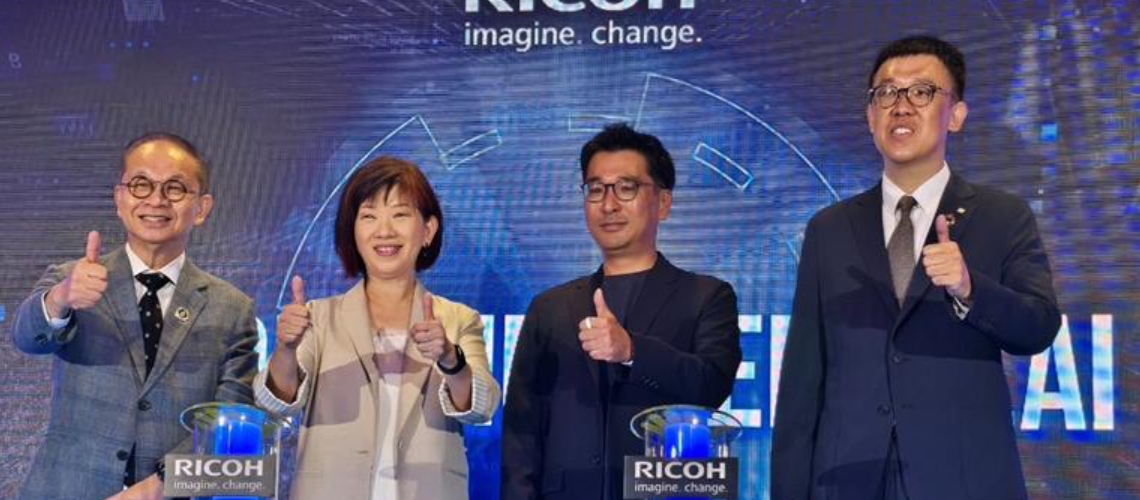
The event was officiated by RICOH Chief Digital Officer for the APAC Region, Satoshi Tsugane, alongside Federation of Malaysian Manufacturers (FMM) President Jacob Lee Chor Kok and RICOH Malaysia Managing Director Alice Lee. Their presence underscored the growing collaboration between industry players, technology providers and policymakers in supporting Malaysia’s smart manufacturing and digital transformation ambitions.
AI Adoption Is Shifting Towards Measurable Business Value
Speaking at the event, Tsugane said organisations across the region are moving beyond proof-of-concept AI projects and are increasingly looking for solutions that can deliver measurable business outcomes.
“As businesses continue their digital transformation journeys, there is growing demand for solutions that can connect information, workflows and people more effectively. Our focus is on helping organisations apply intelligent technologies in ways that create meaningful operational value and support long-term business transformation,” he said.
The showcase reflected this shift in market demand, with businesses increasingly prioritising connected and intelligent operational environments that can improve coordination, operational visibility and responsiveness across workflows.
Manufacturers Seek Practical Technology Integration
FMM President Jacob Lee Chor Kok noted that businesses, particularly manufacturers, are under growing pressure to improve productivity and competitiveness while navigating increasingly complex operating conditions.
“Manufacturers are under increasing pressure to improve productivity and competitiveness amid increasingly complex operating environments. The challenge is no longer just adopting technology, but integrating solutions that can deliver measurable improvements,” he said.
He added that cross-industry showcases such as this provide businesses with useful exposure to how automation and intelligent technologies can be applied in real operational settings rather than remaining theoretical concepts.
Three Core Areas of Intelligent Operations
At the event, RICOH highlighted how AI and automation are being applied across several operational areas.
AI for Operational Precision
RICOH showcased intelligent inspection systems designed to improve accuracy and consistency in operational environments. These included solutions for smartphone defect detection, fibre optic inspection and print quality monitoring, demonstrating how AI can support more precise and reliable inspection processes.
AI for Workflow Intelligence
The company also presented integrated workplace and workflow solutions designed to improve information accessibility, coordination and day-to-day operational efficiency. These solutions aim to help organisations streamline business processes while making information flow more connected and manageable.
AI for Connected Operations
A third area of focus was the use of integrated automation and AI-powered technologies to support more connected, adaptable and responsive operational workflows. These solutions are intended to help businesses build greater agility across different operational environments, from the factory floor to broader workplace ecosystems.
Building Long-Term Operational Agility
RICOH Malaysia Managing Director Alice Lee said the conversation around AI is increasingly shifting from possibility to implementation as organisations search for technologies that can be deployed at scale and deliver measurable operational impact.
“At RICOH, our focus is on helping businesses operationalise intelligent technologies in practical and scalable ways across different operational environments, from logistics and manufacturing to inspection and workplace coordination. The showcase reflects how AI can be applied in real operational settings, with solutions that can adapt to different business requirements and support more connected and responsive operations,” she said.
She added that the priority is no longer automation alone, but enabling organisations to build long-term operational agility and competitiveness in a rapidly evolving business landscape.
A Growing Role for AI in Malaysia’s Industrial Future
As Malaysian businesses continue to accelerate digitalisation and automation, the RICOH showcase reflects a broader trend towards the adoption of intelligent technologies that improve operational visibility, decision-making and responsiveness.
By demonstrating practical AI applications rather than abstract concepts, RICOH is positioning its solutions around the real needs of businesses looking to modernise operations, strengthen competitiveness and create more connected ways of working across increasingly complex environments.