
Malaysia’s small and medium enterprises (SMEs) have never had greater opportunities to expand into regional and global markets. Yet despite increased investment in marketing, digitalisation and product development, many businesses continue to face shrinking margins, rising customer acquisition costs and relentless competition.
According to Phoenix Design, the real challenge facing many Malaysian businesses is not weak marketing or poor products. Instead, it is a lack of meaningful differentiation that leaves brands competing on price rather than value.
The Growing Problem of Price-Based Competition
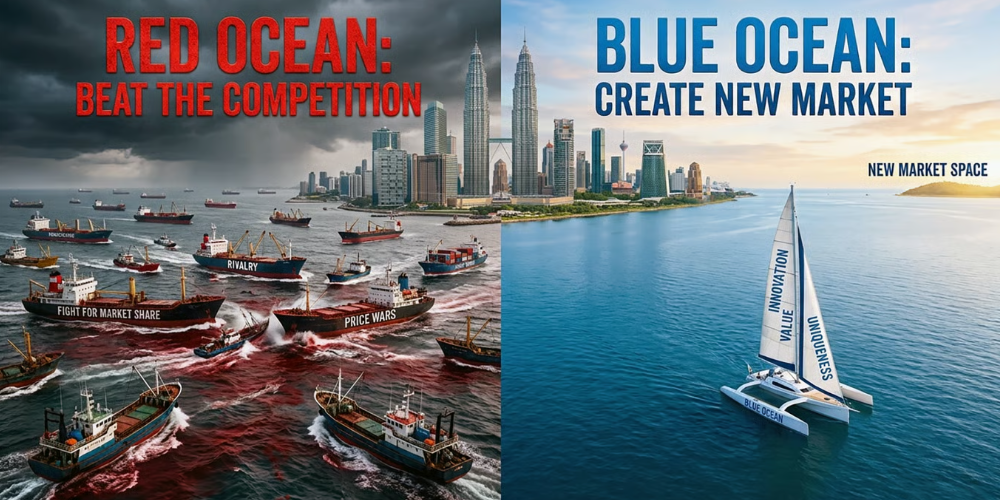
For many SMEs, the response to slowing sales is often predictable: launch promotions, reduce prices, increase advertising expenditure or replicate competitors’ strategies. While these measures may generate short-term revenue, they rarely create sustainable long-term growth.
Across sectors including food manufacturing, retail, automotive, engineering and consumer products, businesses are investing more heavily in marketing than ever before. However, increased competition often leads to a familiar cycle: products improve, marketing activity increases, competition intensifies, prices fall and profit margins shrink.
Understanding Malaysia’s SME Pricing Pressure
Phoenix Design argues that this challenge reflects a broader structural issue within the SME landscape.
SMEs account for more than 97 per cent of business establishments in Malaysia and contribute approximately 38 per cent of GDP. However, productivity and value-added output per company remain lower than regional leaders such as Singapore.
Research cited in the article highlights several recurring challenges facing SMEs, including market fragmentation, limited pricing power, dependence on cost-based competition and weak brand differentiation. Meanwhile, increasing price transparency across digital marketplaces has accelerated margin compression, making it easier for consumers to compare products and services instantly.
In this environment, businesses that fail to establish a clear market position often find themselves trapped in a race to the bottom.
The Real Issue: Interchangeability
According to Phoenix Design, the problem is not a lack of capability among Malaysian businesses.
Rather, many brands remain interchangeable in the minds of customers. When buyers struggle to understand why one company is meaningfully different from another, purchasing decisions become driven primarily by price.
This challenge is particularly significant as Malaysian businesses seek to capitalise on opportunities arising from ASEAN integration, the Regional Comprehensive Economic Partnership (RCEP) and the Comprehensive and Progressive Agreement for Trans-Pacific Partnership (CPTPP). While these agreements provide access to larger markets, businesses must first establish a compelling reason for customers to choose them over competitors.
What High-Growth SMEs Do Differently
Research into high-performing SMEs across Southeast Asia reveals a consistent pattern: successful businesses rarely compete solely on price.
Instead, they focus on becoming category leaders, building distinct market positioning, creating new sources of demand and investing in meaningful brand differentiation. In essence, they aim not to be cheaper than competitors, but to become incomparable.
Introducing the Category Hack Blueprint™
To address this challenge, Phoenix Design developed the Category Hack Blueprint™, a strategic framework designed to help businesses move beyond price competition and establish defensible market positions.

The framework consists of four stages:
Category Friction Mapping
The first stage focuses on identifying customer frustrations, unmet expectations and outdated market assumptions. Businesses assess where competitors are failing to deliver value and where opportunities for differentiation exist.
Demand Gap Discovery
The next step involves uncovering unmet customer needs and identifying areas where existing market offerings are either overserved or underserved.
Category Definition
Businesses then reposition themselves beyond traditional product-based competition by defining a new category, creating a distinct mental space in customers’ minds and establishing a clearer purpose beyond product features.
Market Encoding and Adoption
The final stage focuses on embedding the new category into the market through consistent storytelling, messaging and customer education, helping to build authority and credibility among early adopters.
Real-World Results from Category Creation
Phoenix Design highlights several case studies demonstrating the impact of category repositioning.
A Malaysian food manufacturer operating in a highly competitive packaged food sector repositioned itself from a traditional food producer into a “heritage ingredient experience brand”. Within 18 months, the company entered three new ASEAN markets, increased its average selling price by 27 per cent and reduced reliance on promotional sales.
Similarly, a Malaysian industrial engineering SME shifted its positioning from equipment supplier to “precision uptime engineering partner”. As a result, its tender win rate increased from approximately 18 per cent to 34 per cent while securing two long-term recurring service contracts.
Another consumer lifestyle brand operating across Southeast Asia achieved a 2.3-fold increase in repeat purchases and a 41 per cent improvement in customer retention after aligning its branding strategy with local market behaviours and cultural preferences.
Why Category Creation Matters in ASEAN
Phoenix Design believes category creation is especially effective within Southeast Asia due to the region’s combination of rapid growth, fragmented markets and highly price-conscious consumers.
As digital platforms make price comparisons easier, the first brand to define a category often becomes the reference point for consumers. This creates a powerful competitive advantage that extends beyond product features alone.
The Role of Cultural Intelligence
While category creation can help businesses establish market leadership, Phoenix Design emphasises that success across ASEAN also requires cultural understanding.
Consumer behaviour differs significantly across markets such as Malaysia, Singapore, Indonesia, Thailand and Vietnam. As a result, localisation must go beyond simple translation and take into account local trust signals, purchasing behaviours and cultural expectations.
To address this, Phoenix Design developed its Cultural Compass™ framework, which helps businesses adapt messaging while maintaining brand consistency across different markets.
Shaping the Future of SME Competition
Reflecting on the Malaysian market, Herry Ho, Founder and Managing Director of Phoenix Design, noted that Malaysia is home to many capable businesses with strong operational expertise. However, he believes strategic positioning remains a key challenge preventing many companies from reaching their full potential.
As competition across ASEAN intensifies, Phoenix Design argues that future business success will depend less on aggressive discounting and more on the ability to create clear market distinctions. Businesses that establish unique categories and define customer expectations are more likely to command stronger loyalty, improve profitability and achieve sustainable growth.
For Malaysian SMEs seeking long-term competitiveness, the challenge may no longer be how to become cheaper than competitors—but how to become impossible to compare.