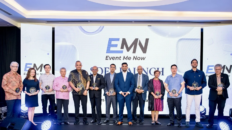

The Malaysia Semiconductor Industry Association (MSIA) marked its fifth anniversary and Merdeka Celebration in Penang, bringing together around 700 leaders and stakeholders from Malaysia’s semiconductor and Electrical & Electronics (E&E) industry, government, academia and the wider business ecosystem.
Held at Iconic Marjorie, the celebration featured a cake-cutting ceremony commemorating MSIA’s five-year journey and was graced by three Guests of Honour: YB Datuk Chang Lih Kang, Minister of Science, Technology and Innovation (MOSTI); YB Tuan Sim Tze Tzin, Deputy Minister of Investment, Trade and Industry (MITI); and YAB Tuan Chow Kon Yeow, Chief Minister of Penang.
The event celebrated MSIA’s establishment in 2021 and the broader transformation of Malaysia’s semiconductor and E&E industry, while reaffirming the importance of Government-industry collaboration as Malaysia seeks to move further up the global semiconductor value chain.
From 68 members to 378 in five years
Reflecting on MSIA’s beginnings, Dato’ Seri Wong Siew Hai, President of MSIA, recalled that the Association was established during the unprecedented COVID-19 crisis, when the semiconductor industry faced difficult decisions surrounding production continuity, workforce safety and the resilience of global supply chains.
“We have grown by leaps and bounds. From 68 members, we now stand at 378 members in 2026 and we are still growing,” said Dato’ Seri Wong.
Over the past five years, MSIA has also expanded its collaborative network locally and internationally, establishing working relationships with 22 embassies, as well as universities and other ecosystem partners.
Malaysia strengthens its semiconductor position
Malaysia is now the sixth-largest semiconductor exporter globally, with approximately 7% of global semiconductor trade flows passing through the country and around 13% of global assembly, testing and packaging capacity located here.
Malaysia’s E&E exports exceeded RM711 billion in 2025, while E&E exports from January to July 2026 reached RM563.6 billion, representing a 43.9% year-on-year increase and accounting for 48.4% of total exports.
Semiconductors contributed approximately 73% of E&E exports during the period.
However, MSIA said the next phase of growth cannot be measured simply by manufacturing capacity or the amount of investment attracted.
Instead, Malaysia must build on its strong manufacturing foundation and strengthen its position across more parts of the semiconductor value chain.
Penang pushes for ‘Made by Malaysia’
In his address, YAB Tuan Chow Kon Yeow, Chief Minister of Penang, said there was no better place to celebrate MSIA’s fifth anniversary than Penang, which has played a central role in Malaysia’s semiconductor and E&E journey for more than five decades.
The Chief Minister reinforced the importance of moving towards “Made by Malaysia”, describing it not merely as a slogan but as an ethos for Malaysia’s next phase of economic growth.
He said Malaysia must build more companies that design products, own intellectual property, develop technologies and compete globally, while strengthening the ecosystem connecting industry, Government and universities.
“Raising the ceiling must also raise the floor. Higher-value investments should create higher-value jobs. Higher productivity should lead to better wages. And stronger Malaysian companies should create better opportunities for Malaysians. This is where the semiconductor industry has an important role to play,” said YAB Tuan Chow.
For Penang, initiatives such as Penang Silicon Design @5KM+ and the Penang ATE Campus are strengthening capabilities in IC design, automation, test and equipment, and other higher-value activities.
Government support targets semiconductor innovation
YB Datuk Chang Lih Kang, Minister of Science, Technology and Innovation, congratulated MSIA on its fifth anniversary and stressed that Malaysia’s ambition must extend beyond competing primarily on cost and manufacturing capacity towards creating greater value through technology, innovation and knowledge.
He highlighted Government support through the Malaysia Science Endowment (MSE) for five Malaysian companies advancing semiconductor technologies, particularly in advanced packaging and IC design.
Through SemiconStart Malaysia, MOSTI, via the Malaysian Technology Development Corporation (MTDC), is also providing support of up to RM35 million to accelerate promising Malaysian semiconductor companies in areas including chip design, advanced materials and emerging semiconductor technologies.
“We want more Malaysian SMEs to become sophisticated suppliers. We want more local companies to become technology partners. And over time, we want to see more Malaysian semiconductor companies developing their own intellectual property and competing in global markets,” said YB Datuk Chang.
E&E exports surge as Malaysia strengthens technology supply chains
YB Tuan Sim Tze Tzin, Deputy Minister of Investment, Trade and Industry, highlighted the strong momentum of Malaysia’s E&E industry and its continued importance to the country’s economy and global technology supply chains.
He noted that Malaysia’s E&E exports surged 42.5% in the first half of 2026 to a record RM467.9 billion, accounting for almost half of the country’s total exports.
YB Sim also highlighted progress under the National Semiconductor Strategy (NSS), which had attracted more than RM91 billion in approved investments as of the first quarter of 2026 and developed more than 18,000 highly skilled workers towards its target of producing 60,000 talents for the semiconductor and related industries.
Looking ahead, he emphasised the importance of building on Malaysia’s established strengths in semiconductor assembly, testing and packaging by strengthening the wider technology supply chain and creating greater opportunities for Malaysian companies to participate in higher-value activities.
“With our established industrial base, skilled workforce and concentration of technology companies, we are well positioned to strengthen our role as a key technology supply-chain partner while creating more opportunities for domestic companies to grow alongside global industry leaders,” said YB Sim.
Malaysian semiconductor companies recognised for growth
The anniversary celebration also recognised Malaysian companies contributing to the country’s transition towards higher-value semiconductor and technology activities.
A key highlight was the recognition of MSIA member companies listed on Bursa Malaysia since 2021, reflecting the growing ambition and capabilities of Malaysian semiconductor and technology companies.
Since the COVID-19 period, 14 MSIA member companies have been listed, including companies operating across IC design, automation, electronics manufacturing services and other technology segments.
During the celebration, recognition was presented to 10 companies that had achieved initial public offerings (IPOs) and 16 companies for their contributions to innovation, highlighting the growing capabilities of Malaysian companies within the technology and semiconductor ecosystem.
The evening also featured the MSIA Members Recognition Awards, acknowledging the achievements and contributions of members across the industry.
Technology and Malaysian culture take centre stage
The anniversary celebration also showcased Malaysian culture and emerging technologies.
Guests were treated to a special kebaya fashion presentation by Nova Productions featuring Kenny Loh Couture, offering contemporary interpretations of traditional Malaysian attire, followed by a live band performance.
Adding a futuristic dimension to the celebration, AIMOGA presented a humanoid robot and robotic dog, offering guests a glimpse into emerging robotics technologies and the possibilities of next-generation innovation.
From the ‘heart of manufacturing’ to the ‘brain of innovation’
Looking ahead, MSIA believes Malaysia’s next chapter must focus on moving beyond being known primarily as a manufacturing location towards becoming a stronger centre for semiconductor design, innovation, technology development and intellectual property creation.
Dato’ Seri Wong said Malaysia must increasingly design, develop and innovate locally, transitioning from being recognised as the “heart of manufacturing” to the “brain of innovation.”
“The next five years will define how much more technology and IP we create, how many more Malaysian companies we take to the world, and how many more Malaysians we nurture to lead the industries of tomorrow,” said Dato’ Seri Wong.
To mark its fifth anniversary, MSIA also released a special The Star pullout edition themed “Advancing Silicon Malaysia”, reflecting on the Association’s five-year journey while highlighting opportunities ahead for Malaysia’s semiconductor industry and its ambitions across the global value chain.
As MSIA enters its next phase, the Association said it remains committed to working closely with Government, industry, academia and international partners to build a stronger, more innovative and globally competitive semiconductor ecosystem — and to accelerate Malaysia’s transition from “Made in Malaysia” to “Made by Malaysia.”