

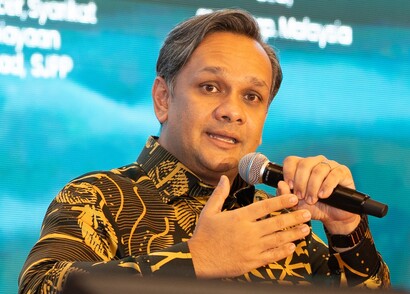
Artificial intelligence (AI) is rapidly becoming a business necessity, but Malaysian companies should use it to improve decision-making rather than replace human judgement, according to Malaysia Digital Economy Corporation (MDEC) Chief Executive Officer Anuar Fariz Fadzil.
Speaking at CTOS SME Biz Day 2026, Anuar stressed that while AI can process vast amounts of information, identify patterns and generate recommendations, business leaders must remain responsible for making final decisions.
“Never outsource your thinking to AI. Ultimately, you make the decisions because that is what makes us human,” he said.
His remarks come as businesses across Malaysia accelerate their adoption of AI technologies to improve productivity, reduce costs and remain competitive in an increasingly digital economy.
AI Can Inform Decisions, But Humans Must Remain Accountable
According to Anuar, AI can analyse information, simplify complex reports and evaluate possible courses of action. As a result, business leaders can make decisions more efficiently. However, leadership decisions often involve factors that technology cannot fully understand or be held accountable for.
These include regulatory obligations, risk management, customer impact, employee welfare, corporate reputation and long-term business strategy.
“For business leaders, judgement also involves considerations that technology cannot be held accountable for,” he explained. “AI can accelerate analysis and present possible options, but responsibility for the outcome must remain with the people running the business.”
As AI tools become more sophisticated, companies should use them to strengthen decision-making. However, leaders should not treat them as substitutes for human judgement.
AI Is Becoming as Essential as Email
Anuar noted that AI is quickly becoming a standard business tool. In his view, companies that fail to understand and adopt AI risk losing their competitive edge.
He also cautioned business owners against treating AI adoption as solely an IT responsibility.
Instead, senior leaders should actively lead digital transformation efforts. They should also understand how AI supports business objectives.
These comments reflect a global shift in how organisations approach AI. Increasingly, leaders see AI adoption as a strategic business issue rather than a purely technical one.
Driving Productivity and Operational Efficiency
Anuar shared that he personally uses large language models to condense briefing materials, organise speaking points and identify key themes within large volumes of information.
These tools, he said, help improve efficiency and speed without replacing human expertise.
“Such tools can help people work faster and process information more effectively, but they should complement rather than replace human experience, judgement and accountability,” he said.
More importantly, he emphasised that businesses should connect AI investments to measurable outcomes.
These outcomes include higher productivity, stronger operational efficiency, reduced business costs, better market access and improved resource allocation.
“Ultimately, AI adoption should be connected to measurable business outcomes,” he added.
Real-World Applications Across Industries
Anuar highlighted several examples of how Malaysian businesses are already benefiting from AI and digital technologies.
In the food and beverage sector, he cited a company that improved productivity with AI. The technology analysed customer behaviour, purchasing patterns and demand fluctuations throughout the day. The insights helped the business optimise operations and better meet customer needs.
In agriculture, technologies such as drones and AI-powered monitoring systems are helping farmers assess crop conditions, identify nutrient deficiencies and determine the optimal time for harvesting.
These technologies help businesses make better decisions. They also improve efficiency and resource management.
“Digital tools could also help companies reach wider markets and respond more quickly to changing customer behaviour,” Anuar said.
“If you are not leveraging AI, you risk being left behind because somebody else is doing it better and faster.”
Supporting Malaysia’s AI Nation 2030 Ambition
The emphasis on practical AI adoption aligns with Malaysia’s broader digital transformation agenda.
As MDEC celebrates its 30th anniversary this year, the agency is focusing on helping businesses translate digital and AI investments into tangible economic outcomes.
Under the national AI Nation 2030 ambition, MDEC is playing an increasingly important role in driving AI adoption across industries and ensuring businesses can benefit from emerging technologies.
“MDEC’s role under Malaysia’s AI Nation 2030 ambition is increasingly centred on translating national digital and AI strategies into practical outcomes for businesses, industries and the wider economy,” said Anuar.
Rather than promoting specific technologies, MDEC’s approach focuses on helping businesses identify solutions that can improve productivity, encourage innovation and lower operating costs.
“Our business digitalisation efforts are technology-agnostic and intend to help companies use suitable solutions to raise productivity, encourage innovation and reduce the cost of doing business,” Anuar said.
Human Judgement Remains the Competitive Advantage
As AI continues to transform industries, Anuar believes the most successful organisations will be those that strike the right balance between technology and human expertise.
While AI can process information faster than ever before, leadership, accountability and strategic judgement remain uniquely human responsibilities.
For SMEs navigating an increasingly competitive business environment, the message is clear: embrace AI, leverage its capabilities and use it to think better, but never let it think for you.