


Featured Image credit by Dhimas Aditya on Pexels
Some months are good. Some are unpredictable. One week, he receives payments from three clients at once. Another week, invoices remain unpaid while supplier costs continue piling up. Recently, one of his products went viral during a livestream. Orders surged overnight. It should have been a breakthrough moment every small business owner dreams of. Instead, it became a stressful one.
Amir did not have sufficient cash flow to restock inventory immediately. When he explored financing options, the process felt exhausting. Traditional loan applications required documents he did not readily have, required walking into a physical branch during working hours, and had approval timelines that stretched beyond the sales spike itself. In the end, Amir missed the opportunity.
The Rise of Malaysia’s Informal Workforce
Informal work can be extremely demanding, and stories like Amir’s are becoming increasingly common across Malaysia. Today’s workforce is no longer defined solely by fixed salaries and conventional employment. More Malaysians are earning a living through freelance work, gig economy platforms, side hustles, the creator economy, social commerce, and small online ventures.
According to the Department of Statistics Malaysia, the country recorded approximately 3.45 million informal workers in 2023 across sectors such as freelancing, e-hailing, online selling, and gig-based work, reflecting the growing size of Malaysia’s flexible and self-driven workforce. Many of them are young, digitally savvy, and economically active. Yet despite their meaningful contributions to the economy, many remain underserved in terms of financial access.
Why Traditional Banking No Longer Matches Reality
Traditional banking systems were largely built around predictability. Fixed salaries, employer verification, stable monthly incomes, and long-term employment records have long formed the basis for assessing financial eligibility. Today, work has changed significantly. More people are building careers through freelancing, the gig economy, social commerce, content creation, and small businesses. These paths may not always fit conventional definitions of employment.
A freelance designer may receive several client payments in one week and none the next. An online seller may experience a surge in revenue during festive campaigns before returning to a quieter period. A Grab driver may combine e-hailing with food delivery, affiliate marketing, or other side hustles, creating multiple income streams that fluctuate from month to month.
Their financial lives are dynamic, digital, and increasingly diverse. Yet many financing models are still evolving to better recognise these new patterns of earning. As a result, individuals with genuine earning potential and healthy cash flow may find that their financial profile is not easily reflected through traditional assessment methods.
This is where GXBank’s Challenge the System (Gegar Sistem) encourages a fresh perspective on what financial inclusion should look like today. It is about recognising ambition, resilience, and the many ways individuals build their livelihoods, while embracing a more inclusive approach to banking that reflects the realities of the modern economy.
Why Speed Matters More Than Ever
One of the biggest pain points is speed. Micro entrepreneurs operate in real time. Business opportunities can emerge and disappear within days, sometimes even hours. An online seller may suddenly need additional inventory after a viral campaign. A freelancer may require software subscriptions or equipment upgrades to secure a project. A home-based food business may need immediate working capital ahead of festive demand. Waiting weeks for approvals simply does not match the pace at which these entrepreneurs operate.
As digital banking reshape expectations, GXBank, a digital bank licensed by Bank Negara Malaysia and a member of Perbadanan Insurans Deposit Malaysia, is introducing financing structures that enable approvals to be completed digitally within minutes and without requiring physical branch visits. For younger entrepreneurs, this is not merely about convenience.
It is about operational continuity. Faster access to liquidity enables small businesses to respond to opportunities immediately, rather than watching them slip away while paperwork is being processed.
Flexibility Is Becoming As Important As Loan Size
The second challenge lies in the structure of financing itself. Traditional loans can be rigid. Borrowers receive a fixed amount and begin carrying repayment obligations regardless of whether the full amount is immediately needed. But many freelancers and sole proprietors do not necessarily require large lump sums. What they often need is flexibility that matches the rhythm of their business.
The GX Biz FlexiLoan allows users to pay only for what they utilise, and it is gaining attention among younger business owners. A sole proprietor may require only temporary working capital for a short inventory cycle or an advertising campaign. A freelancer may need additional funds only during periods where client payments are delayed. Usage-based financing allows them to draw funds only when necessary while maintaining greater control over borrowing costs.
This matters because cash flow management remains one of the biggest struggles faced by small independent operators. Unlike larger companies, many micro entrepreneurs do not have significant financial buffers. One delayed payment or unexpected operational cost can disrupt the entire business cycle. Flexible financing structures reduce this pressure by matching funding access more closely to actual business behaviour.
The Emotional Barrier Younger Entrepreneurs Rarely Talk About
Beyond operational challenges, there is also a psychological barrier many younger entrepreneurs face with traditional banking systems. For some, banks feel intimidating and overwhelming. Lengthy forms, complex requirements, and uncertainty over approvals create hesitation before the process even begins. This becomes even more difficult for freelancers and gig workers, whose income patterns may not appear conventional on paper, yet they remain economically active and financially responsible.
Many younger Malaysians are working hard, earning consistently, and contributing meaningfully to economic activity, but their financial profiles do not always fit neatly into traditional risk assessment models. GXBank is beginning to address this gap by using broader forms of financial evaluation, including transaction behaviour, digital activity, and ecosystem participation.
For younger users already living within app-driven ecosystems, banking also becomes less intimidating when it is integrated into familiar digital environments. Instead of feeling like a separate institutional process, financing becomes embedded into the same ecosystem where users already conduct daily transactions, payments, and business operations.
Supporting Growth Without Encouraging Recklessness
At the same time, accessibility must be balanced with responsibility. The rise of digital financing should not encourage reckless borrowing among younger users. This is particularly important given that around 40% of Buy Now, Pay Later (BNPL) transactions in Malaysia are made by individuals aged 30 and below, highlighting how strongly younger consumers have embraced digital credit; hence, digital financing should provide safer and more transparent ways for entrepreneurs to manage liquidity while growing sustainably.
Features such as controlled utilisation, transparent repayment visibility, and paying only for used amounts can help users avoid unnecessary financial burden. Additionally, digital platforms also allow users to monitor spending and borrowing patterns more actively through real-time mobile visibility. For younger entrepreneurs, this creates a stronger sense of financial awareness and control while allowing them to grow progressively rather than being forced into oversized commitments too early.
The GXBank System That Understands and Appreciates the Hustle
For the informal work segment to thrive sustainably, financial systems must evolve alongside them by recognising the realities of modern work, understanding new income patterns, and providing support that keeps pace with the economy they operate in.
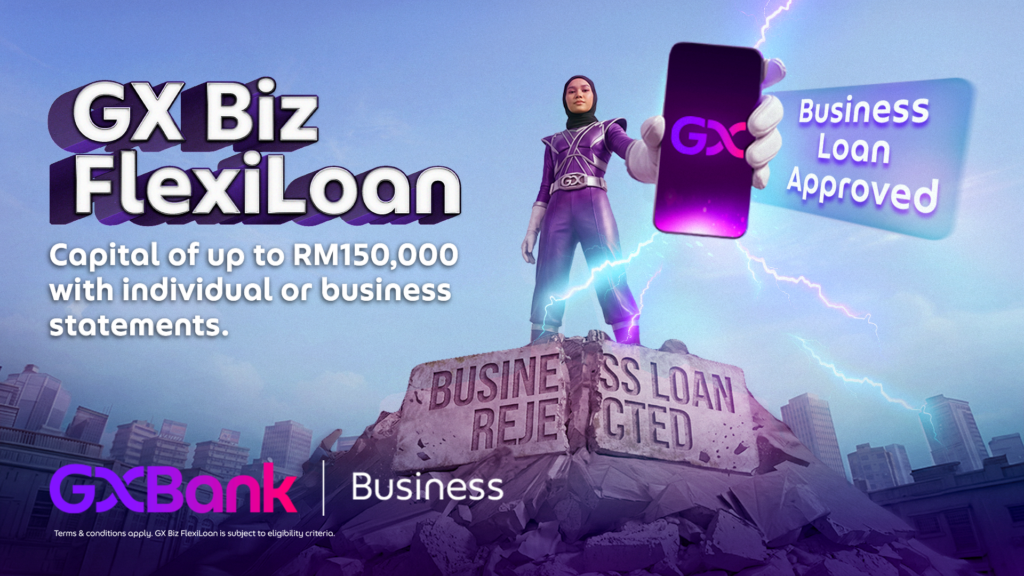
GX Biz FlexiLoan offers upfront credit facilities of up to RM150,000, with digital approval in minutes. Businesses can access financing without branch visits or lengthy paperwork and pay only for the amount they utilise, subject to terms and conditions. By integrating CGC Digital’s guarantee support, a risk-sharing mechanism that covers part of the lender’s potential losses if a borrower defaults, into its digital banking ecosystem, GXBank extends financing to underserved sole proprietors and MSMEs that may lack collateral or an extensive credit history. The result is a more flexible, accessible, and equitable pathway for businesses to manage cash flow and secure the growth capital they need.
At the same time, financial flexibility is not just for business owners. Everyone’s journey comes with opportunities to seize and challenges to overcome, whether it is pursuing further education, managing unexpected expenses, renovating a home, or achieving a personal goal. With GX FlexiCredit, individuals can enjoy the same philosophy of responsible and flexible financing, providing access to credit that fits the realities of modern living and empowers them to move forward with confidence.
For more information, go to: GX Biz FlexiLoan
*Terms and conditions apply. GX Biz FlexiLoan and GX Biz FlexiLoan are subject to eligibility criteria.