
By Aileen Anthony, Executive Editor MALAYSIA SME
Key Takeaways for Malaysian SMEs
- Global Demand Is Creating Opportunities Beyond Traditional Aerospace Players With nearly 20,000 new aircraft projected across Asia-Pacific over the next two decades, demand for manufacturing, maintenance and supporting services is expected to grow. Malaysian SMEs in precision engineering, advanced manufacturing, electronics and specialised services have opportunities to diversify into aerospace supply chains.
- Technical Readiness Matters More Than Business Interest Securing aerospace contracts requires more than manufacturing capacity. SMEs must demonstrate consistent quality, traceability, regulatory compliance and the ability to meet stringent international standards. Investing in certifications, technical expertise and operational excellence is essential to becoming a credible aerospace supplier.
- Supply Chain Gaps Represent Opportunities for Local Businesses Malaysia has established strengths in aerospace manufacturing and airframe MRO, but gaps remain in component repairs, forging, casting and specialised treatments. SMEs that can develop these services could reduce overseas dependencies, shorten turnaround times, and retain more value within Malaysia.
- Strategic Partnerships Can Accelerate Growth French aerospace leaders such as Airbus, Safran and Thales bring technology, industrial expertise and global market access. Malaysian SMEs should explore supplier development programmes, joint ventures and technology partnerships to strengthen their capabilities and move into higher-value activities.
- Access to Capital Is Critical for Scaling Up Aerospace requires substantial upfront investment in machinery, facilities, skilled talent and certification. SMEs should consider strategic investors, industrial partnerships and long-term financing to support long-term sustainable expansion.
- Sustainability Can Become a Competitive Advantage Growing emphasis on fuel efficiency, component refurbishment, material recovery and sustainable aviation technologies is creating new business opportunities. SMEs that integrate resource efficiency and circular economy practices into their operations can strengthen their competitiveness while supporting the industry’s decarbonisation ambitions.
An Unusual Challenge
The global aerospace industry is facing an unusual challenge. Demand is growing, aircraft orders are accumulating, and airlines are expanding their fleets. Yet, manufacturers and maintenance providers are struggling to keep pace. For Malaysia, this presents an opportunity to strengthen its position in global aerospace value chains, building on decades of experience in manufacturing and maintenance, repair and overhaul (MRO).
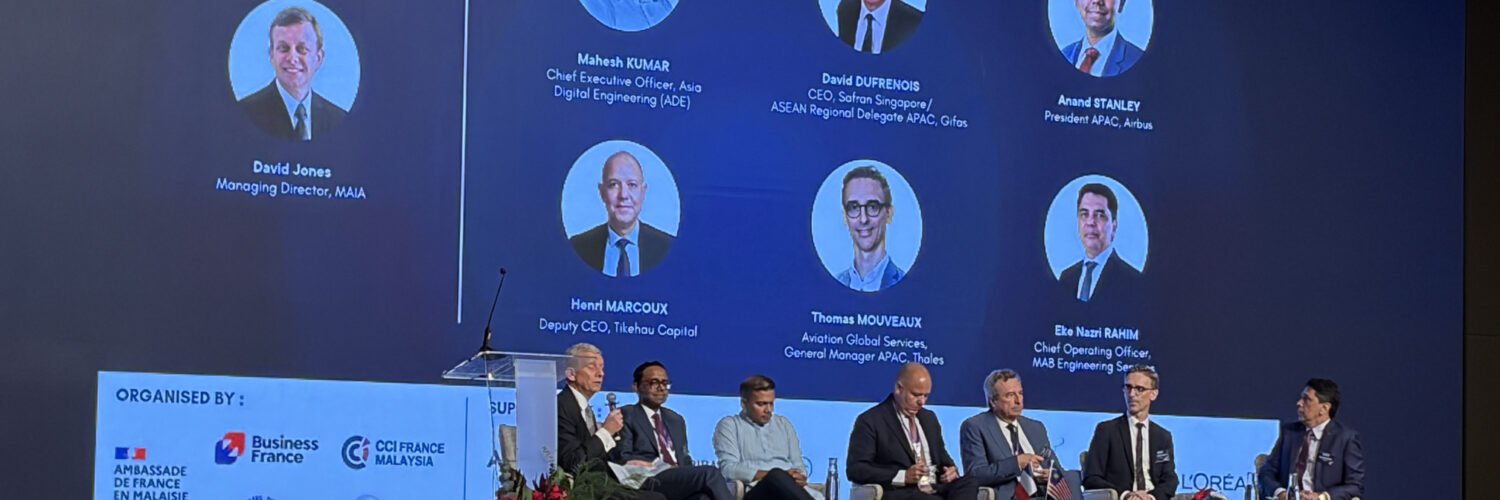
This was the central theme of the Aerospace – Strengthening Aerospace Value Chains panel at the Malaysia–France Business Forum, moderated by David Jones, Managing Director of the Malaysia Aerospace Industry Association (MAIA). The discussion brought together Anand Stanley, President APAC of Airbus; David Dufrenois, CEO of Safran Singapore and ASEAN Regional Delegate APAC for Gifas; Mahesh Kumar, Chief Executive Officer of Asia Digital Engineering (ADE); Henri Marcoux, Deputy CEO of Tikehau Capital; Thomas Mouveaux, Aviation Global Services General Manager APAC of Thales; and Eke Nazri Rahim, Chief Operating Officer of MAB Engineering Services.
20,000 Aircraft and Malaysia at the Centre
To illustrate the scale of the opportunity, Anand Stanley pointed to the projected demand for approximately 20,000 new aircraft across India, Southeast Asia and China over the next two decades. “When you look at the arc between India, ASEAN and China, what is right in the middle? Malaysia. It is super connected,” he said.
“Malaysia has been doing aerospace and MRO for 30, 40, 50 years. There is a lot of talent and infrastructure here. When you merge the two together, you have a strong supply chain,” he said.
Malaysia is already Airbus’ largest supplier base in Southeast Asia. According to figures reported in 2026, Airbus procures more than RM1.5 billion annually from Malaysian suppliers, supporting approximately 5,000 jobs. Stanley nevertheless believes Malaysia has a much greater opportunity to expand its contribution to Airbus’ global supply chain.
Demand Is Strong, but Capacity Must Catch Up
According to Mahesh Kumar, Chief Executive Officer of ADE, MRO providers rarely have plenty of spare capacity. According to Mahesh, aircraft fleets across Asia-Pacific are growing by approximately 5% annually, while MRO capacity is not expanding at a comparable pace.
ADE’s own development illustrates the industry’s potential. Established around 2020, during the COVID-19 pandemic, the company workforce has expanded rapidly. “Malaysia has a talented pool of people. We simply need to create opportunities and make use of that talent,” Mahesh said. However, he acknowledged that strong demand does not eliminate operational constraints.
“From our perspective, business is going well. But we still face challenges with raw materials, supply chains and people.”
Eke Nazri Rahim, Chief Operating Officer of MAB Engineering Services, said that overcoming these challenges requires a more comprehensive aerospace ecosystem. “To achieve our 2030 ambitions, we need a fundamental change in how we do business. We cannot achieve tomorrow’s goals with yesterday’s business model,” he said.
Following the pandemic, MAB Engineering Services reorganised its operations, strengthening its focus on digitalisation, operational excellence, customer-centricity and safety. “We are strong in certain areas, including airframe work, but component services, modifications and other complementary functions are equally important,” he explained.
Eke emphasised the importance of long-term investment and local partnerships to bring these complementary services closer to existing MRO operations.
French Confidence Translates into Investment
David Dufrenois of Safran highlighted Malaysia’s attractiveness as an aerospace investment destination, drawing on the company’s experience of establishing carbon brake manufacturing and refurbishment operations in Sendayan. Dufrenois also indicated that Safran was evaluating further projects beyond its existing activities.
However, he highlighted gaps in Malaysia’s manufacturing ecosystem, particularly in forging, casting and specialised treatments.
He described how parts manufactured in Malaysia may need to be sent to Singapore for qualified treatments before returning for further processing. “It disrupts the supply chain, and it is a source of problems,” he observed. Dufrenois also highlighted the Aero Excellence™ framework, which helps suppliers strengthen industrial maturity and meet international aerospace requirements.
Financing Growth and Building Stronger Suppliers
Henri Marcoux, Deputy CEO of Tikehau Capital explained that aircraft manufacturers’ ability to increase deliveries ultimately depends on whether suppliers possess sufficient capacity and resources. Tikehau Capital has developed dedicated aerospace investment strategies through its Ace Aéro Partenaires funds, supported by industrial partners including Airbus, Safran, Thales and Dassault Aviation.
Marcoux highlighted the substantial investment opportunities emerging from the industry’s expansion, alongside Tikehau’s engagement with local industry players and sovereign investors. He also identified fragmentation as a structural challenge within the aerospace supply chain, as many specialised suppliers possess valuable expertise but may lack the financial resources or scale to expand independently.
Sustainability and Supply Chain Resilience
Beyond manufacturing and maintenance capacity, sustainability is increasingly shaping aerospace operations and investment decisions. Dufrenois highlighted Safran’s efforts to reduce emissions from energy-intensive manufacturing processes while developing more fuel-efficient engines and exploring electrification technologies.
Airbus, meanwhile, is working to enable its aircraft to operate on 100% sustainable aviation fuel (SAF) by 2030, compared with the current certified blend limit of 50%. However, Stanley acknowledged that SAF availability remains a major challenge. He also highlighted Malaysia’s involvement in aviation sustainability research, including work exploring algae-based fuel feedstocks through the Aerospace Malaysia Innovation Centre.
Thomas Mouveaux of Thales emphasised that sustainability extends beyond aircraft engines and fuels. Through advanced flight management systems, air traffic management technologies and aircraft connectivity, Thales is developing solutions that optimise flight trajectories and reduce fuel consumption.
Sustainability is also influencing MRO operations. Eke highlighted MAB Engineering Services’ efforts to repurpose aircraft materials and recover serviceable components, while Mahesh emphasised the importance of expanding approved repair schemes. “If there are more repair schemes, there will be more used parts that can be reused, without jeopardising airworthiness and safety,” he said, adding, “It will also give the supply chain a bit of a breather.”
Building a Franco-Malaysian Coalition
As the discussion drew to a close, the panellists reflected on how France and Malaysia could strengthen their aerospace cooperation. For Thales, which has maintained a presence in Malaysia for approximately five decades, the country’s established aviation industry and skilled workforce provide a strong foundation for future growth. Mouveaux said Asia would remain one of the world’s most dynamic aviation markets, with Malaysia well positioned to participate in its expansion.
Dufrenois emphasised the role French expertise could play in developing Malaysian suppliers, particularly in specialised manufacturing processes and quality standards; and Marcoux highlighted opportunities for investment, joint ventures and partnerships between international aerospace businesses and local industry players.
For Eke, however, the priority was ensuring Malaysia could capture these opportunities. “We need to work together with the OEMs, Airbus and the local government. We need to create a winning coalition.” Stanley shared this optimism, pointing to the complementary strengths of French and European aerospace technology and Malaysia’s talent, industrial experience and geographical advantage. He mentioned, “For the next Airbus product, the next Airbus supply chain, Malaysia should be the heart of it.”
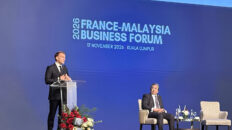
The event also saw French President Emmanuel Macron and Malaysia’s Minister of Investment, Trade and Industry, Datuk Seri Johari Abdul Ghani, address business and industry leaders, while Minister of Digital, Gobind Singh Deo, delivered a keynote address.