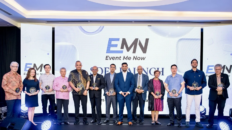


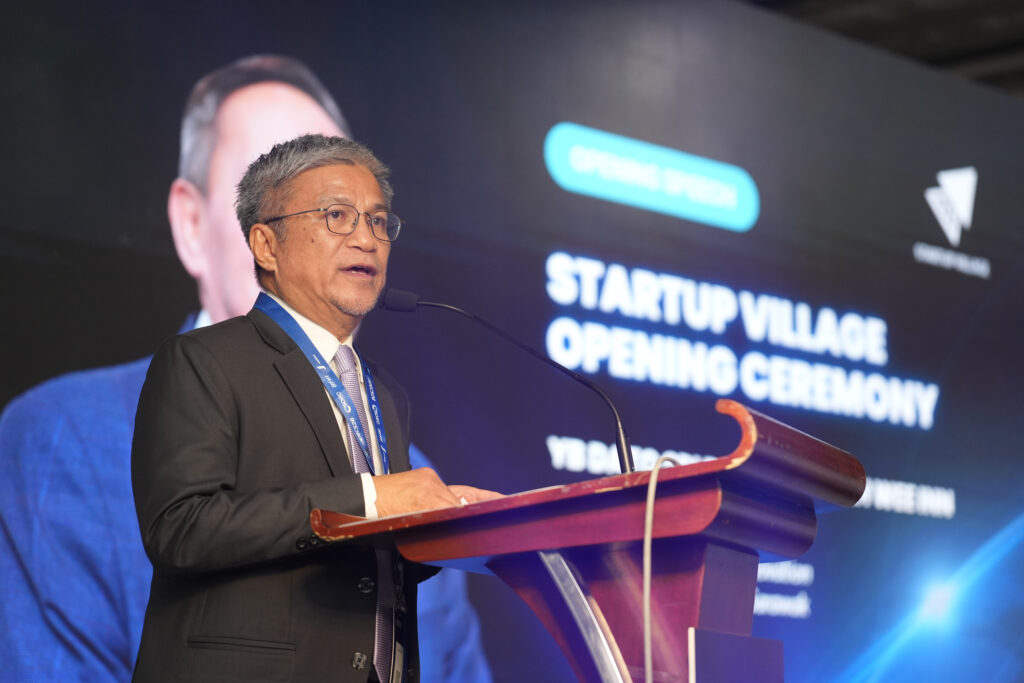
opening Startup Village at IDECS26 dedicated to connecting startups, innovators, investors and industry players.
Sarawak is stepping up efforts to turn startup innovation into commercial success, with the International Digital Economy Conference Sarawak 2026 (IDECS26) placing market access, investment and regional expansion at the centre of its startup agenda.
Held at the Borneo Convention Centre Kuching on 5 and 6 October, IDECS26 marked the ninth edition of the conference. Its Startup Village brought together entrepreneurs, investors, researchers and industry players to strengthen connections across Sarawak’s digital economy ecosystem.
The initiative reflects a shift under the state’s Post-COVID-19 Development Strategy (PCDS) 2030. After investing in digital infrastructure and entrepreneurship training, Sarawak is now focusing on helping startups validate their products, secure customers, attract investment and expand into new markets.
Yang Berhormat Dato Sri Roland Sagah Wee Inn, Sarawak’s Minister for Education, Innovation and Talent Development, outlined this direction in welcoming remarks delivered on his behalf by Yang Berhormat Datuk Dr. Annuar Bin Rapaee, who officially opened Startup Village.
“Startup Village has been created to strengthen those connections. It should be a working environment where a researcher can meet an industry partner, a founder can find a potential customer, an investor can discover an emerging company, and a promising solution can find its next route to market,” the minister said.
Sarawak Builds on Digital Infrastructure to Support Startups
Between 2021 and 2025, Sarawak established nine Digital Innovation Hubs, delivered more than 800 training programmes to 28,000 participants and helped over 33,000 small businesses move online.
With these foundations in place, the state aims to connect its existing support programmes into a clearer pathway from innovation to commercialisation.
Startup Village featured 78 startup exhibitors at IDECS26, up from 54 exhibition booths the previous year. The larger showcase gives founders more opportunities to connect with prospective customers, investors and business partners.
The Sarawak Digital Economy Corporation (SDEC) has also reported progress through its startup acceleration programmes.
The SDEC Technology Accelerator (STAcc) has accelerated 47 research teams and helped 38 organisations validate their markets and technologies. Participants have secured seven external funding opportunities, while spin-off ventures have created 11 jobs.
Further along the startup pipeline, the Digital Village Accelerator (DiVA) and Sarawak SaaS Accelerator (SaSAR) have collectively supported 49 startup alumni. DiVA has generated 41 jobs and RM376,000 in partnership value, while SaSAR’s first cohort generated US$182,000 in partnership value.
SDEC has also facilitated approximately RM8.5 million in investment for startup alumni. In 2025, the corporation established the Sarawak Business Angel Network (SBAN) to strengthen connections with private investors and develop the state’s private-capital ecosystem alongside government support.
Social Enterprises and Business Growth Gain Momentum
Sarawak is also expanding support for social enterprises, which combine commercial activity with social impact.
The state now has 83 enterprises registered under the Social Enterprise Malaysia (SEMy) initiative, the second-highest number among Malaysian states.
The SEHebat Catalyst Cohort 2 has onboarded 10 enterprises, building on the first cohort’s results. Participants in Cohort 1 recorded revenue growth ranging from 10% to 160%, according to the announcement.
These programmes form part of Sarawak’s wider effort to help local ventures develop sustainable business models, generate revenue and create employment while addressing social needs.
Sarawak and Brunei Join Forces to Expand Startup Opportunities
Regional collaboration is another focus of Sarawak’s startup strategy.
SDEC has established a new collaboration with the Brunei Economic Development Board (BEDB), through the Brunei Innovation Lab, to develop a Sarawak-Brunei Hackathon and Incubation Programme.
The initiative will give entrepreneurs from both markets opportunities to develop and validate business solutions, work with mentors and industry partners, and explore cross-border commercial opportunities.
Promising ventures can also progress into SDEC’s existing SaSAR and DiVA accelerator programmes. This creates a potential pathway from early-stage ideas and prototypes to business acceleration, market access and investment.
The partnership could help Sarawak-based startups reach customers beyond the domestic market while giving entrepreneurs in both ecosystems greater access to expertise and regional networks.
IDECS26 Focuses on Commercial Results and Regional Expansion
Sarawak’s evolving startup strategy places greater emphasis on measurable business outcomes rather than the number of programmes delivered or pitches made.
“For Sarawak, the objective must therefore extend beyond the number of companies formed or the number of pitches delivered. We want companies that can build from Sarawak, solve real problems, generate revenue, attract investment and eventually compete in markets beyond the state,” the minister said.
He added that the state wants more of the knowledge, intellectual property, skilled employment and entrepreneurial experience generated through business growth to remain connected to Sarawak.
By linking research, talent development, startup acceleration, private investment and regional partnerships, Sarawak aims to strengthen the pathway from innovation to commercial success.
IDECS26 was jointly organised by SDEC, the Sarawak Multimedia Authority (SMA) and Sarawak Information Systems (SAINS). The conference’s Startup Village reflects the state’s continued push to develop a digital economy in which local startups can secure investment, build sustainable businesses and compete in regional markets.