
By Harriet Santhana and Natasha Isabel Saravanan
Law, Risk, Governance and Technology may once have occupied separate corners of an organisation. Today, the boundaries between them are becoming increasingly difficult to distinguish. Artificial intelligence is changing how businesses operate. Cyber attacks are becoming more sophisticated. Legal and statutory expectations are evolving alongside new technologies. At the same time, leaders are being asked to make decisions that protect not only growth and profitability, but also trust, people and organisational resilience. These converging realities formed the foundation of the recent inaugural She Leads. She Defends—Law, Risk and Governance Forum 2026, organised by WomenAtlas Media & Events, powered by Laurea People’s Signature and founded by Nisha Meng Mingg Li.
The event brought together women leaders and professionals from Corporate Affairs, Law, Governance, Technology, Cybersecurity, Communications, and Public Service. It explored what leadership means at a time when organisations can no longer afford to manage these issues in isolation. As the conversations unfolded throughout the day, one message consistently emerged. The future of leadership belongs to those who understand how to build trust, ask difficult questions, and prepare for risks before they become crises.
Women Leading the Conversation on Trust
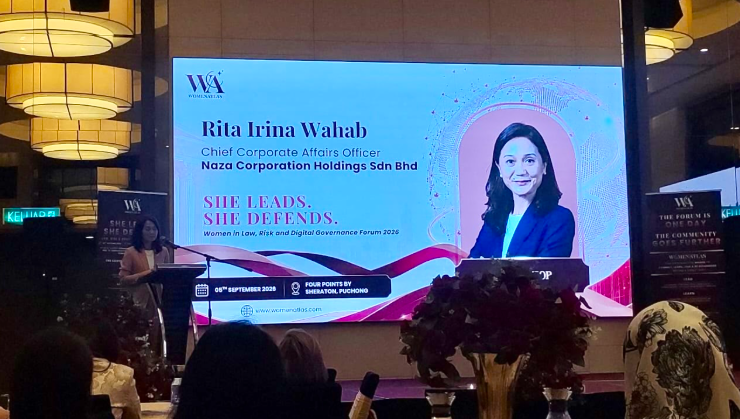
As the event Co-officiator, Rita Irina Wahab reflected on how rapidly organisations are being reshaped. “The way we work is changing. The way we communicate is changing. Technology is reshaping industries and challenging institutions,” she said, before asking, “What kind of leadership does the future look like?” Rita opined, “No organisation succeeds in strategy alone. No institution succeeds in policy alone. And no leader succeeds in expertise alone. What ultimately determines success is trust.”
Trust, she explained, connects businesses with communities, organisations with regulators and leaders with the people they serve. She distilled her message into three principles: lead with purpose, build trust deliberately and lift others. “A single decision does not create trust. It is earned through consistency, credibility, and integrity over time.”
Empowering Women to Ask Difficult Questions
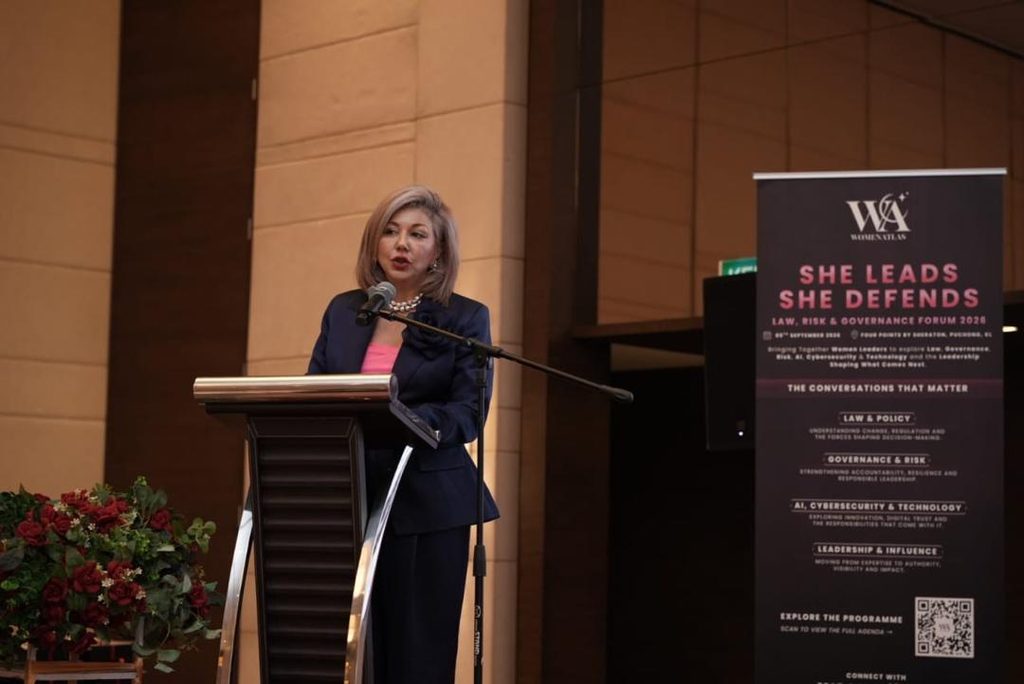
Dalvin Kaur, the event’s Co-officiator, further emphasised the Convergence of Law, Governance, Risk, and Technology. Reflecting on the diverse professionals at the forum, she noted that their presence reflected how these areas have increasingly become interconnected. “In your organisations, Law, Risk, Governance, and Technology have all already collided into one conversation,”she said.
“This is no longer a technology problem with a legal footnote,” she said. “Cybersecurity is no longer confined to an IT department. It is unambiguously a board matter.” Dalvin urged organisations to anticipate emerging risks through stronger governance. “Good governance is the discipline of asking hard questions before you’re forced to answer them,” she said, pointing to questions around an organisation’s readiness for AI decisions, a board’s responsibilities during a cyber incident and the clarity of legal, risk and compliance roles.
Nurturing Women’s Voices
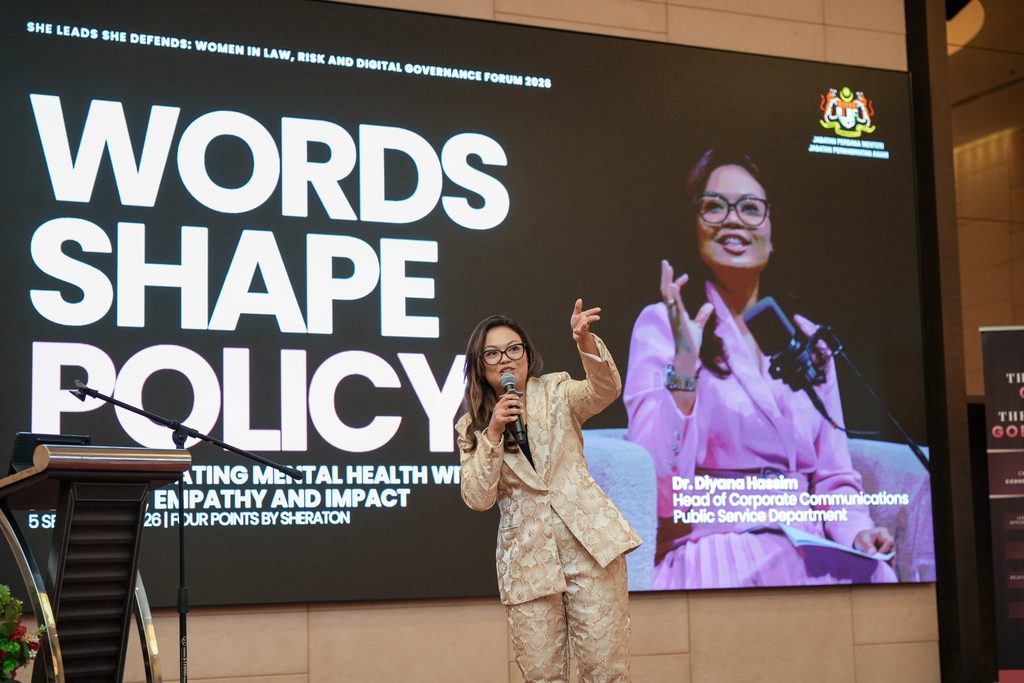
The first keynote of the day turned attention to another area often underestimated in governance discussions: language. Dr Diyana Hassim, Head of Corporate Communications at Jabatan Perkhidmatan Awam, explored the relationship between words, mental health and policy in her keynote, Words Shape Policy: Communicating Mental Health with Purpose, Empathy and Impact.
“With one careless sentence, we can silence an employee. One poorly communicated policy can create fear. One dismissive response can stop someone from asking for help.” Dr Diyana encouraged leaders to consider what employees leave unsaid when fear of judgement or dismissal prevents them from speaking up. “Can your employees speak without fear?” she asked. “Or can your team say anything to you without feeling guilty?”
Women Building Confidence in the Age of AI
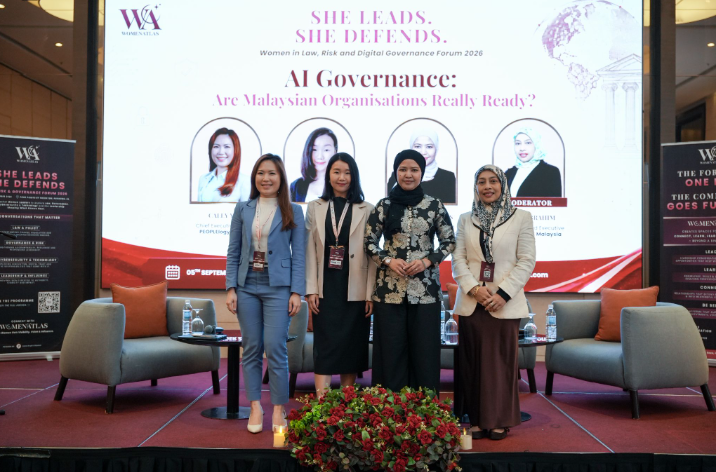
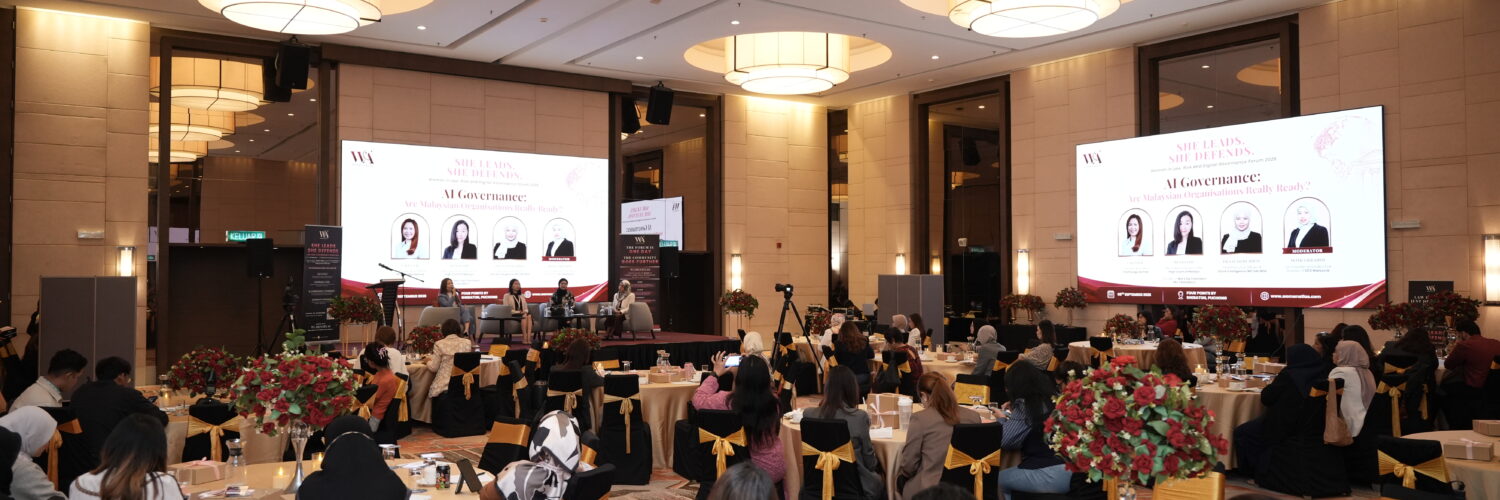
The panel session sought to address one of the most pressing of questions facing Malaysian organisations: are they genuinely ready to govern AI? Moderated by Moyra Ibrahim, Co-Founder and Executive Director at ECS Malaysia, the forum “AI Governance: Are Malaysian Organisations Really Ready?”, brought together Dr Salasiah Abbas, Chief Executive Officer of SOVA Intelligence (M) Sdn Bhd, Wendy Lim, Founder of Wei Ling Chambers, and Cally Yau, Chief Executive Officer of PEOPLElogy Berhad.
Dr Salasiah said the biggest gap was not necessarily policy or awareness, but practice. “Come Monday morning, when everybody is busy, we use AI tools and may upload sensitive documents. As deadlines loom, and we chase profit and revenue, are we going to follow the policy? The gap lies in putting governance into practice.”
Cally Yau brought the discussion closer to everyday workplace behaviour, noting that while many people were already using tools such as ChatGPT and Claude, fewer organisations appeared to have AI handbooks or governance frameworks. She quizzed, “How do we measure our own responsibility for AI governance that we have checked in for our day-to-day use?”
Wendy Lim emphasised that organisations should first understand their current position before building policies for the future. She recommended an AI impact assessment, describing it as “like a health check” to identify existing AI use and governance gaps across policies, employment practices, personal data and external contracts.
Women Leaders Navigating Uncertainty with Purpose
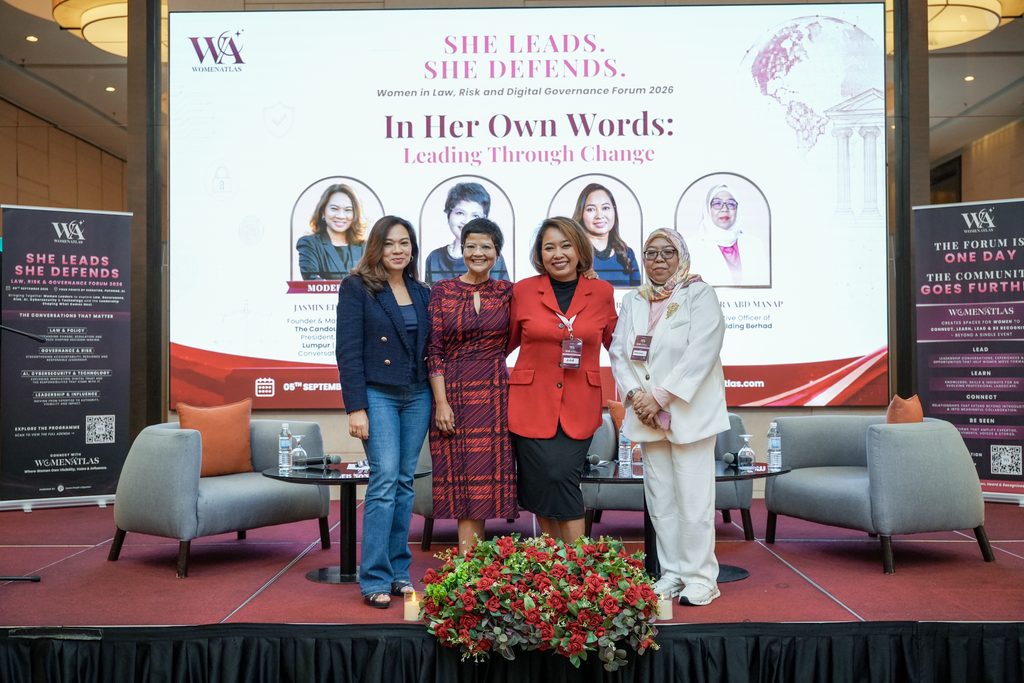
The fireside session In Her Own Words: Leading Through Change shifted the focus from systems and governance to the personal realities of leadership. The session featured Farah Jaafar, Global Advisor at Straits Investment Bank; Norliana Aida Ramli, Principal at Luminar Consulting Services Sdn. Bhd.; and Hjh. Mastura Abd Manap, Chief Executive Officer at Scubatex Holding Berhad, and was moderated by Jasmin Edna Peters.
The conversation explored how leaders navigate uncertainty and take responsibility for the people behind their decisions. Norliana reflected on making high-stakes decisions during her corporate career, noting the importance of having support. Mastura, speaking from the perspective of an entrepreneur, highlighted, “As an entrepreneur, I have to make the decisions that affect the company and its people.” She shared that giving long-serving employees greater authority helped the business continue in her absence. “The trust that I’ve given to them gives them a feeling of belonging to the company,” she said. Farah offered a broader reflection on leadership, noting that while traditional corporate environments often focus on financial returns, a ‘return on care for people’ could bring more sustainable impact to businesses.
Equipping Women Leaders to Understand the Systems Behind Decisions
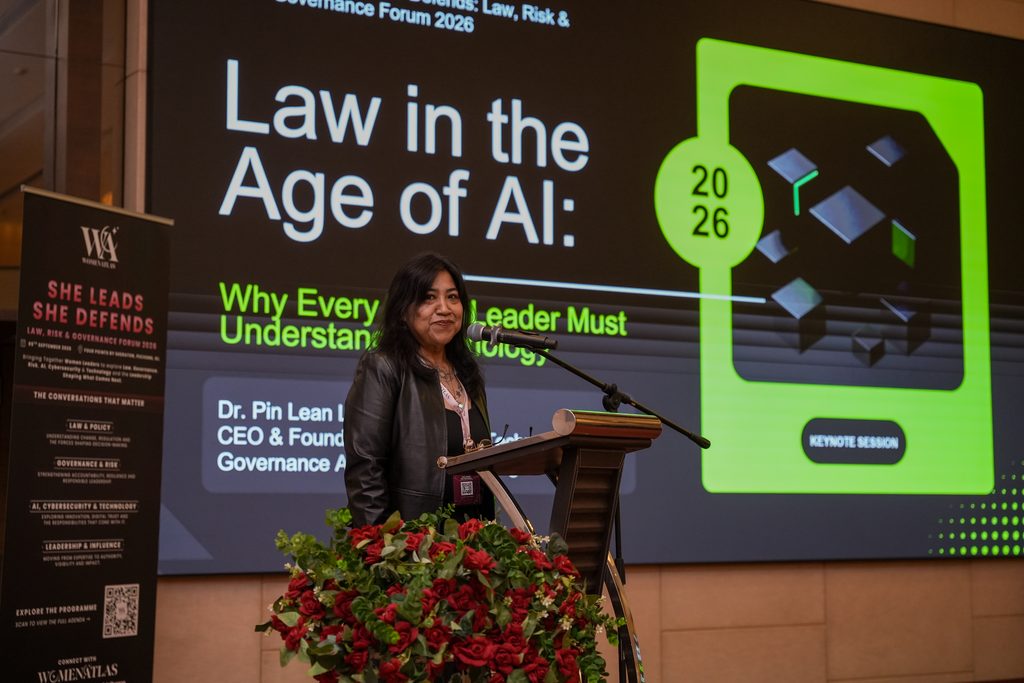
The second keynote by Dr Pin Lean Lau, Law in the Age of AI: Why Every Legal Leader Must Understand Technology, brought the discussion back to the relationship between law and technology. “Technical fluency is a currency of our legal leadership,” she said. “If you don’t understand code and how it executes policy, then how do we credibly determine what accountability might be?” she asked. She later put the argument more strongly: “Ignorance is a violation of duty,” she said.
Her keynote explored emerging legal questions surrounding AI, blockchain, virtual environments and digital assets, while also introducing the idea that “code is law”. Technology, she explained, increasingly shapes what people can access, copy, share and do online, regulating behaviour in ways similar to traditional rules and laws. Dr Pin Lean urged legal and governance professionals, particularly when dealing with data, automated decisions and AI systems to, “anticipate [the questions] and move from reactive to being proactive.”
Women Connecting Law, Risk and Compliance
The forum’s discussion on the modern legal leader continued the theme of the day by examining how the traditional boundaries between legal, risk, compliance and regulatory functions are becoming increasingly blurred.
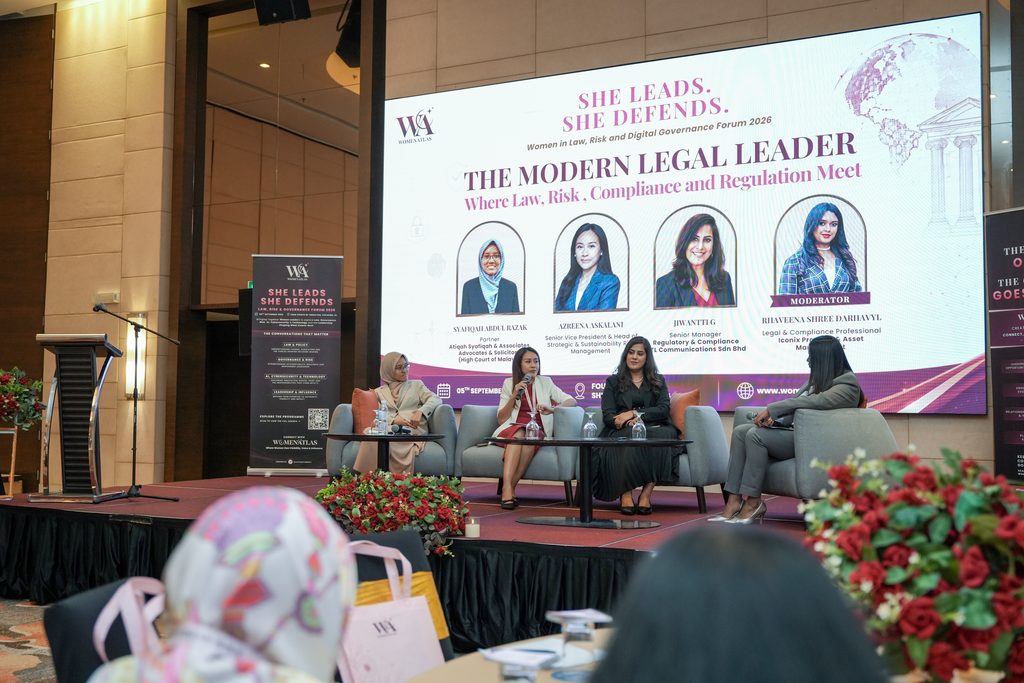
The panel, moderated by Rhaveena Shree Darhavyl, Head of Legal and Compliance at Iconix Property and Asset Management, featured Syafiqah Abdul Razak, Partner at Atiqah Syafiqah and Associates, Jiwantti G., Senior Manager of Regulatory and Compliance at YTL Communications, and Azreena Askalani, Senior Vice President and Head of Strategic and Sustainability Risk Management at Bursa Malaysia. The discussion pointed out the need for leaders to move beyond narrow functional responsibilities and understand how legal decisions affect business strategy, reputation, regulatory criteria and organisational risk.
Legal professionals increasingly need to understand business realities. Risk professionals need to understand regulatory developments. Compliance teams need to communicate effectively across the organisation. The modern leader, therefore, is not only someone with deeper expertise in one discipline, but someone who can connect disciplines and ensure important risks do not fall between organisational silos.
Women at the Forefront of Digital Defence
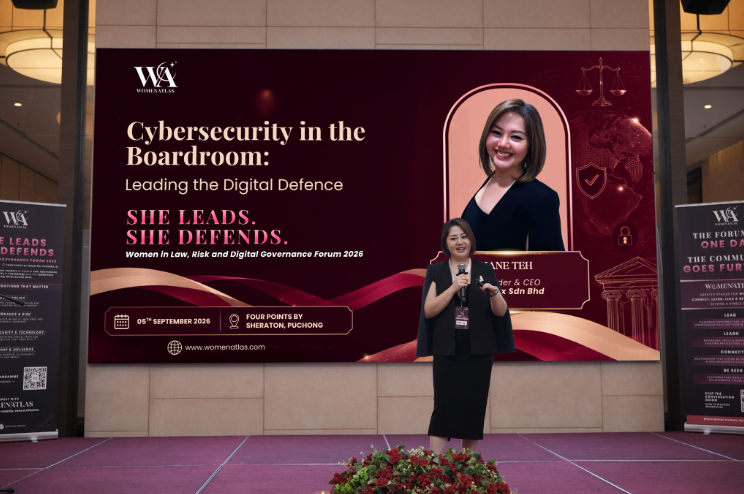
Cybersecurity formed the focus of the forum’s later sessions, beginning with Jane Teh’s keynote on leading digital defence. Teh emphasised that cybersecurity is a leadership responsibility, not a purely technical concern. “Doesn’t matter what size company you are. You can be an SME, you can be a Sendirian Berhad, or even a solopreneur; if you’re servicing a customer, you will be the target,” she said. The growing use of AI, she explained, has created new opportunities for both defenders and attackers.
“AI is a double-edged sword,” she said, with organisations using it to improve security and analyse threats while attackers use it to operate at greater scale and speed. Teh who is the Founder & Chief Executive Officer of VortiQ[x], stressed the importance of governance when deploying AI systems. “If your organisation is mature enough, you should be able to have an AI to detect the attacks before it actually attacks you,” she said.
At the board level, Teh argued that cybersecurity discussions must move beyond technical jargon to focus on business risks, including “What kind of risk am I taking on? What kind of losses?” She urged organisations to align risk appetite, third-party governance and incident response in line with business goals. “In the age of AI, resilience is not only about technical achievement. You must ensure that you are able to recover, and recover fast.”
From Women Leading Prevention to Forming the Response
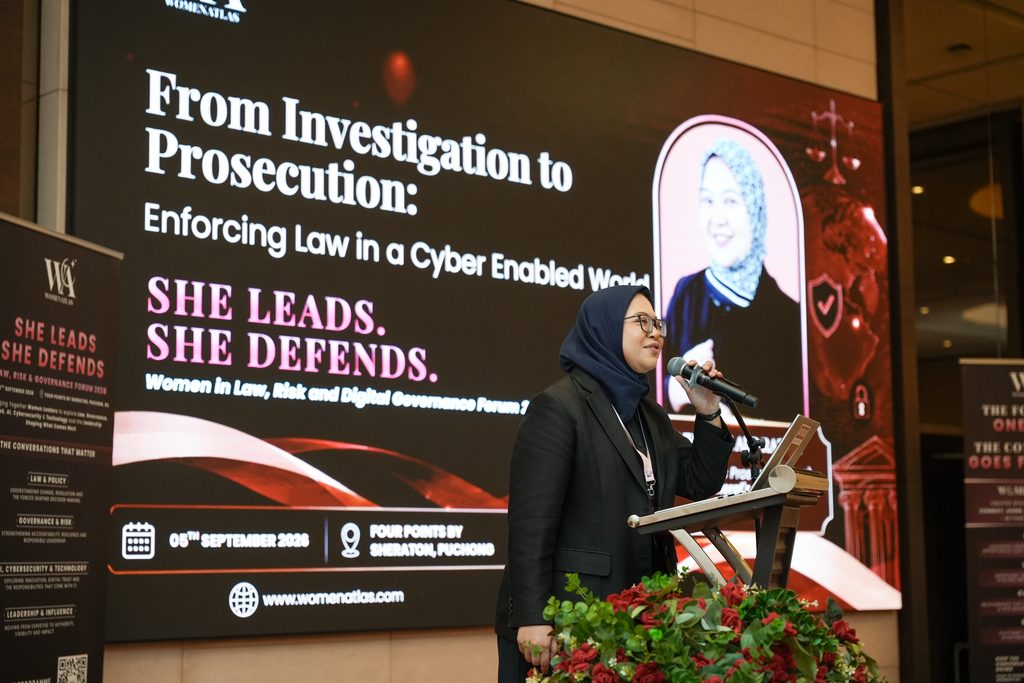
The keynote by Raihanah Abdul Razak, Deputy Public Prosecutor at the Attorney General’s Chambers of Malaysia, examined the challenges of investigating and prosecuting cyber-enabled crimes, where evidence may span devices, cloud platforms, financial systems and international jurisdictions. She stressed the value of understanding technology even inside the legal system. “When I receive a case whereby it involves technology, I translate [it] as simply as possible,” she said, pointing out the need to explain complicated ideas in ways that courts can understand. She also emphasised the importance of acting quickly following a digital incident.
“When something happens, you have to report it as soon as possible. Then you must preserve the evidence,” she said. Digital evidence must also be authenticated with screenshots, recordings and devices which may require forensic examination. Her message reached beyond prosecutors and investigators, stressing that everyone involved in cyber investigations must develop a working understanding of technology.
Women Moulding the Conversation
From its opening ceremony to its final keynote, She Leads. She Defends. presented leadership as an ever more interconnected responsibility. AI decisions carry legal implications, cybersecurity requires governance, communication shapes trust, and leadership determines how organisations prepare for uncertainty.
For Malaysian SMEs, this makes cross-functional thinking especially important. Throughout the forum, speakers returned to the need to ask questions early, build trust deliberately and develop the confidence to engage beyond one’s traditional area of expertise.
Perhaps this was best captured in Dalvin Kaur’s challenge to the audience during the opening ceremony: “Good governance is the discipline of asking hard questions before you’re forced to answer them.”