

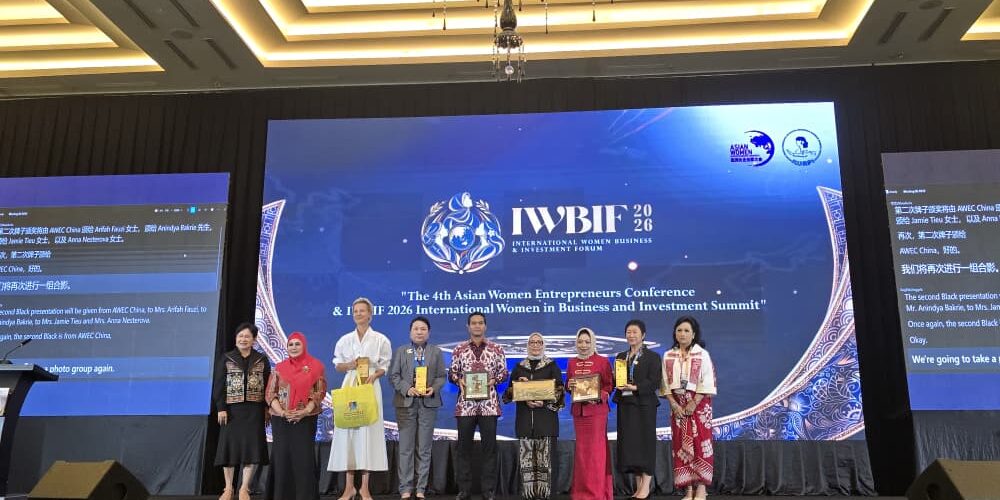
Asia’s growing network of women entrepreneurs presents opportunities for businesses to expand beyond domestic markets, establish new partnerships and participate in regional economic growth. Yet, building connections is only the beginning. The greater challenge lies in translating these relationships into tangible business outcomes.
For Jamie Tiew Yen Houng, Chairperson of the Women Entrepreneurs Committee of the Malaysia-China Chamber of Commerce (MCCC WEC), the future of women entrepreneurship in Asia depends on the ability to connect markets, embrace innovation and build partnerships founded on mutual trust.
Speaking at the 4th Asian Women Entrepreneurs Conference & IWBIF 2026, held from 14 to 18 October in Jakarta and Bandung, Indonesia, Jamie encouraged women entrepreneurs to look beyond networking and focus on creating meaningful commercial opportunities.
Under the theme “CONNECT. COLLABORATE. CO-CREATE. — STRONGER TOGETHER”, the conference brought together women leaders, entrepreneurs and representatives from across the region to explore financing, global collaboration and digital transformation. Jamie emphasised that women entrepreneurs should not be viewed merely as participants in Asia’s economic growth. Rather, they have the potential to become catalysts who connect markets, accelerate business development and contribute to shared prosperity.
Building Businesses Beyond Borders
With approximately 30 years of business experience, including more than two decades in real estate, Jamie understands the importance of recognising opportunities and adapting to changing market conditions. Her entrepreneurial journey has taken her from the hardware industry into real estate, Malaysia My Second Home (MM2H) and new energy-related sectors.
These experiences have shaped her belief that sustainable business success extends beyond financial performance. Understanding people, recognising opportunities, building trust, adapting to change and investing in teamwork are equally important. At the conference, Jamie outlined three priorities that she believes can strengthen the role of women entrepreneurs in Asia’s economic future. The first is connecting markets through cross-border partnerships.
Malaysia, Indonesia and China each possess distinct strengths that can complement one another. Rather than viewing differences in business environments as obstacles, entrepreneurs should explore how these strengths can create opportunities for cooperation. However, meaningful partnerships require more than introductions or exchanging business cards. They depend on understanding market conditions, respecting cultural differences, conducting due diligence and building trust over time.
Innovation as a Driver of Competitiveness
Jamie’s second priority centres on innovation and preparing businesses for the future. As digital technology continues to influence how companies operate and compete, she highlighted the opportunities presented by artificial intelligence (AI), e-commerce and other digital solutions. These technologies can help businesses reach international customers, improve productivity and strengthen their competitiveness. Importantly, innovation need not be confined to technology adoption.
It can also involve improving operational processes, strengthening customer service and developing better approaches to solving business challenges. For entrepreneurs seeking to expand across borders, this broader understanding of innovation provides opportunities to strengthen their business foundations while preparing for new markets.
The third priority is empowering women through leadership, knowledge-sharing and collaboration. Jamie highlighted the importance of connecting women-led businesses with investors, buyers and international markets. She also encouraged experienced entrepreneurs to mentor emerging businesswomen, enabling knowledge and experience to be shared across generations.
From Business Matching to Actual Transactions
While cross-border networks create access to opportunities, converting those opportunities into executable business transactions requires a more structured approach. This was a key message shared by Dr Linea Tee, Deputy Chairperson of MCCC WEC, who spoke from a Malaysian investor’s perspective and her involvement with cross-border women entrepreneurs’ networks. Dr Tee highlighted the importance of moving beyond identifying potential buyers and suppliers towards ensuring that both parties are commercially and operationally ready to transact.
She proposed starting with a clear, one-page business brief that outlines essential transaction requirements, including product specifications, minimum order quantities, quality standards, certifications, packaging, delivery terms, payment arrangements and acceptance criteria. This provides potential partners with a common understanding of what is expected before progressing into commercial discussions. Equally important is assessing whether suppliers can fulfil their commitments.
Factors such as production capacity, export documentation, production stability and after-sales responsiveness must be considered to determine whether a proposed partnership can be executed successfully. Dr Tee also advocated a structured business-matching process that evaluates product specifications, supplier capabilities, commercial terms and potential execution risks. She encouraged entrepreneurs to reduce the risks associated with initial transactions through trial orders or smaller batches, clearly defined acceptance standards and milestone-based payments. Cross-border business networks can play a supporting role by helping partners maintain communication, coordinate documentation and keep deliveries on track.
Strengthening Malaysia–Indonesia Business Collaboration
The conference also highlighted opportunities for closer economic cooperation between Malaysia and Indonesia, particularly among women-led enterprises. Jamie identified trade, investment, tourism, healthcare and property as sectors with considerable potential for collaboration between the two countries. Beyond bilateral opportunities, broader Asian entrepreneurial networks can facilitate connections with China and other international markets.
Within this landscape, MCCC WEC aims to serve as a bridge connecting women entrepreneurs across industries, supporting members in strengthening their capabilities, exploring new markets and developing meaningful business partnerships. The objective is to create connections that deliver value beyond individual networking events. Potential outcomes include distribution partnerships, investment projects, technology collaborations and joint initiatives involving women-led businesses across national borders.
Turning Conversations into Action
As entrepreneurs increasingly participate in regional business platforms, Jamie encouraged them to consider what happens after the conference concludes.
She posed three questions for participants to reflect upon:
- What value can my business offer a partner in another country?
- What resources and connections do I need to grow?
- What concrete action can I take after this forum to turn today’s introductions into tomorrow’s results?
These questions place responsibility on entrepreneurs to approach regional networking with purpose and a willingness to act. They emphasise a shift towards identifying complementary strengths, exploring viable partnerships and following through on opportunities.
The 4th Asian Women Entrepreneurs Conference & IWBIF 2026, organised with the involvement of the Indonesian Business Women’s Association (IWAPI), the Asian Women Entrepreneurs Council (AWEC) and other participating organisations, provided a platform for these conversations.
The gathering brought together distinguished representatives from business organisations and international entrepreneurial networks, including IWAPI, the Indonesian Chamber of Commerce and Industry (KADIN), the BRICS Women’s Business Alliance and the Hainan Women Entrepreneurs Association of China.
“Let us connect with purpose, collaborate with trust and co-create with vision,” Jamie said.