

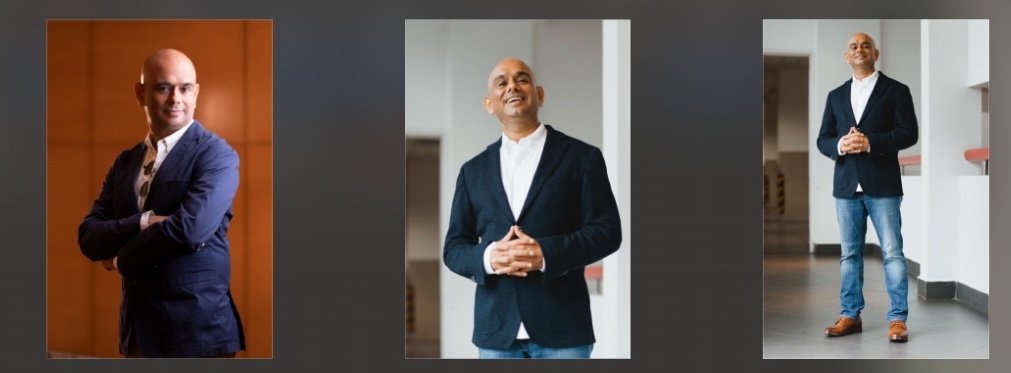
by Aileen Anthony
Karthik often reaches for this shorthand because it cuts through sentiment and lands on reality, unicorns. “The US has over 700. India, 126 and China, about 250. Malaysia’s got one unicorn.” He was quick to remove judgment from the comparison. “It’s not something to feel bad about,” he said. “It’s really about understanding what it takes to create unicorns.”
For Karthik, the question is not “Why aren’t we winning?” but “What are we missing and how do we build it?” That question takes him back to first principles, education and mindset. And it also explained why he had spent the last decade building Global Entrepreneur Xchange (GEX).
From branding as the visible layer to strategy as the deeper system
“I started with marketing with Xerox,” shared Karthik. From there, he moved into advertising and branding, spending most of his career in Bangalore before relocating to Singapore. Singapore became a defining chapter. “A very good part of my life was in Singapore,” he recalled. “I advised the Singapore government and worked with large global companies.”
Yet the more he worked in branding, the more he felt its limits. “Branding is one part of it,” he said. “But there is something a lot deeper, which is not very visible. The brand is very visible. The strategy sometimes is not visible.”
He then built a platform that matched his appetite for scale, the Global Brand Forum. “The Global Brand Forum grew to one of the largest platforms for business and leadership,” he said, adding that it was designed to convene leaders across politics, business, and culture.
“From Lee Kuan Yew to Al Gore, Rudy Giuliani to top Hollywood personalities Francis Ford Coppola, Oliver Stone, Spike Lee.” He also brought the founder of Wikipedia, Jimmy Wales, and what he calls the builders of modern branding itself, Professor David Acker and Al Ries.
The Forum, Karthik said, had two goals. “One is to be a platform for inspiration for business leaders. The second was about positioning Singapore itself as a global leader for innovation and talent.” The BBC, he noted, referred to it as “the Davos of branding.”
Starting GEX as an ecosystem of solutions
Karthik’s work then took him across the border to Malaysia. “I was invited by the Securities Commission and then by the Economic Planning Unit.” His life then took a personal turn. “I got married to a Malaysian,” he said, laughing at the inevitability of what followed. “As they say, you go where your life takes you or where your wife takes you.”
When he relocated, he found the dynamics fundamentally different from Singapore. “The dynamics of Malaysia are very different,” he said. “So I said, I’m going to start small here.” That decision, to start small but build properly, became GEX. Between 2015 and 2016, he launched its flagship “Strategy Masterclass”, designed for CEOs, founders, entrepreneurs and it was deliberately intensive.
“It is a three-day intensive workout to understand strategy, leadership and branding so that they’re able to apply it to their own companies.” The Masterclass, he said, focused on “advisory on upgrading capabilities and transformation for a business.” Then came scale through content. “We wanted to share business wisdom insights,” he said. “We created a platform on YouTube called “Business Bites for Entrepreneurs”. It’s got videos on every conceivable subject connected to business.” Then came “Face to Face with Innovators” and later Karthik launched his book “Spark” with Tom Kelley from IDEO.
During the COVID Pandemic, GEX moved online. And Karthik addressed another gap, women entrepreneurs who were building without access to networks and capital.
Mastering the Idea Maze
“Malaysia has no dearth of talent,” he said. But he opined that Malaysia may have fallen into the trap of “creating little intellectual property. “Very little original content, very little innovation.” The root cause, in his view, education, then ecosystem, then mindset. But he was specific about what education had to produce.
“An education system must be configured to create robust critical thinking skills.” He defined critical thinking as, “The capacity to make sense of the market, make sense of the different customer groups, to make sense of competition, to make sense of global trends.”
He also drew a line between instinct and analysis. “This is not a gut feeling,” he said. “An idea has no intrinsic value if it is not validated and if it cannot be converted into a commercial proposition.” Karthik calls this capability “mastering the idea maze.”
It meant asking the hard questions,
- “Is this idea potentially monetisable?
- Has anybody monetised it here or anywhere else in the world?
- What are the typical business models that may apply?
- How do I know that a customer [is] going to find value in this? How do I price it?
- What could be the size of the market? What are the barriers?”
And the bar, he said, was higher than most founders realised. “Outstanding entrepreneurs master the idea maze. They have thought through every nook, cranny, corner and space,” he said. “They’ve thought it through, not for a week or a month; sometimes for 8,9, 10, 15 years.”
Beyond education, he believes in mentorship. “Here, there is a scarcity of mentorship.” He also pointed to capability gaps in STEM education and deep tech knowledge. There was a pattern he saw, company after company, imitation.
“The go-to strategy is imitation. And sometimes it’s not even an imitation. It is a copy of a copy of a copy.” Karthik added another mindset layer, what he called “fluid intelligence”, the capacity to adapt knowledge to new markets, new regulations, new competitive realities. “Fluid intelligence is the capacity to be intellectually malleable,” he said. “How quickly can you take what you’ve got and make it work?”
The Business of Solving a Problem
“An entrepreneur is not in the business of selling something,” he emphasised. “An entrepreneur is in the business of solving a problem.”
Clear value comes with pain-point removal. He described GEX’s work with a client. “Car service is car service. A workshop could be authorised, semi-organised, or absolutely disorganised. A two-man mechanic shop. It’s still a car service,” stated Karthik.
The problem, he emphasised was, “Unprofessionalism, uncertainty, delays in quotations, and inconvenience. So we built a system, a 35-point check, followed by a same-day quotation, plus pickup and drop-off.” He framed it, “A 5-star service for cars.”
He cited another example. “A tile is a tile is a tile.” And pointed out how few customers remembered what brand they bought. The differentiation, he explained, is framing, “This is a piece of art.” These are not marketing tricks. They are examples of what happens when a business starts solving a problem, and then uses that differentiation to earn a premium.
“It doesn’t matter what commodity or sector you’re in,” he said. “Today, if all you’re doing is selling a product or peddling a service, you’re going to be struggling.”
Why GEX keeps building original frameworks
All roads in Karthik’s work lead back to one commitment, to build thinking tools that fit the region. An intent that has and continues to empower GEX to shape a body of intellectual property designed to compress complexity without diluting rigour.
He mentioned “Spark”, an innovation ecosystem model. He referenced “Tools, Tips and Thoughts”, a unique perspective on strategy, and “Startup Secrets”, a framework for startups to succeed in being competitive.
Then came localisation, the“Startup Manual for Malaysian Entrepreneurs.” Most recently, GEX launched digital products aimed at speed-to-competence, “Startup Express to master startup fundamentals in three hours” and “Brand Express to learn and master branding in three hours”.
Karthik’s logic is consistent, if Malaysia’s gaps were structural, education, ecosystem, mindset, then solutions had to be structural too. Not one-off talks, but a pipeline of learning, mentorship, and tools that made entrepreneurs sharper, more analytical, more original, and more globally ready.
Disclaimer
All figures and data cited are accurate at the time of the interview and are subject to change thereafter.