

Luke David, iWISERS
Why AI Matters Now?
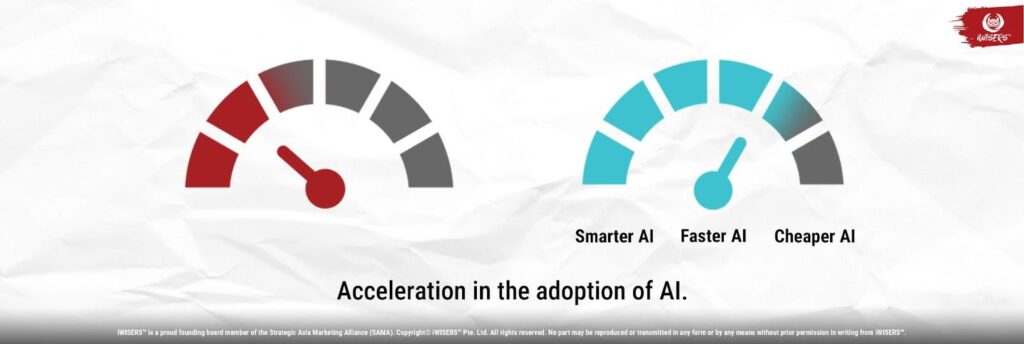
Three converging trends explain the acceleration:
1. AI inference costs have dropped dramatically [2], making real-time personalisation feasible for brands of all sizes.
2. Marketing platforms have matured, embedding machine learning directly into CRMs, CDPs, and programmatic ecosystems.
3. Customer expectations are rising, shaped by seamless interactions across apps like TikTok, Shopee, and Grab that blend personalisation with immediacy.
In a competitive environment where customers decide in seconds, automation powered by AI delivers not just speed, but precision.
Where AI Delivers the Greatest Value
1. Predictive and Prescriptive Personalisation
AI interprets thousands of behavioural signals to predict what an individual will do next. These models calculate micro-intent: whether someone is ready to purchase, churn, or explore, and trigger automated “next-best-action” responses. For example, Spotify [3] continuously updates playlists using real-time engagement data to curate music that feels humanly intuitive.
2. Generative Creative and Content Velocity
Generative AI tools like Adobe Firefly [4] and ChatGPT Enterprise [5] enable teams to produce ad copy, visual concepts, and personalised variations instantly. This means moving from a few static creatives to thousands of contextualised assets, each tailored to specific audiences or even individuals without proportionate increases in production costs.
3. Autonomous Workflow Orchestration
Agentic automation; systems that can plan, execute, and self-correct is reshaping campaign management. Platforms like HubSpot’s Breeze AI [6] and Salesforce Einstein Copilot [7] now automate complex workflows from segmentation to reporting. They connect data ingestion, model scoring, and creative deployment into one continuous loop, freeing marketers from repetitive tasks while maintaining brand alignment.

Governance and Responsible Scaling
As the famous saying from Spider-Man goes, “with great power comes great responsibility.” As technologically advanced as AI is today, it is still ultimately a machine. AI can amplify bias, misinterpret tone, or breach privacy if left unchecked. Organisations must pair automation with human oversight through strong governance frameworks.
Best practice includes:
Transparent data usage guided by GDPR-style consent-first policies [8].
Model monitoring and explainability, ensuring AI decisions remain auditable.
Ethical guardrails, especially for generative content where tone and accuracy matter.
Recent studies by Accenture [9] highlight that brands applying “responsible AI” frameworks outperform peers by up to 20% in customer trust scores.
Building the Right AI Foundation
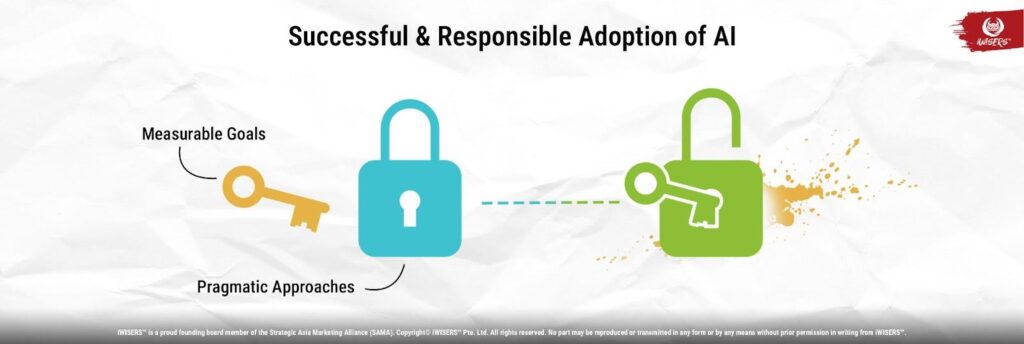
1. Start with clear business outcomes: Identify where AI can create measurable impact, conversion uplift, churn reduction, or campaign velocity.
2. Build an integrated decisioning layer: Use a Customer Data Platform (CDP) and real-time event streams to unify signals, feeding data into an AI-driven personalisation engine.
3. Automate incrementally: Pilot one channel, test for lift, and expand. Combine experimentation with human-in-the-loop evaluation to ensure outputs remain on-brand.
The Vendor and Talent Landscape
The vendor ecosystem is rapidly consolidating. Platforms like Adobe Experience Cloud [10], Salesforce Marketing Cloud [11], and Braze [12] are merging CDPs, creative generation, and decisioning layers into unified systems. Meanwhile, startups are innovating in niche areas such as contextual image generation and agentic optimisation.
But technology is only half the equation. The modern marketing team requires AI-literate talent, data translators, creative technologists, and ML-ops liaisons to bridge human strategy with machine efficiency. As highlighted by Deloitte’s 2025 CMO survey [13], companies investing in these hybrid roles see faster time-to-value from automation initiatives.
An Amplifier
AI and automation are not replacements for creativity or empathy; they amplify them. When paired with a clear strategy and human judgment, they transform marketing from reactive execution into predictive orchestration.
The next frontier isn’t whether marketers will use AI, it’s how intelligently they will use it. The winners will be those who blend machine precision with human intuition, turning automation into a true growth engine.
Citations
[1] – https://www.idc.com/getdoc.jsp?containerId=US53601725 [2] – https://www.marketingaiinstitute.com/2025-state-of-marketing-ai-report [3] – https://www.marketingaiinstitute.com/blog/spotify-artificial-intelligence [4] – https://www.adobe.com/products/firefly.html [5] – https://chatgpt.com/business/enterprise [6] – https://www.hubspot.com/products/artificial-intelligence [7] – https://www.salesforce.com/news/press-releases/2024/02/27/einstein-copilot-news/ [8] – https://www.gov.uk/data-protection [9] – https://www.accenture.com/us-en/services/data-ai/responsible-ai [10] – https://business.adobe.com/products/experience-platform/adobe-experience-platform.html [11] – https://www.salesforce.com/marketing/ [12] – https://www.braze.com/product/overview [13] – https://www.deloitte.com/us/en/programs/chief-marketing-officer/articles/cmo-survey.htmlThe views expressed in this article are those of the author. The content is provided for informational purposes only and should not be taken as professional advice. Readers are encouraged to consult a qualified professional before making any decisions.