

Southeast Asia is on track to become the world’s second fastest-growing e-commerce market by 2029, driven by rapid digital payment adoption and the increasing participation of small and medium enterprises (SMEs) in the region’s digital economy.
According to a new study commissioned by 2C2P by Antom and conducted by global market intelligence firm IDC, the Southeast Asian e-commerce market is expected to record a compound annual growth rate (CAGR) of 13.2 per cent between 2024 and 2029, placing it just behind India globally.
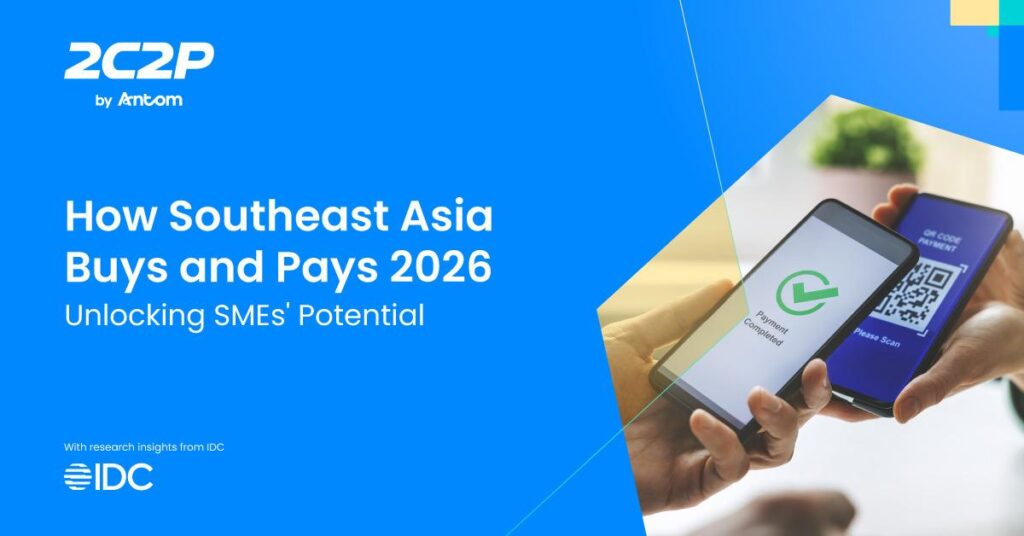
The report, titled How Southeast Asia Buys and Pays 2026: Unlocking SMEs’ Potential, projects the region’s e-commerce market will grow by 85.4 per cent to reach US$289.8 billion by 2029, highlighting the accelerating shift towards digital commerce and cashless payments across ASEAN economies.
Digital Payments to Dominate Southeast Asia’s E-Commerce Growth
The study found that digital payments are expected to account for 97 per cent of all e-commerce transactions in Southeast Asia by 2029, up significantly from 89 per cent in 2024.
Among the fastest-growing payment methods are domestic payment systems, mobile wallets, and Buy Now Pay Later (BNPL) services, reflecting changing consumer preferences and increasing financial digitalisation across the region.
Domestic payment methods — including instant payments and local bank-based payment schemes — are forecast to become the largest segment within Southeast Asia’s digital payment ecosystem by 2029. Transaction values are expected to increase by 104 per cent, reaching US$92 billion compared to US$45.1 billion in 2024.
Meanwhile, mobile wallet usage is projected to surge by 107 per cent, growing from US$38.2 billion to US$79 billion during the same period. The report also predicts BNPL services will experience the strongest growth trajectory, rising by 174 per cent to US$18.9 billion by 2029.
The findings reflect how consumers across Southeast Asia are increasingly embracing flexible, mobile-first payment solutions as digital commerce becomes more embedded in everyday life.
SMEs Emerging as the Core Driver of Digital Economy Growth
The report identifies SMEs as a major force behind Southeast Asia’s digital economy expansion, with the sector expected to contribute approximately 58 per cent of the region’s e-commerce market by 2029.
However, despite growing online participation, many SMEs continue to face digitalisation challenges that limit their ability to scale effectively.
The study surveyed 600 SMEs across six Southeast Asian markets — Malaysia, Indonesia, Singapore, Thailand, Vietnam, and the Philippines — examining business priorities, payment adoption trends, and digital readiness levels.
Across the region, 66 per cent of SMEs now conduct business online, reflecting increasing participation in digital commerce. Yet one-third of respondents still rely heavily on cash transactions in their day-to-day operations, even in highly developed markets such as Singapore.
According to the report, ongoing barriers include:
- High transaction fees
- Fraud and cybersecurity concerns
- Payment system integration complexity
- Infrastructure and connectivity gaps
- Regulatory and taxation challenges
These issues continue to affect SMEs’ ability to modernise operations, optimise payment systems, and expand into new markets.
Cross-Border E-Commerce Presents Major Growth Opportunity
Although only 49 per cent of SMEs currently participate in cross-border trade, the report found that approximately three-quarters of businesses intend to expand internationally within the next two years.
This trend is particularly strong in emerging digital economies such as Indonesia and Thailand, where SMEs increasingly view regional expansion as a key growth strategy.
IDC estimates that broader SME participation in cross-border e-commerce could generate an additional US$20.8 billion in sales by 2029, potentially increasing Southeast Asia’s total e-commerce value by 7.1 per cent.
The report also highlighted how digital payment innovation could help bridge financial inclusion gaps across the region. According to data cited from the World Bank, 56 per cent of the population in Southeast Asia still do not own payment cards, reinforcing the importance of alternative payment solutions such as mobile wallets and instant payment systems.
Malaysia’s SMEs Prioritising Efficiency and Payment Upgrades
In Malaysia, SMEs are increasingly focused on improving operational efficiency and modernising payment capabilities.
The report found that Malaysian SMEs are prioritising:
- Reducing operational costs
- Increasing revenue growth
- Improving payment solutions
At the same time, businesses identified fraud concerns, limited payment options, integration complexity, and high transaction costs as among their biggest digitalisation challenges.
The findings suggest that Malaysian SMEs are actively upgrading their digital payment capabilities while balancing profitability and operational resilience in a competitive economic environment.
2C2P by Antom: Simplifying Southeast Asia’s Complex Payment Landscape
According to Worachat Luxkanalode, businesses across Southeast Asia require more streamlined payment solutions capable of supporting increasingly diverse local payment ecosystems and cross-border expansion ambitions.
“Businesses in Southeast Asia, especially SMEs, are the backbone of the region’s economic growth, yet many continue to struggle with digital transformation challenges,” he said.
He added that integrated payment infrastructure and unified API solutions could help businesses simplify operations, support local payment preferences, and unlock broader participation within Southeast Asia’s fast-growing digital economy.