


Malaysian small and medium-sized businesses are showing growing interest in artificial intelligence (AI), but widespread adoption remains in its early stages, according to insights shared at the inaugural Kintone Day Kuala Lumpur 2026.
Held on 8 September at Zepp Kuala Lumpur, the event brought together around 600 business leaders from industries including manufacturing, logistics, healthcare and professional services.
Insights gathered from attendees showed that only one in 10 business leaders in the room were using AI agents in their operations, while between 30 and 40 per cent were using AI in simpler forms, such as prompting a chatbot.
For Kintone Southeast Asia, the figures represent an opportunity for Malaysian businesses to get ahead as AI becomes increasingly integrated into everyday operations.
Malaysia Named Kintone’s Highest-Potential Southeast Asian Market
Kintone Southeast Asia, a subsidiary of Tokyo-listed Cybozu, Inc. (TSE: 4776), used the event to identify Malaysia as its highest-potential market in Southeast Asia.
New customer acquisition in Malaysia increased by more than 160 per cent year-on-year in the first half of 2026, reflecting growing demand for digitalisation among local businesses.
The company said this opportunity is supported by the strength of Malaysia’s SME ecosystem.
According to the Department of Statistics Malaysia, micro, small and medium enterprises contributed RM689.8 billion in value added in 2025, equivalent to 39.7 per cent of the country’s GDP. The sector grew 5.7 per cent, compared with national economic growth of 5.2 per cent, and employed 8.09 million people, close to half of Malaysia’s workforce.
“Every SME will be using AI before long,” said Tsubasa Nakazawa, Managing Director of Kintone Southeast Asia. “The ones that gain most from it are the ones that start while most have not, and starting no longer requires an IT department or a single programmer.”
Bringing Agentic AI Into Everyday Business Operations
A key focus of Kintone Day was the growing potential of agentic AI, with Kintone giving attendees an early look at capabilities currently in development.
Unlike AI tools that simply respond to individual prompts, an AI agent within the Kintone platform could carry a business process forward after a specified trigger condition is met.
Potential applications include automatically routing a closed sales opportunity to a delivery team or proposing a response when a recurring quality issue is identified.
The company said organisations would retain control over how these AI capabilities are used.
Kintone’s controls allow businesses to establish their own requirements around data safety and permission levels, including who can use AI and how far an AI agent can act. Organisations can also switch the technology off entirely.
The approach is intended to allow AI adoption to fit alongside individual company policies as well as Malaysia’s National AI Action Plan 2026–2030, which outlines the country’s ambition to become an AI Nation by 2030 through 28 initiatives covering sectors, talent, infrastructure and governance.
Closing the Digitalisation Gap for SMEs
Despite growing interest in AI, many Malaysian SMEs continue to operate using a combination of spreadsheets, messaging applications and single-purpose software that do not necessarily communicate with one another.
This can leave employees repeatedly reconciling information manually and spending valuable time managing disconnected systems.
Kintone said that while consolidating these systems can address part of the problem, technology adoption can lose momentum after implementation, particularly among businesses without dedicated IT departments or in-house technical expertise.
“Malaysian companies are not short of ambition. They are short of IT people, time and the confidence that help will still be there after go-live,” Nakazawa said.
He added that Kintone is designed to address this gap by allowing employees closest to the work to build and modify their own systems, while the company and its partners provide continued support.
The approach also extends to AI adoption, with businesses able to decide whether or not to use AI based on the nature of the data they handle.
Cybozu and Kintone Continue Regional Growth
The growth of Kintone in Malaysia comes as its parent company, Cybozu, reports continued expansion.
For the first half of 2026, Cybozu recorded consolidated net sales of approximately US$130 million (RM532 million), representing a 16.1 per cent year-on-year increase.
Kintone was the group’s largest product line, generating approximately US$77 million (RM313 million) in sales, up 19.1 per cent year-on-year.
Kintone established its Malaysian operation in March 2022.
Building Technology Around People
Yoshihisa Aono, President and CEO of Cybozu, Inc., also shared the company’s approach to building technology around people during his keynote conversation.
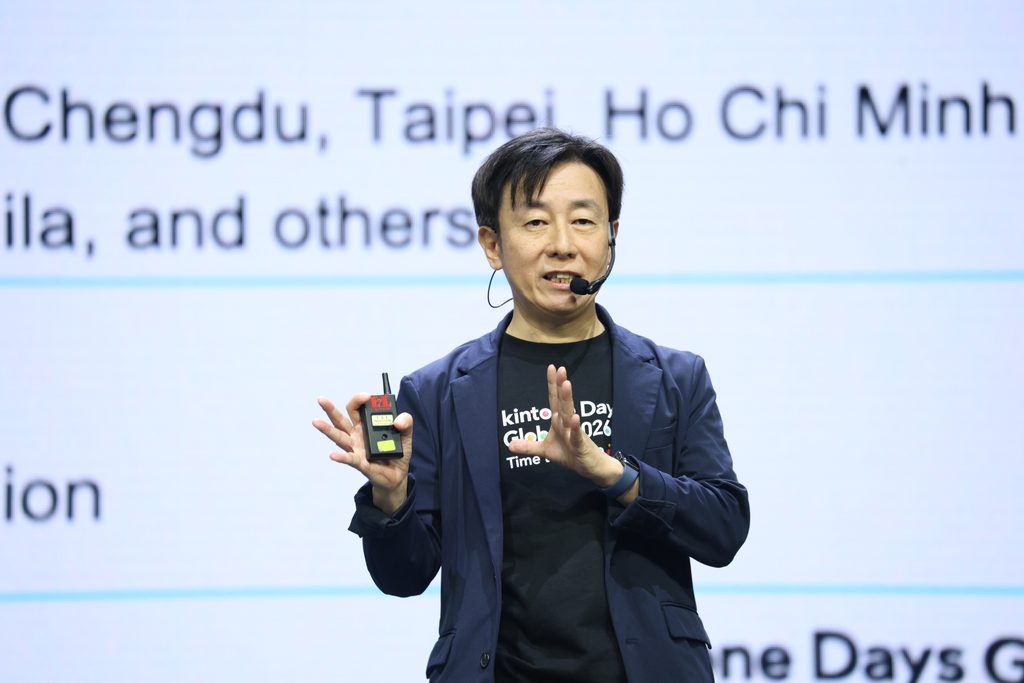
Speaking about Cybozu’s development, Aono said the company chose to listen to individual employees rather than rely solely on a single set of policies.
“If you have 100 people, you get 100 different answers, so we stopped writing one policy and started listening to each person,” he said.
According to Aono, the people who remained with the company played a significant role in its transition to cloud technology, after which its revenue grew more than tenfold.
Cybozu now employs more than 1,000 people, compared with three employees when the company was founded.
MAEKO Shows How SMEs Can Digitalise Without an IT Department
The experience of Malaysian food waste technology company Mentari Alam Eko (MAEKO) provided an example of how digitalisation can address operational challenges within an SME.
MAEKO designs and builds food waste conversion machines in Malaysia. Its operational needs became more complex after the company moved from selling machines to renting them.
While a sale involves a single transaction, a rental model creates ongoing requirements for maintenance, servicing and asset tracking. With around 200 to 300 machines operating nationwide, managing these processes manually became increasingly demanding.
The company previously responded by adding more people to handle paperwork.
Today, MAEKO uses Kintone to manage areas including purchase approvals, manufacturing drawings, HR records and ISO documentation, alongside smaller operational processes such as service vehicle bookings and key custody.
The company operates without an IT department or programmers, with its employees building and modifying applications internally.
AI Adoption Could Shape the Next Stage of SME Growth
For the second half of 2026, Kintone said its priority in Malaysia is to help more small and medium-sized businesses establish digital systems that they can build and maintain themselves.
As AI adoption accelerates, the company believes SMEs that begin experimenting with practical applications early could gain an advantage in productivity and competitiveness.
For Malaysian businesses, the challenge may therefore no longer be whether AI will become part of their operations, but how they can adopt it in a way that fits their people, processes and data requirements.