
Malaysian professionals are spending more time managing software than doing meaningful work, according to findings from Kintone’s latest workplace activation, which identified manual processes and overly complicated systems as the biggest sources of frustration among office workers.
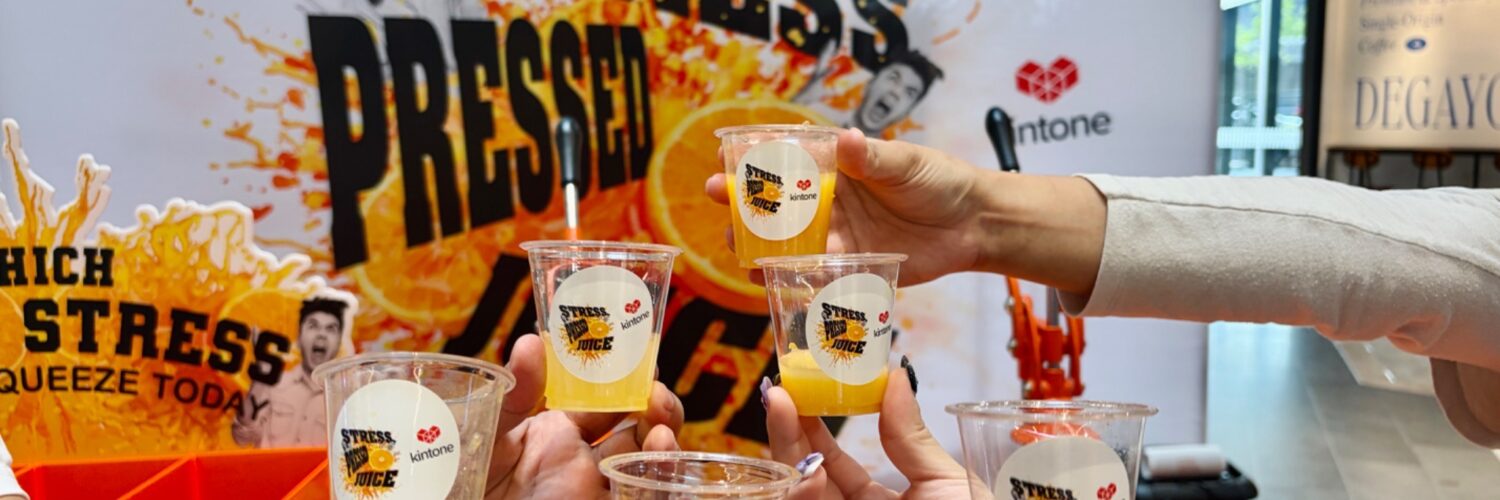
The no-code digital workplace platform by Cybozu Inc. hosted a two-day experiential pop-up, “Stress Pressed Juice”, at KL Eco City Mall on 25 and 26 June 2026, inviting office workers to literally squeeze their work-related frustrations into a cup of fresh orange juice while sharing what slows them down most during the working day.
The initiative attracted 506 participants, primarily professionals aged between 25 and 40 working within the KL Eco City precinct, transforming a light-hearted activity into a real-time snapshot of workplace productivity challenges.
Bringing Workplace Conversations into the Open
Running from 11.00am to 5.00pm over two days, the activation was designed to engage busy professionals in a relaxed environment while gathering genuine insights into the challenges they face at work.
“The goal of this pop-up was to meet busy professionals exactly where they are, in the middle of a hectic day, and create a fun, disarming space for them to share what is genuinely slowing them down,” said Tsubasa Nakazawa, Managing Director of Kintone Southeast Asia.
He noted that many organisations instinctively respond to workplace challenges by introducing additional software, dashboards or processes. However, the survey findings suggest that adding more applications does not necessarily solve the underlying issues and, in many cases, simply creates greater complexity for employees.
The activation also comes as Cybozu continues to strengthen its presence in Southeast Asia, following the announcement earlier this year of an initial US$6.4 million investment into its Kuala Lumpur operations. As Malaysia becomes an increasingly important market within Kintone’s regional strategy, understanding the day-to-day challenges faced by local businesses remains a key priority.
Manual Work Tops the List of Workplace Frustrations
Participants were asked to identify the single biggest obstacle affecting their productivity throughout the working day.
The survey found that too much manual work ranked as the leading concern, cited by 41.1% of respondents. This was followed by overly complicated systems (29.8%), limited visibility across work and information (16.2%), and too many digital tools (12.8%).
Although the frustrations varied, Kintone noted that they all point towards a common issue—fragmented workplace technologies that fail to work together effectively.
Instead of streamlining operations, disconnected systems often leave employees spending valuable time switching between applications, searching for information and manually transferring data.
SMEs Face Greater Challenges from Software Fragmentation
According to Nakazawa, the findings are particularly relevant for Malaysia’s small and medium-sized enterprises (SMEs), which often operate without dedicated IT teams.
“The irony is hard to miss because despite years of digitalisation, many teams feel slowed down by the very tools meant to speed them up,” he said.
He added that for SMEs, every additional application introduces another subscription to manage, another system to maintain and another source of data that must be reconciled with existing platforms.
Beyond the direct cost of software, businesses also face hidden productivity losses as employees spend more time locating information, updating multiple systems and following up with colleagues instead of focusing on customer service, operational improvements or business growth.
Simplifying Digital Workflows for Long-Term Productivity
The findings reflect a broader shift in how organisations approach digital transformation. Increasingly, business success is measured not by the number of software applications deployed, but by how effectively those tools work together.
Rather than expanding technology stacks, businesses are beginning to prioritise simpler, more connected systems that provide a shared view of work while allowing employees closest to day-to-day operations to improve processes without lengthy development cycles or specialist technical support.
By encouraging open conversations about everyday workplace frustrations, Kintone hopes to help organisations rethink how work is managed.
Ultimately, the objective is not to introduce more software, but to enable employees to work more efficiently, collaborate more effectively and reduce unnecessary complexity across business operations.
Looking Ahead
Building on the insights gathered during the “Stress Pressed Juice” activation, Kintone will continue the conversation at Kintone Days Global 2026, which will take place at Zepp Kuala Lumpur on 8 September 2026.
The flagship event will bring together businesses from across the region to explore practical approaches to digital transformation and discover how organisations can achieve sustainable productivity improvements through smarter, more connected workflows.