
As Sarawak expands its ambitions in artificial intelligence (AI), semiconductors and space technology, the next challenge is not simply building these capabilities, but turning them into solutions that industries can use, businesses can build around and communities can benefit from.
This challenge will run across five interconnected tracks at the ninth International Digital Economy Conference Sarawak (IDECS26), bringing together different parts of the ecosystem needed to move technology from potential to application.
The five tracks are The Future, Future Cities, Startup Village, SHE-TECH Asia Forum 2026 and the inaugural Centre of Excellence (CoE) for Digital Research Conference.
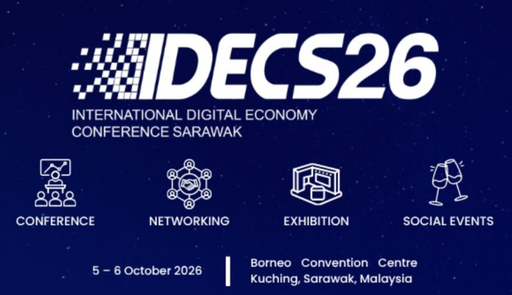
Taking place from 5 to 6 October at the Borneo Convention Centre Kuching (BCCK), IDECS26 is hosted by the Sarawak Government and jointly organised by the Sarawak Digital Economy Corporation (SDEC), Sarawak Multimedia Authority (SMA) and Sarawak Information Systems (SAINS).
This year’s conference carries the theme “Scaling Innovation Ecosystems for a Borderless Economy: Earth, Orbit & Beyond.”
From Digital Capabilities to Economic Value
The focus comes as Sarawak moves into the next phase of its digital economy agenda, with growing capabilities across AI, semiconductor design, smart infrastructure and space technology.
The state is also exploring the development of satellite-grade semiconductor chips and systems alongside its planned satellite programme. These capabilities could open potential downstream applications in areas including earth observation, forestry, disaster management, carbon tracking and maritime monitoring.
For Yang Berhormat Dato Sri Haji Julaihi Haji Narawi, Minister for Utility and Telecommunication, the priority is ensuring the right conditions are in place for these emerging industries to develop and create economic value.
“Sarawak has made deliberate investments over the years to build the foundations of a digital economy, from connectivity and infrastructure to talent and innovation. We are now entering the next phase, where the measure of success is not how much technology we deploy, but the economic value we create from it. Our ambition is to build a RM282 billion economy by 2030. Digitalisation will be critical to that growth because it gives us the ability to raise productivity across industries, compete for higher-value investment and develop new sources of economic growth.”
He added that Sarawak wants its investments to attract private capital, create higher-value industries within the state and give Sarawakian companies and talent a stronger position in regional and global markets.
“IDECS26 is where we bring those ambitions together with the partners who can help us take them to scale,” he said.
Connecting Research, Startups and Industry
SDEC Chairman Tan Sri Datuk Amar Mohamad Morshidi bin Abdul Ghani said IDECS26 would build on Sarawak’s work in AI, digital talent and future cities while bringing semiconductors and the space economy further into the discussion.
“IDECS must therefore be more than a conference where ideas are presented. It should be a place where international knowledge meets local capability, where relationships are formed, and where conversations can move towards research, investment, deployment and commercial opportunities,” he said.
The five tracks are designed to address different parts of the same economic challenge.
The Future will examine the infrastructure and capabilities required to support emerging industries, while Future Cities will explore how technology can address operational and public-service challenges.
The CoE for Digital Research Conference will connect research with potential users and commercial applications. Startup Village will focus on helping turn ideas into companies, customers and investment.
Meanwhile, the SHE-TECH Asia Forum 2026 will examine whether leadership and the talent pipeline can keep pace with the industries being developed.
Together, the tracks provide industry participants with multiple entry points into the same ecosystem, whether through research collaboration, technology testing, startup partnerships, investment opportunities or public and industry challenges that could lead to deployment.
Global Speakers Explore AI, Space and Future Cities
IDECS26 will also bring international perspectives to the discussion through five highlight speakers whose work spans industries shaping the next phase of the digital economy.
Dr Soichi Noguchi, former astronaut and project professor at the University of Tokyo, will bring insight into the growing commercial space economy.
Architect and urbanist Professor Jason Pomeroy will examine the future of sustainable and technology-enabled cities, while technology entrepreneur and futurist Dr Catherine Ball will explore emerging technologies and new possibilities for industry.
AI pioneer Professor De Kai will address how artificial intelligence is reshaping the way businesses and societies operate, while Dr Nici Sweaney, founder of AI Her Way, will examine the leadership required as AI becomes increasingly embedded in organisations and decision-making.
Space Economy Moves Beyond Launches
Dr Noguchi will open IDECS26 with the keynote “Earth, Orbit and Beyond: The Potential of the Space Business”, examining how the space sector is moving beyond government-led programmes into a growing commercial economy.
He will also explore what this shift could mean for regions beginning to develop their own space capabilities.
“A satellite launch is an important milestone, but the economic value comes from the services built around it. For Sarawak, that means developing the talent and partnerships to turn satellite data into solutions for environmental monitoring, disaster response and resource management, and finding the people and businesses who will use them,” Noguchi said.
Moving Technology from Pilots to Industry
Across its five tracks, IDECS26 will focus on what it takes for technology to progress beyond research and pilot projects into wider industry use.
This includes putting the right infrastructure in place, connecting research with businesses that can apply it, helping startups find customers and capital, and developing the talent required to support emerging industries as they grow.
For Sarawak, the conference provides a platform to bring these different elements together as the state continues building its digital economy and exploring new opportunities across AI, semiconductors, smart infrastructure and the space economy.