

As artificial intelligence (AI) transforms industries at an unprecedented pace, organisations are being urged to look beyond technology investment and place greater emphasis on developing human judgement, governance and leadership capabilities.
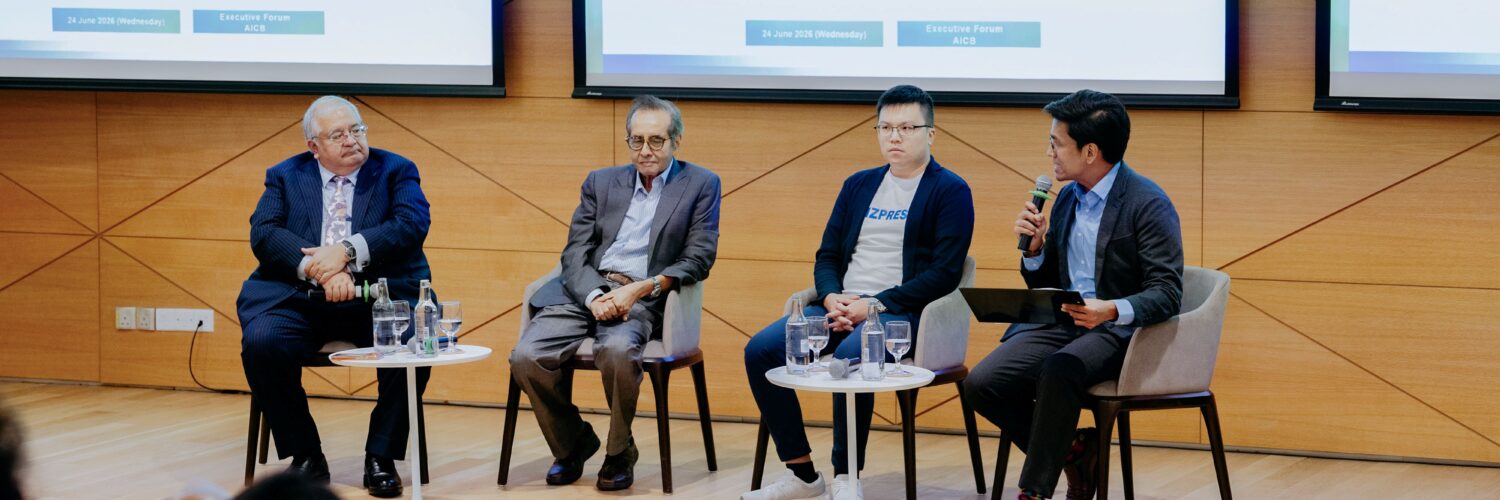
This was the central message from ICAEW Malaysia’s recent leadership forum, “From Oversight to Foresight”, held in collaboration with FIDE FORUM, where leaders from the governance, technology and finance sectors discussed how AI is reshaping organisations and the capabilities needed to unlock its full potential.
Moderated by Danial Rahman, Chief Executive Officer of ASLI, the forum explored how AI is changing the financial services landscape and highlighted the growing importance of governance, ethical decision-making and workforce readiness. During the discussion, Danial noted that more than three-quarters of the audience—comprising professional bankers and chartered accountants—were already using AI in both their professional and personal lives.
AI Is a People Challenge, Not Just a Technology Challenge
While many organisations continue to accelerate investments in AI technologies, speakers cautioned that technology alone will not guarantee success.
As AI increasingly automates routine analytical tasks, businesses will depend more heavily on professionals capable of exercising sound judgement, applying critical thinking, questioning AI-generated recommendations and managing the ethical and governance challenges associated with artificial intelligence.
For chartered accountants, the shift represents an evolving role that extends well beyond financial reporting. In addition to supporting AI adoption, accountants are increasingly expected to advise organisations on governance, risk management and workforce preparedness.
According to ICAEW Malaysia, organisations that invest solely in AI systems without strengthening the human capabilities needed to govern and utilise them effectively risk undermining their long-term competitiveness and value creation.
Leadership Must Evolve Alongside AI
Speaking during the forum, Dato’ Mohd Faiz Azmi, ICAEW Council Member and Chairman of the Securities Commission Malaysia, emphasised that AI should be viewed not as another technological upgrade, but as a transformative force requiring organisations to fundamentally rethink leadership, governance and talent development.
Unlike conventional technologies that operate within predictable, rules-based environments, AI introduces uncertainty, making human oversight more important than ever.
As organisations expand AI adoption, technical expertise alone will no longer be sufficient. Future business success will increasingly depend on professionals who can interpret context, ask the right questions, evaluate AI-generated outputs critically and make informed decisions in complex business environments.
The discussion also highlighted the importance of responsible AI governance. Because AI systems learn from data, they can inherit biases or overlook important contextual factors. This makes effective oversight, accountability and ethical decision-making essential for organisations seeking to deploy AI responsibly.
ICAEW believes chartered accountants are uniquely positioned to strengthen governance frameworks, build stakeholder trust and help organisations ensure AI delivers sustainable long-term value.
Closing the AI Governance Gap
The forum also examined the growing disconnect between AI adoption and AI governance.
Drawing on research conducted by the Hong Kong Chartered Governance Institute, Calvin Cheng, Founder of Wizpresso, shared findings from an analysis of more than 2,500 listed companies.
The study found that 88 per cent of companies referenced AI in their annual reports and business strategies. However, fewer than 25 per cent addressed AI governance or AI risk management.
The findings suggest that while many organisations are eager to embrace AI, comparatively few are developing the governance structures necessary to manage its risks effectively.
Cheng also noted that many smaller organisations continue to promote ambitious AI strategies without investing sufficiently in workforce capabilities.
“Giving people the right tools is not enough,” he remarked. “AI literacy is one of the first stages of the journey. The real question is how organisations equip people with the knowledge and training to use these tools effectively and efficiently.”
AI Transformation Starts with Leadership
Adding to the discussion, Dato’ Seri Hamzah Kassim, Chairman of Prudential Assurance Malaysia, argued that many AI initiatives fail not because of technological limitations, but because organisations lack the leadership needed to drive enterprise-wide transformation.
He observed that many businesses remain in the experimental phase due to limited risk appetite, talent shortages, difficulties demonstrating return on investment and the scale of organisational change required.
According to Hamzah, AI should not be viewed as a standalone technology project.
Instead, it represents a transformation of an organisation’s business and operating model.
He added that AI failures are often governance failures, occurring when boards and management fail to work collaboratively or when organisations approach AI using outdated management practices rather than cultivating the organisational capabilities needed to support long-term adoption.
Redefining Talent in the AI Era
One of the forum’s key messages was that the qualities organisations value in talent are changing.
Where previous generations of professionals were primarily rewarded for analytical precision and procedural expertise, the AI era increasingly demands individuals who can think laterally, ask insightful questions and confidently challenge AI-generated outputs.
The panel agreed that AI is not replacing human capability—it is redefining it.
While technical skills remain essential, competitive advantage will increasingly belong to organisations that invest in professionals capable of exercising judgement, interpreting complex situations and making decisions beyond the capabilities of machines.
For boards and business leaders, this requires treating AI as more than a technology investment. Long-term success will depend on leadership, governance, organisational culture and the development of talent capable of deploying AI responsibly.
Human Judgement Will Remain a Competitive Advantage
The discussion concluded that as AI technologies become more widely accessible, technology itself will become less of a competitive differentiator.
Instead, organisations that succeed will be those able to combine AI with distinctly human strengths—including ethical judgement, critical thinking, curiosity and the confidence to question AI-generated recommendations rather than accepting them unquestioningly.
For chartered accountants, this presents a significant opportunity. Long recognised for their integrity, objectivity and professional judgement, they are well positioned to bridge the gap between AI capability and responsible decision-making.
Ultimately, the future of work will not be defined by competition between humans and artificial intelligence, but by how effectively the two work together. Organisations that invest as heavily in developing human judgement as they do in deploying AI technologies are expected to be best placed to create sustainable, long-term value in an increasingly AI-driven economy.