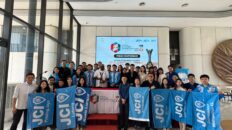

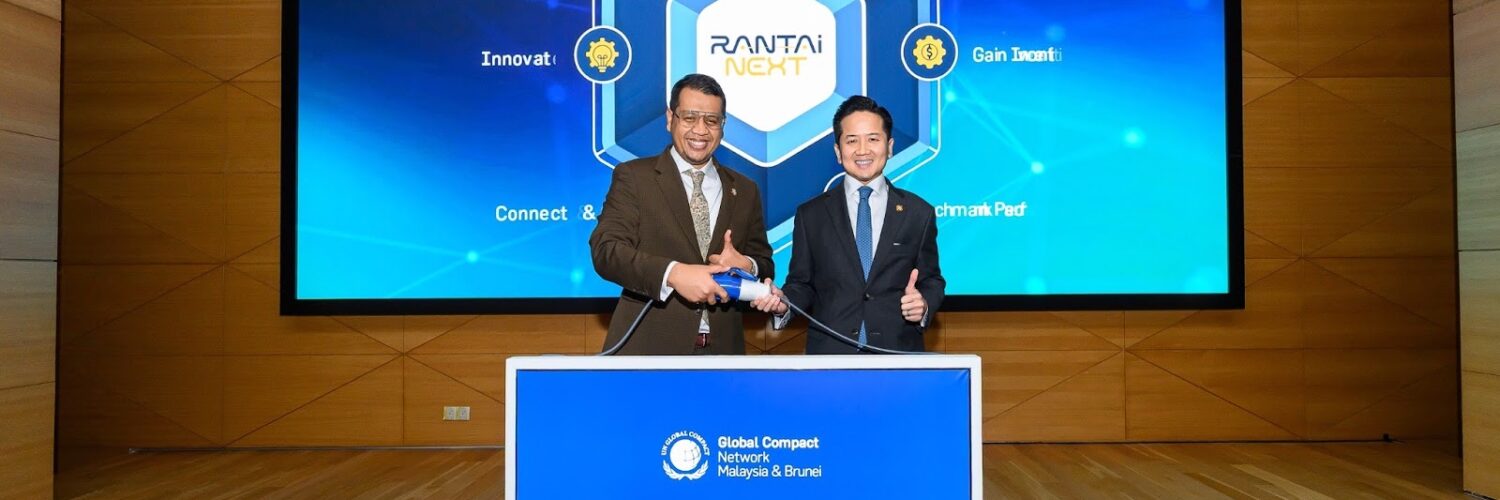
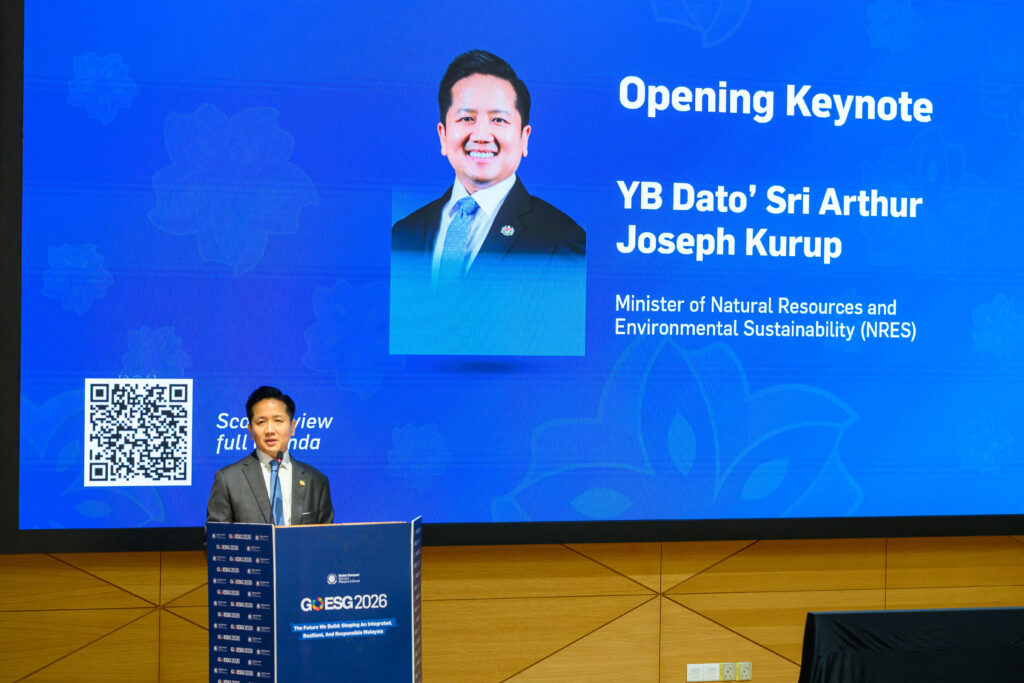
The event featured a keynote address by YB Dato’ Sri Arthur Joseph Kurup, Minister of Natural Resources and Environmental Sustainability (NRES), and the launch of two major initiatives:
- RANTAiNEXT, a platform to boost supply chain resilience and ESG action through an integrated, measurable, and rewardable ecosystem
- The ESG Playbook: Practical Steps for Manufacturing SMEs, a guide to help SMEs turn sustainability strategies into real business action
MALAYSIA SME features the keynote speech and a coverage of both key panel sessions:
- The Future Economy Playbook: Regional Strategies for a Better Tomorrow
- The Manufacturing Value Chain Reimagined: How Practical ESG Steps Are Shaping Malaysia’s SME Sector.
Opening Keynote Speech
Simple, Powerful
The title of this conference is simple yet powerful: The Future We Build: Shaping an Integrated, Resilient and Responsible Malaysia. It is a mandate for collective action. It reminds us that a sustainable future is not something we inherit by default, but something we must design with intention and integrity.
We are in an era of transformation—technology, shifting trade, and the drive for sustainability are reshaping economies and are interconnected. Malaysia faces a clear choice: act or be left behind.
Constraint or Catalyst
We can see sustainability as a constraint—something to manage after growth has already happened—or as a catalyst —something that shapes growth from the start. This is why platforms like GO ESG matter. I understand that this is now the sixth year of the conference. Over that time, GO ESG has helped us move beyond asking whether sustainability is important. Today, the more meaningful question is how we embed sustainability into innovation, investment, and inclusion. In this new era, sustainability is not an add-on; it has become the outcome of sound economic design.
Sustainability is no longer a niche topic, but a core economic issue. It dictates competitiveness, access to global capital, and long-term profitability. Countries and companies that build sustainability into their operations will attract investors, retain talent, and earn trust. Those who wait will find themselves reacting to change instead of shaping it.
This is where the private sector’s role becomes critical. The government can set policy direction, put frameworks in place, and provide incentives—but it is businesses like yours that turn direction into results. Your investment decisions, procurement choices, product designs, and supply chain practices will determine whether sustainability remains an aspiration or becomes a real competitive advantage.
Integration, Resilience, Responsibility
Today’s theme speaks directly to this shared responsibility. Integration means breaking down silos between policy, finance, technology, and industry. Resilience means building business models that can withstand climate risk, supply chain disruptions, and regulatory changes. Responsibility means ensuring that growth creates value not only for shareholders but also for workers, local communities, the environment, and future generations.
At the Ministry of Natural Resources and Environmental Sustainability, our mandate is to ensure that Malaysia’s development pathway remains both economically robust and environmentally credible. In line with the Sustainable Development Goals, our Ministry plays a central role in aligning environmental stewardship with national development priorities—so that sustainability commitments are translated into predictable policy signals that give businesses the confidence to invest.
Not Regulate for Regulation’s Sake
Our approach is to enable transition, not regulate for regulation’s sake. This includes strengthening climate and ESG governance, improving transparency and data consistency, supporting carbon market readiness, and scaling up nature-based and climate-resilient solutions. These steps reduce uncertainty, unlock green finance, and help Malaysian businesses—especially SMEs—adopt practical, commercially viable sustainable practices.
And we are already seeing this impact. At the International Green Tech and Eco Products Exhibition and Conference Malaysia (iGEM 2025), Malaysia secured RM7.3 billion in potential green investments. That did not happen by chance. It reflects growing confidence that Malaysia is serious about sustainability as a pillar of its economic strategy.
At the same time, Malaysia is also embedding climate action firmly into national policy. Our Ministry is advancing the National Climate Change Bill to provide a clear, transparent, and long-term framework for climate action across sectors. By providing regulatory certainty, this landmark legislation will place Malaysia’s climate agenda on a firm legal footing. This clarity will allow companies to plan with confidence and investors to allocate capital with greater certainty.
Toughest Scrutiny
I’m mindful that many in this room—particularly CFOs—must ensure every ringgit justifies itself. Sustainability investments are often subject to the toughest scrutiny, but the data has shifted. Sustainability is no longer a cost centre; it is a value generator.
By investing now, you are securing your future seat at the global table. Those who lead early will spend their time innovating, while those who wait will spend their time explaining.
But policies alone are not enough. The private sector must be willing to move early, not merely react quickly. To invest before regulation compels it. To set examples for others to follow. To innovate ahead of our competitors. And to see sustainability not as a reporting requirement, but as a mindset for long-term value creation.
Let’s go beyond rhetoric: integrate sustainability into strategy, build economic resilience, and act for long-term value.
When sustainability is foundational, Malaysia becomes resilient, competitive, and compassionate. The future depends on the choices we make now.
Panel Discussion 1 : The Future Economy Playbook: Regional Strategies for a Better Tomorrow
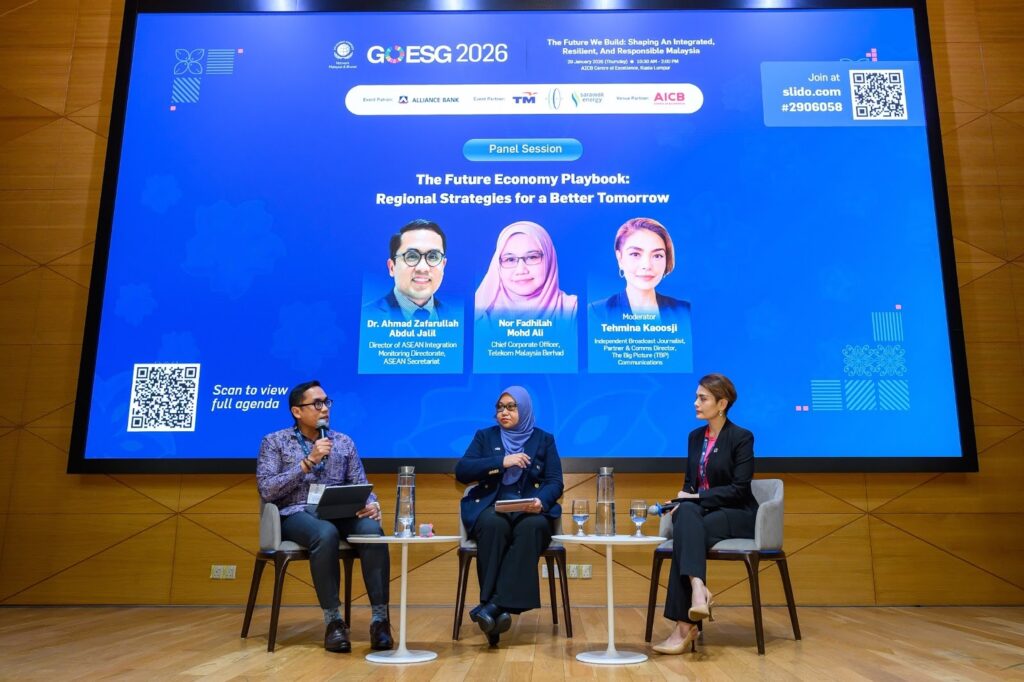
The panel explored how ASEAN’s regional frameworks can deliver meaningful outcomes for businesses, workforces, and communities. As a result of these discussions, participants gained clearer insights and actionable strategies in regional integration, digital transformation, and sustainability, particularly in strengthening economic resilience.
ASEAN Integration: From Frameworks to Tangible Outcomes
Dr Ahmad Zafarullah Abdul Jalil, Director of ASEAN Integration Monitoring Directorate, “ASEAN isn’t short of vision—we know where we want to go. But implementation slows when domestic reforms are needed,” said Dr Ahmad Zafarullah, who explained that a phased approach works better than a one-size-fits-all. Initiatives like the ASEAN Power Grid and bilateral QR payment systems reflect a practical, phased approach to integration. As of now, QR payments are live across seven ASEAN nations.
Telekom Malaysia’s Digital Playbook: From Telco to Digital Powerhouse
Nor Fadhilah Mohd Ali, Chief Corporate Officer of Telekom Malaysia Berhad (TM), spoke on TM’s evolution and its vision for 2030: to be Malaysia and the region’s digital powerhouse.
It’s not just about telecom anymore. It’s about submarine cables, open access broadband, enterprise-grade data centres, and AI-skilling our entire workforce, Fadhilah shared.
By the end of 2026, TM plans to have 100% of its workforce digitally conversant, with AI modules rolled out this year. The company’s network infrastructure already serves as a gateway to regional digital connectivity, from submarine cables to open data access.
Sustainability = Resilience: ASEAN’s Green Economic Frameworks
As geopolitical tension and climate risks rise, Dr Ahmad Zafarullah underscored the urgency of embedding sustainability within ASEAN’s economic frameworks:
- The ASEAN Circular Economy Framework
- The Carbon Neutrality Strategy
- The Centre of Excellence for MSMEs in Green Transition
- The ASEAN Simplified ESG Disclosures for SMEs
- Upgrades to the ASEAN Trade in Goods Agreement to include circularity
“These are designed in the language of business, to align economic and environmental interests,” said Dr Ahmad Zafarullah.
Building Resilience from the Inside Out
Across the panel, a clear theme emerged: ASEAN’s economic strength will depend on how well it balances regional coordination, digital infrastructure expansion, and climate-smart policies.
Dr Ahmad Zafarullah emphasised that not every member state moves at the same pace. Flexibility, pilot-first models, and shared knowledge are key to regional scaling success. TM’s corporate shift toward a digitally fluent workforce and Malaysia’s leadership in green MSME initiatives are examples of how national actions can strengthen a regional ecosystem.
Moderator, Tehmina Kaoosji aptly put it, ASEAN sits at the heart of critical global transformations. The real task now is to operationalise the future, together.
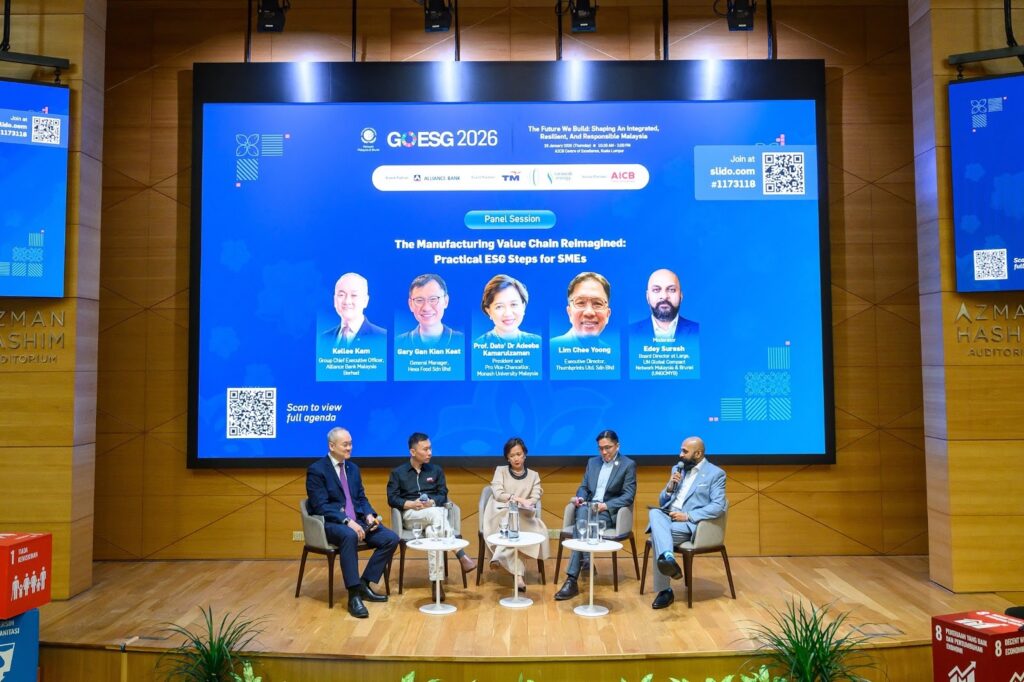
PANEL SESSION 2: The Manufacturing Value Chain Reimagined: How Practical ESG Steps Are Shaping Malaysia’s SME Sector
For Malaysian SMEs in the manufacturing sector, the pressure from financiers, regulators, customers, and global supply chains is mounting. The panel brought together thought leaders from banking, academia, and SME operations to unpack what works in ESG integration.
From Framework to Factory Floor: Building an ESG Playbook
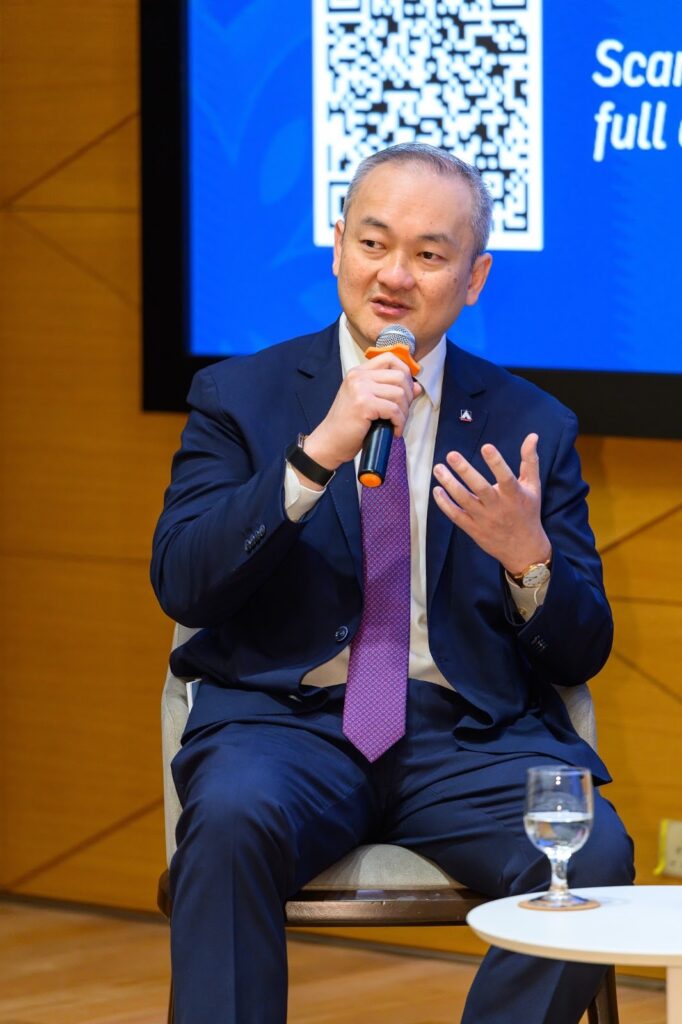
Kellee Kam, Group CEO of Alliance Bank Malaysia Berhad, opened the conversation with an honest reflection on the ESG journey: “We started by asking a simple question: what is ESG for SMEs, really?” His answer came in the form of a collaborative playbook—developed with UNGCMYB and other partners—which breaks down ESG into relatable, actionable steps for manufacturers.
“Instead of overwhelming businesses with ideals, we designed the playbook to map out ESG opportunities across the value chain: from sourcing and procurement, to operations, distribution, and marketing,” Kam explained. “It’s not just about compliance. It’s about competitiveness.”
He stressed that Alliance Bank’s support extends beyond financing. The bank’s ‘Three-A Model’—Advocacy, Advice, Answer—guides SMEs through awareness building, advisory support, and implementation pathways.
First Steps Matter: Governance First, Then the Rest Will Follow
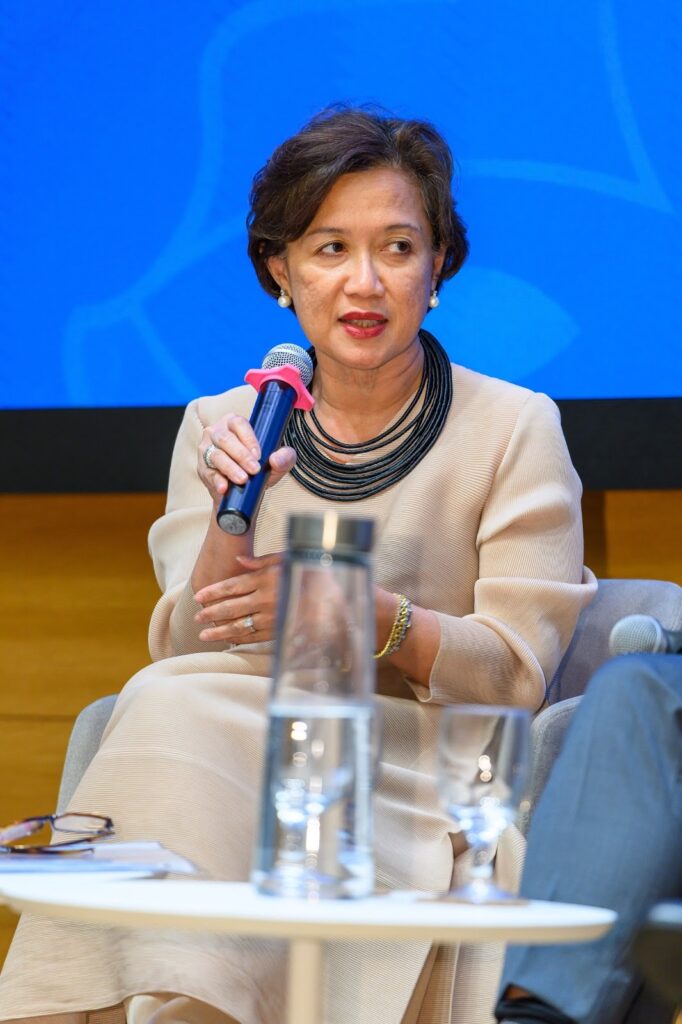
Prof. Dato’ Dr Adeeba Kamarulzaman, President and Pro Vice-Chancellor of Monash University Malaysia, provided an academic lens, yet grounded in pragmatism. “The first thing SMEs should do is map where they are on the ESG journey. Then begin with the ‘G’—governance. If governance is in place, the rest will follow.”
Her point was clear: ESG isn’t just an overlay—it must be embedded into ethos. At Monash, this means integrating ESG principles across curricula, launching immersive flagship programs, and conducting applied research in partnership with industry players.
Real Talk from the Factory Floor
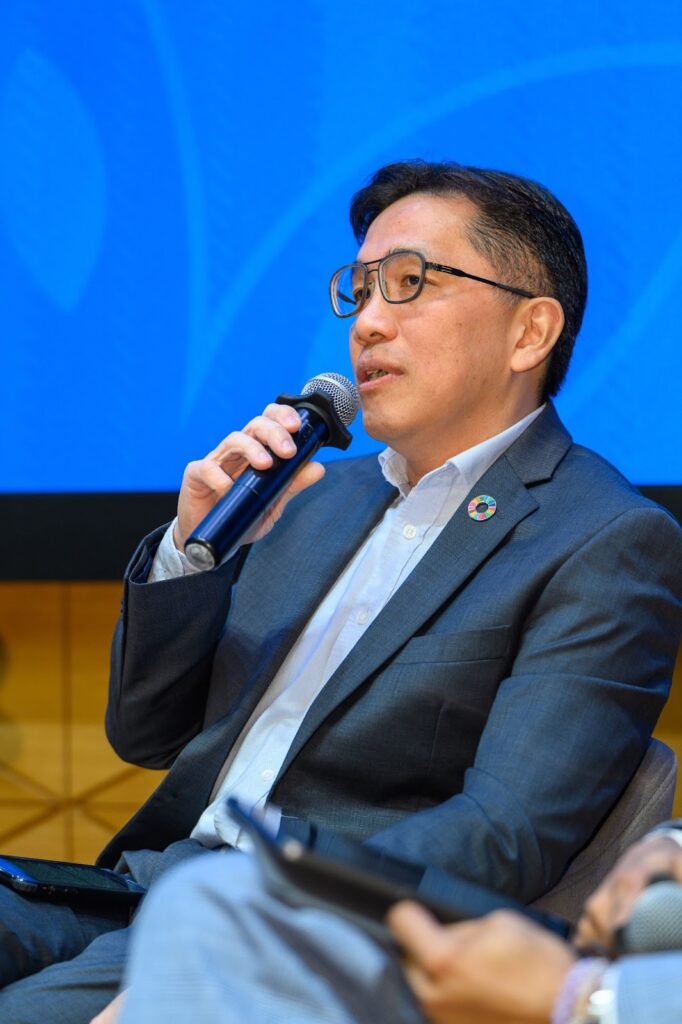
Lim Chee Yoong, Executive Director ofThumbprints Utd Sdn Bhd, shared: “Fifteen years ago, we didn’t even have ESG. We had a CSR, and even that was hard with no budget or team. But we had a desire to go global.”
Starting with solar panels (back when they were still prohibitively expensive), the company invested in what they couldn’t afford—not as a cost, but as a strategic bet on competitiveness. The results? A transformation from SME to mid-tier player with 3x revenue growth over 15 years.
Lim’s key mantra—“no lie, no cheat, no bribe”— became a business filter. “We lost half our customers at first. But today, the ones that remain are the right ones. And that gives us staying power.”
Among the quick wins Lim cited were profit-sharing with employees and the adoption of a productivity-linked pay system. These human-centred policies not only improved engagement but also rewired the company into a mission-driven enterprise.
Small Acts, Big Impact
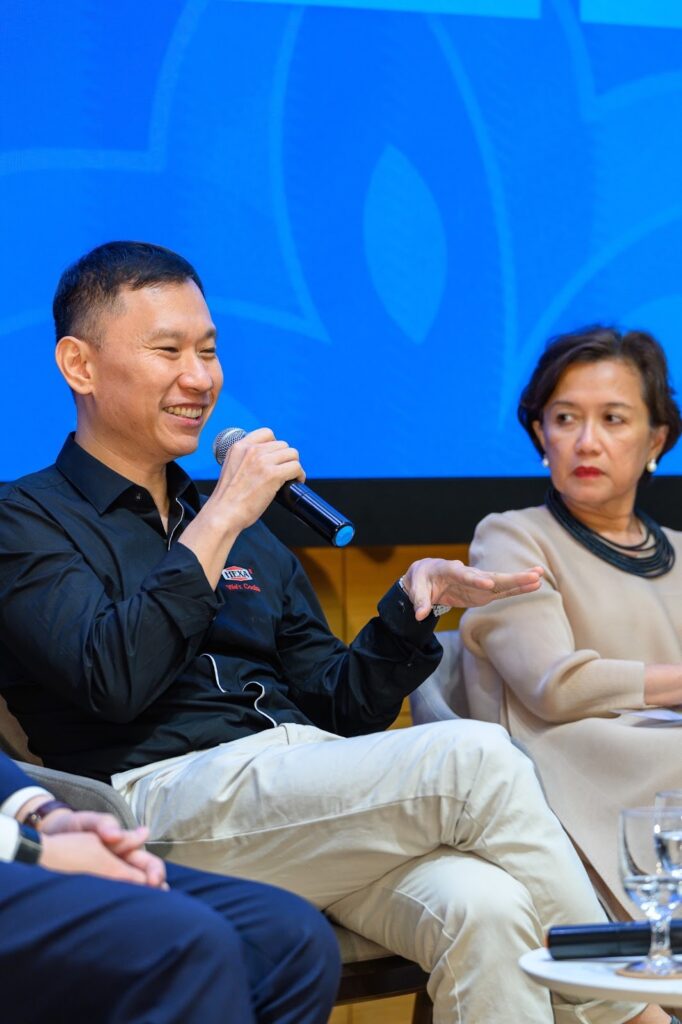
For Gary Gan Kian Keat, General Manager of HexaFood Sdn Bhd, the ESG journey also began with employees. “We looked at what our staff needed—financial support, education, stability—and acted. That delivered the most impact with the least disruption.”
As a spice manufacturer operating in the fast-moving consumer goods (FMCG) space, Hexa focuses on certifications like HACCP and FSSC to meet international standards. Yet it’s the invisible work—like reducing food wastage and supporting single mothers—that reaffirms their ESG purpose.
“Inventory management has the highest ESG risk for us,” Gan noted. “But it’s also the easiest place to create impact. If we get our data and predictions right, we reduce waste and improve margins.”
Gan also likened ESG evolution to the trajectory of halal certification. “Fifteen years ago, halal went mainstream. ESG will be the same. If you don’t adopt, your competitors will. Compliance today is survival tomorrow.”
ESG as Growth Strategy, Not Compliance Burden
A recurring message from the panel was that ESG should not be mistaken for a compliance headache. Instead, when done right, it unlocks long-term market advantages.
Lim explained how transitioning from virgin paper to FSC-certified and recycled paper gave Thumbprints a brand boost—and market edge. “It made our customers look good and positioned us as a green printing partner.”
Their bold move to delay shareholder dividends in favour of profit-sharing with staff also paid off in loyalty and enterprise value. “You don’t build value by extracting profits. You build it by reinvesting in people.”
Kam concurred: “The better you do, the more competitive you are. And that makes you more bankable. It’s a win-win.”
What Gets Ignored, and What Shouldn’t Be
When asked which part of the value chain carries the most overlooked risk, Gan pointed to waste and inventory management. “Better forecasting and just-in-time practices reduce ESG risks significantly.”
Kam expanded the frame: “Governance is the most ignored, yet highest-risk area. It’s not glamorous. It’s not big-bang. But policies, culture, and mindset—those are foundational.”
His reminder was clear: upstream awareness—who you sell to and who you buy from—shouldn’t be underestimated. Scope 3 emissions, supply chain sustainability, and ESG-compliant customers all add up to larger market potential.
Universities as Catalysts
Dr Adeeba’s closing point reframed the role of academia. “It’s no longer just about publishing papers. It’s about solving real problems. Our research must matter—and our students must be prepared to lead, not follow.”
Through Monash’s credit-bearing industrial placements, community-based environmental programs, and cross-border learning initiatives, the university is ensuring that ESG becomes second nature to tomorrow’s workforce.
A Call to Reframe the ESG Conversation
Whether it’s reframing ESG as a growth strategy, focusing on governance before budgets, or recognising that sustainability is now mainstream, the message was resolute: SMEs don’t have to be perfect, but they do have to start. And with the right support from banks, universities, and industry peers, steps taken today can lay the foundation for tomorrow’s resilience.
“Do good. Stay resilient. Compete globally,” the panel concluded.
Download Practical Steps for Manufacturing SMES The ESG Playbook. More on RANTAINEXT