

By Natasha Isabel Saravanan
Reflecting on her role, she said, “Endeavor is a global organisation of entrepreneurs. We’ve been spending the last 28 years selecting and bringing high-impact entrepreneurs into this network of trust around the world.”
Today, Endeavor operates in more than 50 countries, supporting entrepreneurs who aim to scale rapidly and multiply their social and economic impact. Tay’s responsibility is to identify these entrepreneurs in Malaysia and connect them to global networks of capital, mentorship, and markets.
“Our role is to find these kinds of great entrepreneurs in Malaysia and bring them into this network,” she explained. Ultimately, people turn to Endeavor to scale their businesses and take them to the next level.
Her journey to this position was anything but linear. It was shaped by curiosity, discipline, experimentation, and a deep respect for the realities of entrepreneurship.
From Balance Sheets to Baby Products: Learning Entrepreneurship the Hard Way
“Before Lazada and Shopee even existed, I was fortunate enough to co-found one of the earliest e-commerce platforms in Malaysia back in 2011, a mum and baby portal called Babydash,” Tay recalled.
Her professional life began in audit and accounting, followed by corporate finance in banking. These early years were driven by a desire to understand how businesses functioned at their core.
“I’ve always been motivated by businesses and how they make money,” she said. “Starting with audit and accounting was to understand the basics of how a business runs. Then moving to banking was about learning how companies raise money to grow.”
Yet it was her side venture, Babydash, that transformed her understanding of entrepreneurship. Running an e-commerce platform in an underdeveloped digital ecosystem exposed her to operational struggles, cash flow pressures, and customer expectations.
“That opened my eyes to the world of entrepreneurship and what entrepreneurship was like,” she said. “It showed me what the ecosystem was really like.”
This hands-on experience shifted her perspective permanently. She no longer saw entrepreneurs as distant success stories, but as individuals navigating uncertainty every day.
Later, she ran an accelerator called Scaleup Malaysia and became deeply involved in supporting startups. Looking back, she described her career as “a diverse background but all leading back to enjoying watching entrepreneurs and learning from how they build and grow their businesses.”
Her early failures and experiments gave her credibility and empathy. When she now advises entrepreneurs, she does so from lived experience, not theory.
Selection as a Service: Rethinking What Support Really Means

The Endeavor Entrepreneur selection journey is a rigorous, multi-stage process, with only a small fraction of entrepreneurs ultimately chosen to join the global network.
Endeavor looks for entrepreneurs who are neither at a stage where support would be premature nor at a stage where Endeavor can no longer move the needle, but at the point where the right backing can change their entire trajectory.
The process begins with identifying entrepreneurs who meet three criteria. First, they must dream big and want to scale. Second, their businesses must truly be scalable and solve real problems. Third, they must be at a pivotal moment of growth.
“We look for whether the entrepreneur wants to scale their business and also wants to pay it forward,” she said. “They must want to help other entrepreneurs.” From there, selected entrepreneurs meet experienced mentors and industry leaders who assess their companies and offer feedback. Later, they face International Selection Panels, held across the world multiple times a year.
“They have to pitch in front of six panelists,” she said. “All six have to say yes.” Through this process, entrepreneurs gain exposure, credibility, and global perspectives long before formally joining the network.
Entrepreneurs who pass the final stage, the International Selection Panel, gain access to a trusted network across more than 50 markets, along with mentorship, and capital to help them scale.
“We don’t really see Scale Up as an accelerator programme,” Tay clarified in reference to Scale Up by Endeavor. “We call our process ‘selection as a service’.”
Unlike many short-term programmes that focus on workshops and training sessions, Endeavor’s model is built around long-term relationships and rigorous evaluation.
At the centre of this process is Tay herself. Her role at Endeavor is to find great entrepreneurs who are solving real-world problems at scale and to guide them through a rigorous evaluation journey. Together, with her team, she identifies promising entrepreneurs and puts them through this rigorous evaluation which she oversees.
“We put entrepreneurs through what we call a selection journey,” she explained. “Every person that an entrepreneur meets during this journey gives them value.”
“This is not about workshops,” Tay emphasised. “It’s about connection, review, and real conversations.” The aim is to build trust, accountability, and resilience. For Tay, real support is not about temporary motivation. It is about building lasting ecosystems.
From Kuala Lumpur to the World: How Local Startups Went Global

“If not for Endeavor, he wouldn’t have met Nick Nash,” Tay said with a proud smile, recounting one of her favourite success stories.
She was referring to Eric Cheng, founder of Carsome, whose encounter with an international investor during his selection panel later led to major funding. “Nick Nash was his panelist,” she explained. “Asia Partners then invested in Carsome. And Endeavor Catalyst, a rules-based, co-investment fund of Endeavor, also invested.”
Another example is CapBay, an invoice financing company that first joined the Endeavor network through the Scale Up by Endeavor before progressing through the international journey. “When we first met them, they joined Scale Up,” she said. “Then we realised they were scaling fast enough to go through the real selection journey.” CapBay’s founders later attended Endeavor’s Executive Education programmes at Stanford and MIT, gaining access to global leaders and advanced management training.
JurisTech offers another illustration. As one of Endeavor Malaysia’s earliest entrepreneurs, it used the network to expand into Africa. “From Malaysia, it’s hard to understand that market,” she said. “So they sat down with our offices in Kenya and different parts of Africa.”
Similarly, iMotorbike benefited from international mentorship. “One of their panelists was Michele Levy,” she said. “The founder, Gil Carmo, has said that just bouncing ideas with her was very helpful.”
Tay also highlighted newer examples such as respond.io and RPG Commerce’s Montigo brand. “They are building in Malaysia and serving the world,” she said. “Some panelists didn’t even know Montigo was Malaysian.”
For her, these stories prove that Malaysian startups are not limited by geography.
“What they need is access,” she said. “Access to mentors, markets, and people who’ve done it before.”
We Need More Stories: Championing Women in Entrepreneurship
“If I ask today, who is the most successful female entrepreneur in Malaysia, it’s hard to find,” Tay admitted. Despite progress in recent years, she believes women remain underrepresented in high-profile startup success stories.
“Everybody talks about Eric Cheng,” she said. “We need more.” She argued that visibility matters deeply. Without well-known role models, young women may hesitate to pursue entrepreneurship. “We need more people telling these stories,” she observed.
She also cited examples such as See Wai Hun from JurisTech and Hooi Ling Tan, co-founder of Grab, whom she described as “probably the most successful female entrepreneur from Malaysia.”
“Hooi Ling sits on the Endeavor Global Board,” she added. “These kinds of stories should be better known.”
Globally, she pointed to founders like Hande Cilingir (Insider One) and Mona Ataya (Mumzworld) as evidence that women can build unicorn companies. “It’s a global thing,” she said. “We just need more of these success stories.”
Beyond representation, Tay emphasised that diversity strengthens innovation. “When you have different perspectives, you build better businesses,” she said.
Through Endeavor, she actively encourages female entrepreneurs to seek international exposure and confidence. “I would like more female entrepreneurs who want to tap into global markets to come forth,” she opined. Her advocacy is grounded in action, not rhetoric, aimed at building sustainable leadership pipelines.
Paying It Forward: Measuring Success Beyond Valuation
“If you are successful alone, it’s not really good enough for us,” Tay emphasised.
For Endeavor, success is measured not only by valuation or market share, but by contribution. She pointed to Eric Cheng once again, and Loi Tuan Ee of Farm Fresh, both of whom returned to serve on Endeavor Malaysia’s board. “That’s their way of paying it forward,” she said.
Globally, she highlighted the founders of Mercado Libre who now serve on Endeavor’s board, and Mudassir Sheikha of Careem, who established Endeavor Pakistan. “From Mercado Libre alone, over 50 companies have been formed by former employees,” she said. “That’s how impact multiplies.”
Her philosophy centres on ecosystems rather than individuals. “If you build a successful business, you create jobs,” she said. “Those people start new businesses. That’s how it grows.”
When asked how she evaluates Endeavor’s future success, her answer was simple. “The key one is how many entrepreneurs we bring into the network,” she said. “The second is how many multiply the impact.”
She also mentioned fast-growing companies like ElevenLabs, a Polish-founded company joining Endeavor despite already being large. “They can see that with support, they can be even bigger,” she said.
Looking Ahead: A Platform for the Next Generation
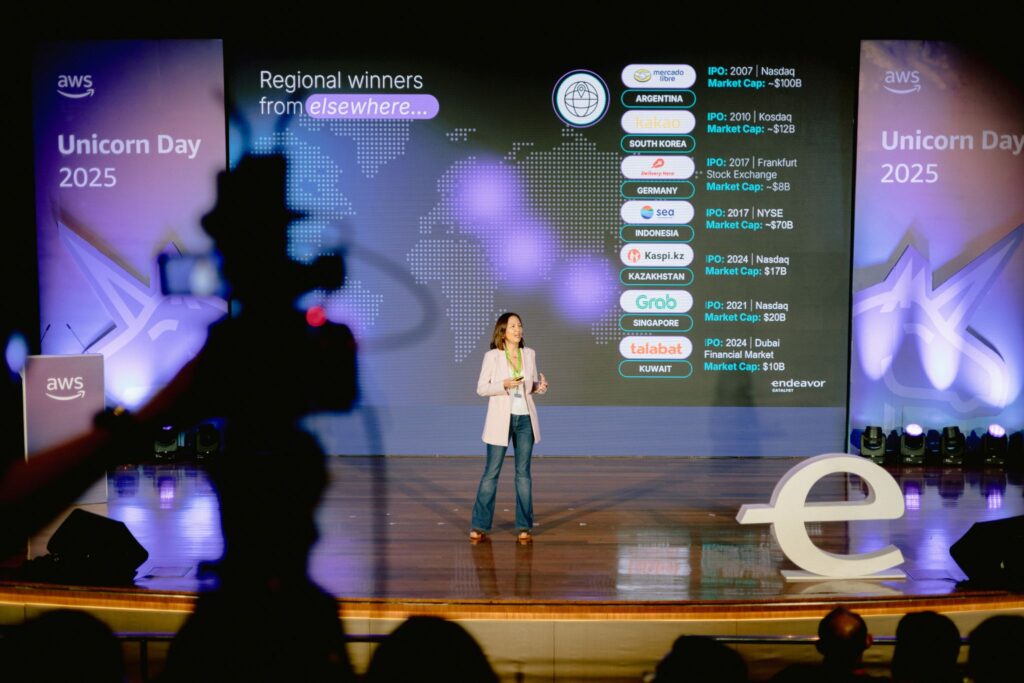
Tay’s career reflects a rare alignment between technical expertise, entrepreneurial empathy, and long-term vision.
“I don’t even remember the technical details of accounting,” she laughed. “But it gave me a foundation.” That foundation, combined with lived experience and global exposure, has shaped her leadership style.
She believes Malaysia is well positioned for the future, not only in artificial intelligence and digital services, but across a broader range of high-growth sectors. “Malaysia is a very good place to build and scale,” she said. “We just need to use platforms like Endeavor better.”
Within the Endeavor Malaysia network, entrepreneurs like Gil Carmo of iMotorbike, Richard Kim and Alex Kim of Paywatch, and Gerardo Salandra of respond.io are originally from outside Malaysia, but chose to build their companies here.
Her final message is an invitation. “We are calling for more entrepreneurs to come forth,” she said. “Look up Endeavor and see what we can provide.”
For Tay, entrepreneurship is not a solo race. It is a collective journey built on trust, generosity, and ambition.
By connecting local entrepreneurs to global opportunities and encouraging them to lift others as they rise, she is helping to build an ecosystem designed not just for rapid growth, but for lasting impact.
Her story reminds us that true leadership lies not in standing alone at the top, but in creating ladders for others to climb.