

By Pauline James
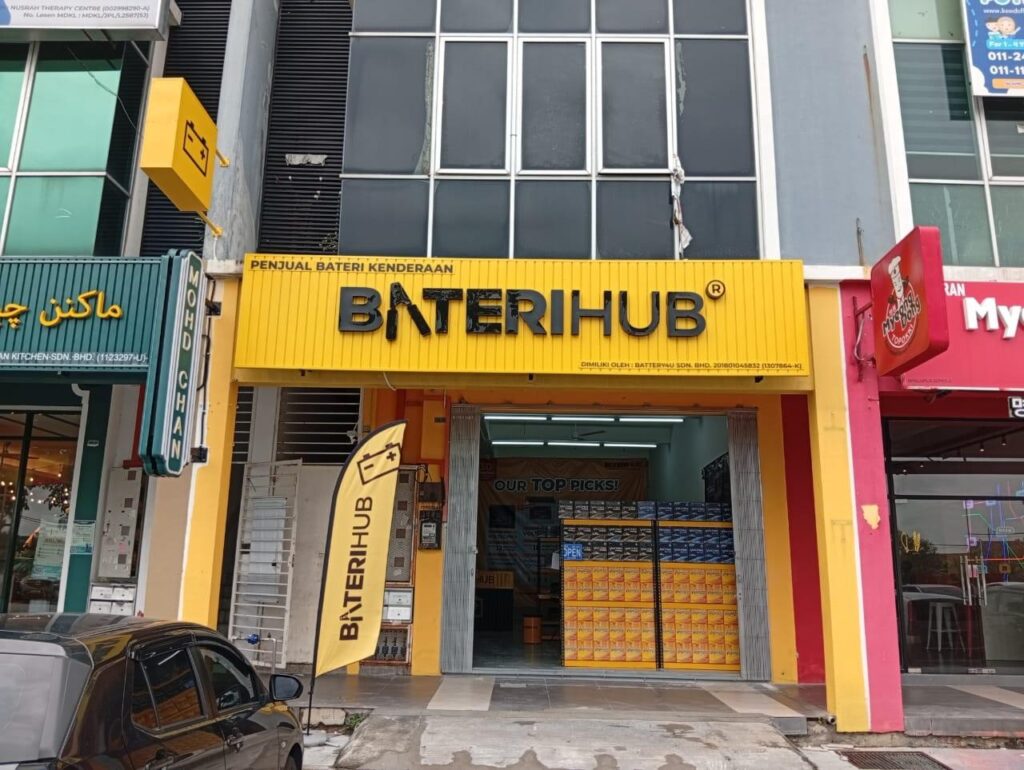
BateriHub has established itself as the largest direct-owned car battery retailer in Malaysia, offering an extensive range of vehicle battery brands that cater to over 1100 car models, from popular Malaysian favourites such as Perodua and Honda to luxury vehicles like BMW and Mercedes-Benz. Backed by specialists, the company offers comprehensive battery solutions and roadside assistance, going beyond simple replacements with complimentary doorstep delivery and installation.

At the helm of this growth is General Manager Stanly Ng, who has been instrumental in shaping the company’s trajectory. Under his leadership, BateriHub doubled its branch network from 100 to over 200 outlets in 2025 alone.
“For BateriHub’s expansion, it’s driven by structure and a data-led approach,” he said. “We focus on finding strategic site selections, we base it on the populations, the vehicle density, as well as the demand patterns, as well as the coverage gaps around the area.”
This precision has allowed BateriHub to scale without falling into a common trap of fast-growing service networks: operational inconsistency. “We standardise our branch setup and process to ensure the speed of expansion without compromising our quality,” Ng explained. “Operationally, we strengthen our back-end support, such as procurement, inventory planning, and technician deployment, for us to scale efficiently.”
Yet even with structure in place, expansion at this scale introduces friction. “The biggest challenge that we face is consistency across our network,” Ng admitted. “To ensure every outlet delivers the same level of service, professionalism, and reliability requires significant investment in terms of systems, training, and leadership alignment.”
Why Ownership Matters
In an industry where franchising is often the fastest route to scale, BateriHub has deliberately taken the harder road, full ownership. “BateriHub consciously chose a fully direct-owned model. ” It’s all because of control,” Ng said. “We want to have full control over our customer experience as well as our brand standards.”
By owning every outlet, BateriHub can enforce consistent standard operating procedures, ensure transparent pricing, and react quickly to market changes, advantages that are often diluted in franchise-heavy models. “In our service or automotive industry, trust as well as reliability is critical for us,” Ng noted. “By owning and managing all of these branches by ourselves, we can ensure service quality across our network, as well as respond quickly to market changes.”
But perhaps the most important differentiator lies in people. “We are not only teaching them how to change a battery,” Ng said. “We also align them with BateriHub culture.” Every employee must pass through a structured training programme before deployment, ensuring that, regardless of location, customers encounter the same service ethos.
Serving a Nation on Wheels
A striking data point shapes everything BateriHub does. “As of mid-2025, Malaysia’s registered vehicles already exceed our total population, 38.7 million registered vehicles versus 34.1 million people,” Ng said. “We are actually living in a country where there are 4.6 million more vehicles than our citizens.” For BateriHub, this is not just a statistic; it is a blueprint for operational design anchored in two priorities, coverage and logistics.
On coverage, “We expand strategically. Our goal is to connect the dots and provide comprehensive coverage around each area, so whether the customer is in a major city or suburban areas, there will always be a technician, always a ready station close to them.”
On logistics, he pointed to what makes battery demand uniquely predictable. “A battery is a product with a limited lifespan that typically requires replacement every 18 to 24 months. With the estimation of 38 million vehicles on the road, that creates a continuous as well as a predictable demand for us.” This insight drives the company’s inventory planning, ensuring the right battery models and quantities are positioned at the right locations, often before the customer even reaches out.
Consistency at Scale
Translating that operational blueprint into a consistent customer experience across 500-plus service areas requires more than SOPs. BateriHub’s answer is a three-layer training-and-management model.
“Before any staff member is deployed, we guide them through what we call our ‘2-plus-2’ training programme,” Ng explained. “Every team member begins with two weeks of intensive technical and product knowledge training, including installation skills. This is then followed by another two weeks of buddy training, where they work closely alongside a senior technician before being assigned to any of our branches.
He also highlighted the importance of consistent oversight and alignment across the organisation. “We currently have over 30 retail managers overseeing and managing all of our branches on a daily basis.” In addition, the company brings its teams together annually to ensure everyone stays aligned. “Every year we gather our frontliners as well as customer service under the same roof to recalibrate and realign everybody’s standards, whether it’s new technology, refreshed standards, or knowledge we want to update for the team.”
Expanding East
The true test of BateriHub’s model lies beyond Peninsular Malaysia. Its planned expansion into Sabah and Sarawak by Q3 2026 marks a significant shift in operating conditions. “The geographical spread is larger, and population density is lower. It requires a very different level of planning in terms of service coverage and inventory placement,” Ng said.
Rather than relying on data alone, he took a ground-up approach. “I spent time across several cities in East Malaysia; that’s how we approach things,” he shared. “We go on the ground, observe the brands people prefer, understand consumer behaviour and spending patterns, and carry out thorough research before entering any new market”
What stays constant, he insists, is the standard. “What doesn’t change is the same BateriHub that we hope to bring to East Malaysia, the same quality of service we already provide in Peninsular Malaysia.”
From Battery Retailer to Mobility Platform
Looking ahead, BateriHub’s ambitions extend far beyond batteries. The target of 300 branches by end-2026 is, in Ng’s framing, not a destination but a foundation. “It’s not just about reaching 300 branches, it’s about building a nationwide, reliable automotive support ecosystem,” he said.
In the pipeline are expanded product lines, new service categories, and strategic partnerships. “We welcome exploring partnerships to add additional services as well as merchandise to our product line to further enhance customer value, while also strengthening our position in the automotive industry,” Ng said.
The vision is one of transformation: from the country’s largest battery retailer into something far more expansive. “We aim to become Malaysia’s, and eventually ASEAN’s, most trusted automotive service platform, offering transparent, professional solutions to all vehicle owners, anytime, anywhere.” For a company that began by simply ensuring cars could start, BateriHub is now setting its sights on keeping all of Malaysia moving.