


MALAYSIA SME | Editor’s Introduction
For many Malaysian SME owners, running a business is often about getting the next customer, securing the next order and ensuring there is enough money to pay suppliers, employees and operating expenses. But how often do we stop to ask a more important question: Are we actually making money from every job we take on? And even if the job is profitable, does the business have enough cash available to pay its suppliers before the customer settles the invoice? These are everyday challenges faced by Malaysian SMEs, regardless of their size or industry.
The following sponsored feature by Papertools, a business bookkeeping and financial management software provider, explores how better financial records can help business owners make more informed decisions. Through the example of an event rental business, the article illustrates how recording costs, tracking invoices, understanding profit margins and monitoring cash flow can influence something as simple as preparing the next quotation.
Why should SMEs know this?
Because business decisions should not depend on guesswork alone. Understanding where your money comes from, where it goes and how much you actually retain can make the difference between growing sales and building a financially sustainable business. Before diving into the article, here are six practical lessons worth considering.
Six Takeaways for SME Owners
- A bigger sale does not necessarily mean a bigger profit A RM5,000 job may look attractive, but the real question is how much remains after all relevant costs have been accounted for. Know your numbers before celebrating the sale.
- Never assume the next job will cost the same as the last Changes in delivery requirements, manpower, customer expectations or timelines can quickly eat into your margins. Review past costs before issuing a new quotation.
- Small, unrecorded expenses can become costly Transportation charges, additional labour and miscellaneous purchases may appear insignificant individually. But when they are not properly recorded, business owners risk underestimating their actual costs.
- Separate business investments from day-to-day job expenses Buying a delivery van is different from paying for fuel or hiring extra workers for a particular job. Understanding this distinction helps owners evaluate individual job costs while keeping track of longer-term business investments.
- Profit does not mean cash in the bank Your business may be profitable on paper, but if customers have not paid their invoices, you may still struggle to pay suppliers or meet operating expenses. Cash flow deserves as much attention as profitability.
- Good financial records lead to better business decisions You do not need to be an accountant to understand your business finances. But you do need reliable information to decide what to charge, when to spend, whether to extend credit and how to grow sustainably.
The following sponsored feature demonstrates how Papertools brings these financial records together to support everyday business decisions with examples and financial figures drawn from a Malaysian demonstration workspace.
A SPONSORED FEATURE by papertools.app
Before You Quote The Same Price Again
“Same price as last time?” An event rental owner could quote for a hundred chairs from memory. But the last venue let the crew collect on Monday morning. This one wants the hall cleared by midnight. The chairs are the same. The collection could mean bringing a second crew back after hours.
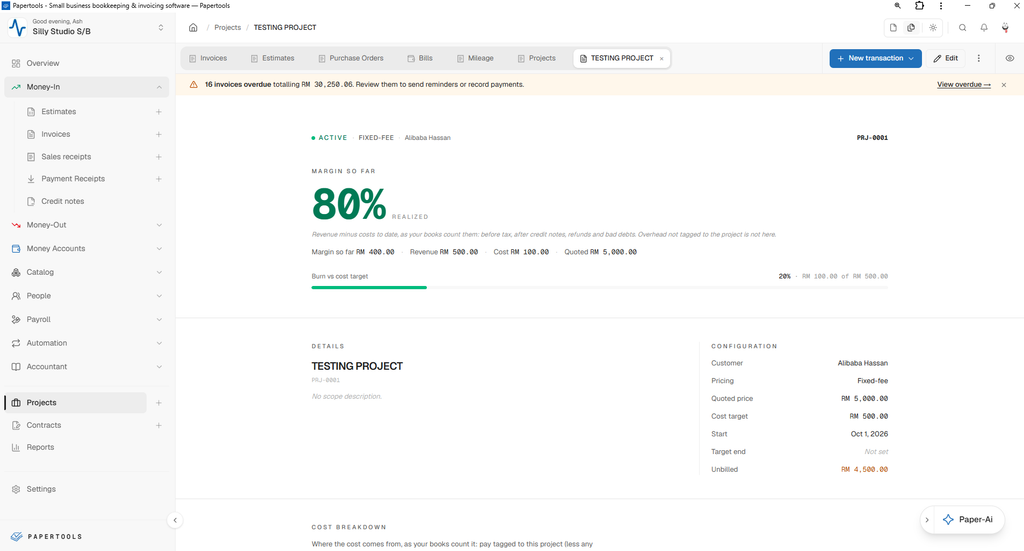
Before answering, open the last project. In this Malaysian Papertools demo, the fixed fee is RM5,000. The job has RM500 in recorded revenue and RM100 in recorded costs. That leaves RM400, an 80% margin on the work recorded so far. RM4,500 of the quote is still unbilled. An owner looking at that 80% has a good reason to check which costs have come in before using it to price another job.
A caterer might check how much it cost to keep staff on for an extra hour. A design studio might look up what a freelancer charged for a third round of revisions. For the rental owner, one question for the venue could change the quote: “What time do the chairs have to be out?”
Which costs made it into the job?
In the same project, two paid invoices of RM250 each account for the RM500 of revenue. Open the expenses and the RM100 cost has a name: transport. There is also a separate RM94.34 expense marked Draft. The project summary currently shows RM100 in costs. Anyone preparing the next quote can see exactly which item needs checking.
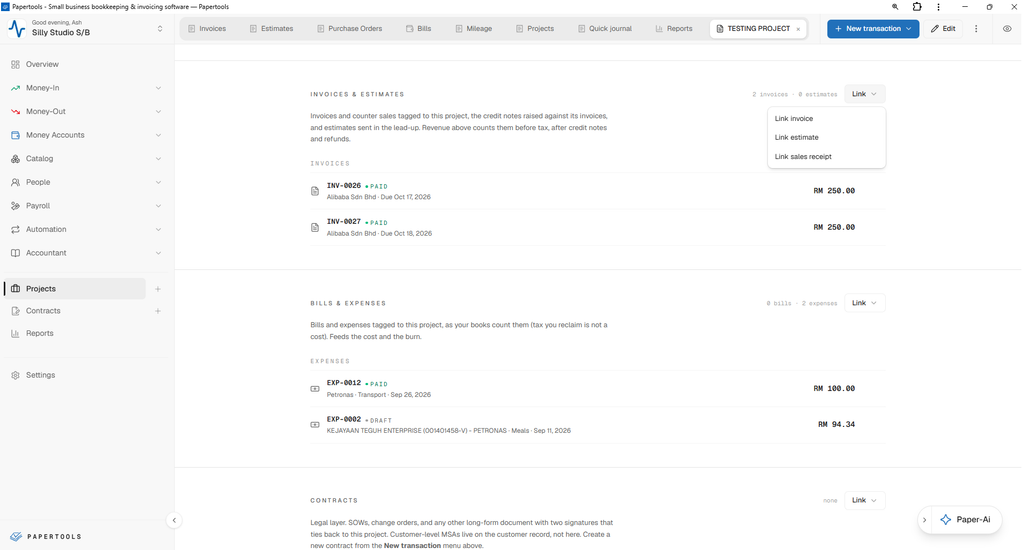
If that draft belongs to the job, the owner can check the receipt and finish recording it. If the pickup will take two people, allow for both when pricing the next booking. These are two different judgements: what happened last time, and what this customer is asking the crew to do.
See how to connect documents and costs to a job in the Papertools Projects walkthrough
The van will outlast this booking
Now suppose the rental business buys a van in the same week. The crew will use it for this delivery and for dozens more. The owner needs a record of buying the vehicle as well as a way to look up what this particular delivery cost.
Papertools Quick Journal starts with “What happened?” Choose “We bought equipment, a vehicle, or a machine”. The follow-up questions cover what was bought, what it cost, how it was paid for and how long the business expects to use it. Saving the details creates a numbered journal entry the accountant can review.
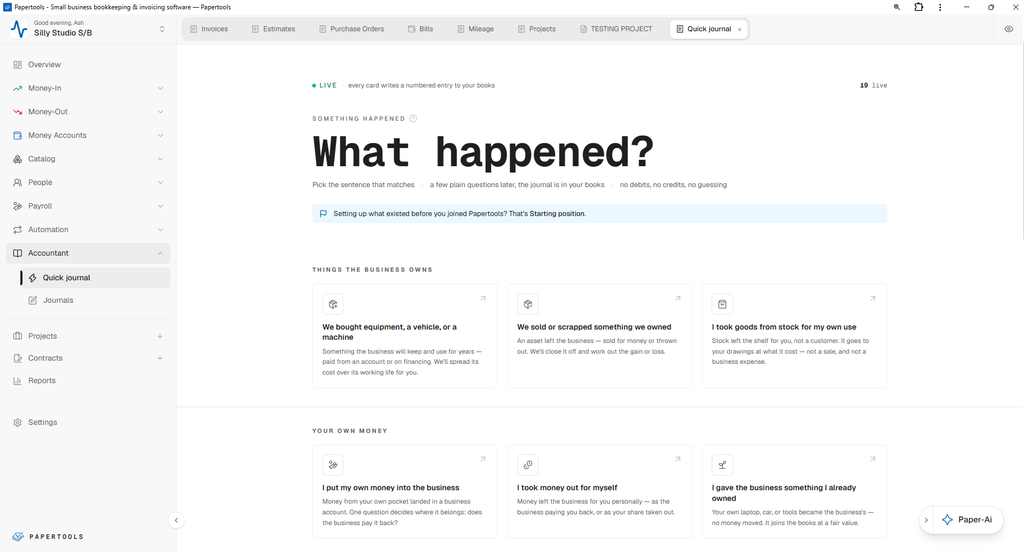
Months later, a colleague can trace the purchase even if someone else bought the van. Meanwhile, the person pricing Saturday’s booking can focus on the costs the venue actually changes: loading time, the late collection and the extra crew.
Can we pay the supplier on Thursday?
The venue confirms the midnight collection. Before promising the chairs, the owner wants to know whether the business can pay a supplier on Thursday. This calls for a look across the business, beyond the margin on one booking.
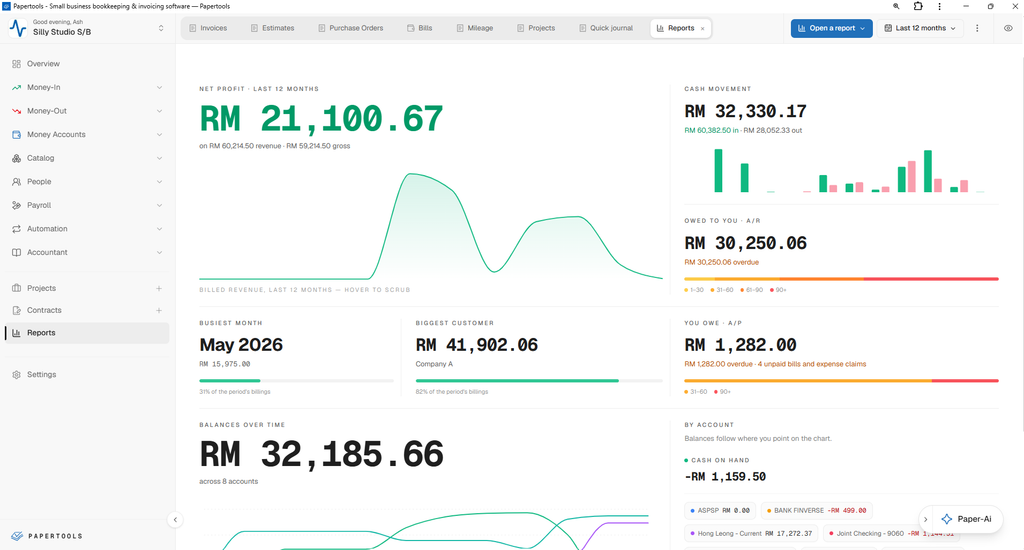
In the demo workspace, the last 12 months show RM21,100.67 in net profit and RM32,330.17 in positive cash movement. Customers still owe RM30,250.06, all shown as overdue. Thursday’s decision depends on cash available now, bills falling due and which customers will actually pay in time.
The owner now has a useful answer for the customer: “If we can collect on Monday morning, I can quote the same arrangement. If everything has to be out by midnight, I’ll include the late crew.” That gives the customer a choice, and the rental company a price it can explain.
Explore bookkeeping, invoicing and job costing for small businesses at papertools.app