


By Aileen Anthony
How Zicy {pronounced ~ Ziki} is Rewriting the Future of Online Visibility
Growth.pro has spent the past eight years helping businesses win in SEO. But as Google’s interface shifts, search results get buried, and generative AI begins to answer questions without sending users to websites. SEO as we know it is being replaced by something far more complex, intelligent, and unforgiving—Answer Engine Optimisation (AEO).
I speak with him to go deeper into the specifics, so SME owners can understand how changes in the search landscape have caused their homepages to slide down the online visibility ladder. Over 90 minutes, he patiently and unequivocally explained what had changed over three decades and the perils it brings to businesses.
The Hidden Truth
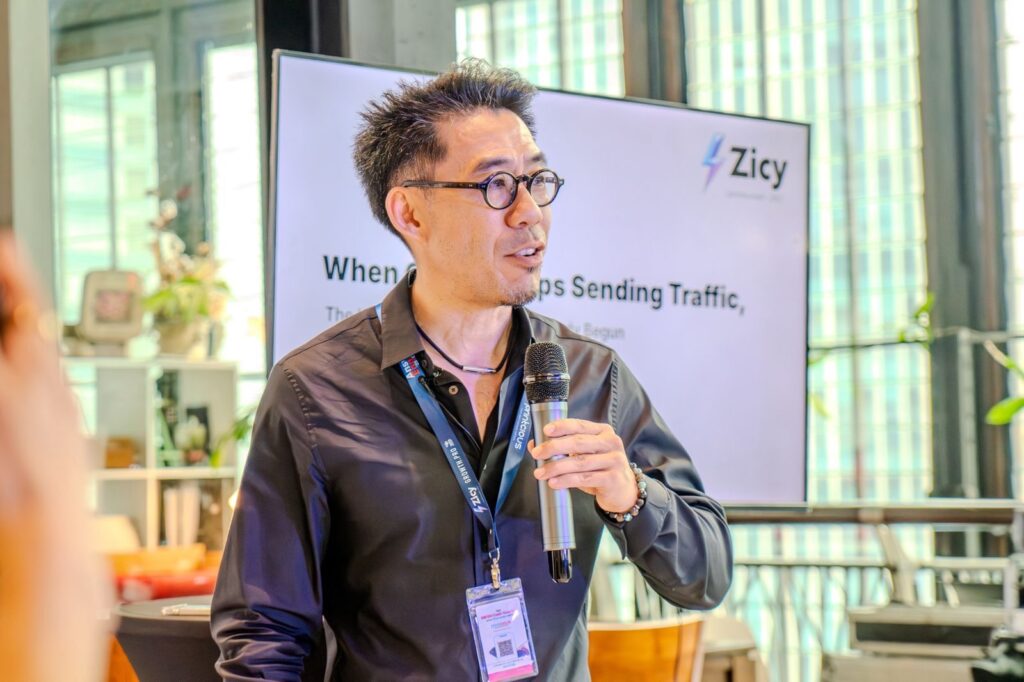
Alvin doesn’t mince words when it comes to the traditional SEO industry.
“Many SEO agencies are peddling outdated tactics—bulk backlinks, article spinning, keyword stuffing—techniques that not only no longer work, but could get your site penalised,” he stated.
I ask for elaboration, and he breaks down how many agencies make easy money by gaming Google’s early algorithms: buying expired domains, using content farms, AI-generated spam, and embedding links in useless spun articles. “It’s a daisy chain of deception. Clients are told they’ll rank for “20 keywords” but don’t realise this translates to being buried in low-quality backlink farms,” he explained.
Yet for years, this system thrived—until Google’s algorithm caught up.
“Now, search engine results are governed by over 200 factors, and manipulated backlinks do more harm than good,” he said. “Google rewards content that demonstrates E-E-A-T – Experience, Expertise, Authoritativeness, and Trust. It’s no longer enough to “rank”—your content must deserve to be found.”
Then he throws in the spanner. Even this is being upended.
From Search Engine to Answer Engine – The Great Displacement
The arrival of ChatGPT, Google’s response through AI Overviews, and Gemini has triggered a revolution.
“Google is shifting from being a search engine to an answer engine—where AI-generated summaries answer users’ queries directly, often without ever showing traditional search results – which provides links back to the ‘publisher’, the originator of the information, or in simple terms – business websites,” he said. A shift, subtle, but with seismic repercussions to business bottomlines.
He added,“#1 ranked content is falling into second page searches.” I recalled a joke in the industry: If you need to hide a dead body, the second page would be a good place. Alvin continued. “Look at your Google Search results. The first page of Google is no longer the first page—it’s the AI overview answer box. AI now does the reading, ranking, and recommending.
This shift kills the traditional SEO model. And this, Alvin stresses, is the lesser-known predicament of AEO.
What Is AEO and Why Most Companies Are Not Ready
Unlike SEO, which is about ranking web pages in search engines, AEO is all about AI engines retrieving your content and citing you as the source when answering user prompts. And that requires a complete restructuring of how businesses approach digital presence.
But here’s the problem:
- Most companies create content without structure.
- Messaging is outdated and inconsistent across digital platforms.
- No use of schemas or structured data to help AI understand content.
- No way of tracking if or how AI engines are mentioning them.
“It’s like training an AI on a library where your books are outdated, unlabeled, unindexed, and contradict each other,” Alvin said.
Even worse, inconsistent information across websites and online presence—e.g., on Shopee, Lazada, Google Business, YouTube, and LinkedIn — can cause hallucinations—leading to AI engines inadvertently making up false information about a brand due to a lack of clarity and alignment.
“You can’t afford that,” he stressed. “Because ChatGPT is the friend your customer is asking for recommendations from. If your brand isn’t mentioned in that answer, or worse inaccurately represented, you’re irrelevant.” And then he opens another conundrum – LLMs.
Large Language Models (LLMs) and the Token Economy
“Large language models (LLMs) like ChatGPT operate on tokens which are units of data to generate answers. The longer and more unstructured a particular content is, the more tokens it consumes to process this content. That’s expensive for the engine and inefficient,” Alvin explained.
This means that even comprehensive, well-written SEO articles can become invisible to AI engines—because they’re not structured for fast, token-efficient retrieval. So, what does AEO do? It skips your content.
To help businesses cross this chasm, Alvin and his team have launched a solution through Zicy.com—an AI platform that operationalises everything Growth.pro has learned about SEO, AEO, AI, and digital transformation since the dawn of Google.
‘Someone’ to tell you what to do
“Zicy.com is an AI clone with the soul and spirit of Growth.pro,” said Alvin.
“It is your AI agent that identifies visibility gaps, flags brand hallucinations, audits sentiment across digital assets, and shows exactly where a brand is falling short in AI citations; and tells you what to do about it.”
The AI agent dives into online (website) pages, flags the inconsistencies, breaks it into entity-based sections – which is the fundamental way AEO fans out its search (see side box), and recommends improvements in your brand voice,” said Alvin.
“In 15 minutes and at a very affordable fee, you get a side-by-side comparison of your old vs. optimised content, suggested edits and additions, schema-enhanced, retrieval-friendly output and all ready for copy-paste upload.”
For SMEs, this will be game-changing
For years, Growth.pro has supported listed companies in Malaysia, across the region, and globally—spanning diverse sectors in online optimisation. “We’ve never had to pitch hard on what we do,” Alvin shared—but he does so only to make one thing clear: their work has always spoken for itself. Still, they’re pushing the boundaries—not because they need to, but because they believe they must. “And that’s why Growth.pro is taking everything we’ve learned and putting it into Zicy.com – to provide a solution to the world,” he said.
But, he insisted, the real transformation starts with mindset. “We must get out of our backyard mentality. We are all using the same ‘engine’—it’s a global ecosystem we’re dialling into. Getting in line and ahead of AEO will be the make-or-break for businesses anywhere in the world.”
Adding, “Pay attention to Answer Engine Optimisation, or risk losing your lead and revenue generation channels.”
Entity Structuring is Everything: Understanding ‘Fan-Out’ Queries in AEO.
A fan-out query is when an answer engine breaks a long prompt into multiple sub-queries, each based on an entity (e.g., location, need, product type), to retrieve the most relevant, structured content across the web.
For example, instead of typing “best hotel Kuala Lumpur,” people now ask:
“What is the best family-friendly hotel in Kuala Lumpur near Zoo Negara Pandas with breakfast included?”
This type of long-form query contains multiple entities:
🏨Hotel
👨👩👧👦Family-friendly
📍Kuala Lumpur
🦁Near Zoo Negara
🐼Pandas
🍳With breakfast
How AEO Engines (like ChatGPT, Gemini, Google AI Mode) Respond?
These answer engines don’t just match keywords—they "fan out" each entity into subqueries behind the scenes to gather relevant information.
For example:
“Singapore hotels near zoo”
“Best hotel for family with kids in Singapore”
"Hotels near Zoo Negara Pandas"
“Hotels with free breakfast”
All these subqueries are sent out to retrieve content from the web. Then, the AI assembles the best answers and cites the sources it trusts most.
Why This Matters for You?
If your content:
❌ Isn’t structured clearly by entity,
❌ Doesn’t match the intent of subqueries,
❌ Is inconsistent across platforms,
…then the AI skips you because the AEO is about being the most retrievable.