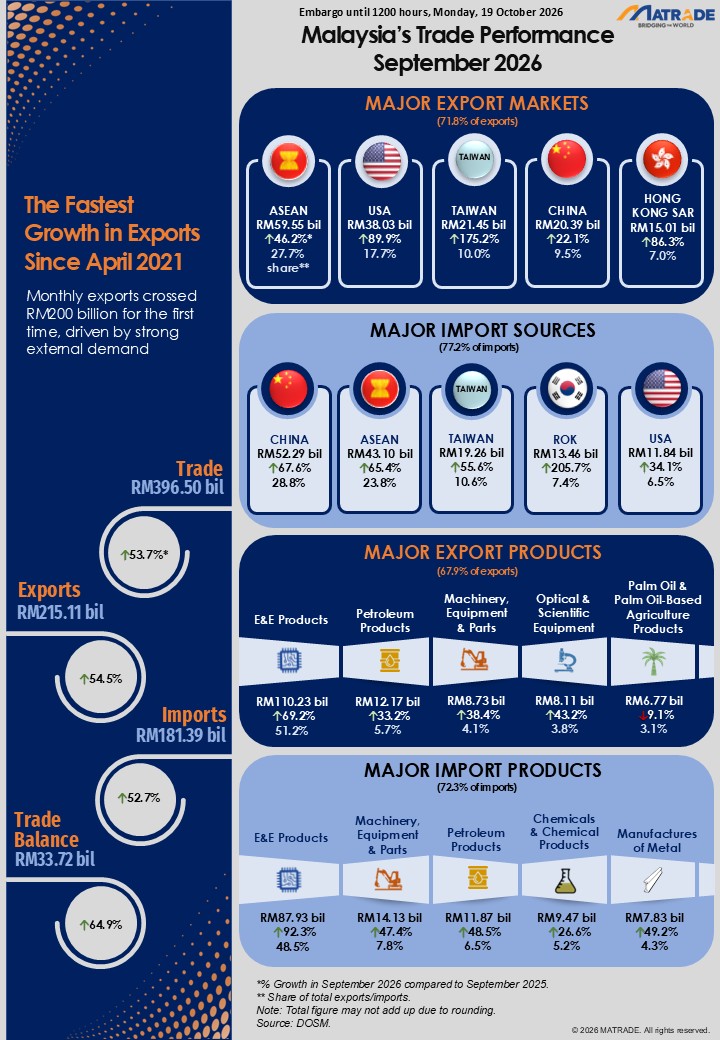


Malaysia’s external trade reached new heights in September 2026, with exports surpassing RM200 billion in a single month for the first time, reflecting the country’s strong performance amid a shifting global economic landscape. According to the Ministry of Investment, Trade and Industry (MITI), Malaysia recorded total trade of RM396.50 billion in September, representing a 53.7% increase compared with the same month in 2025. Exports surged 54.5% year-on-year to RM215.11 billion, marking the fastest growth since April 2021, while imports expanded 52.7% to RM181.39 billion. The country also registered a trade surplus of RM33.72 billion, extending its uninterrupted run of trade surpluses to 77 consecutive months since May 2020.
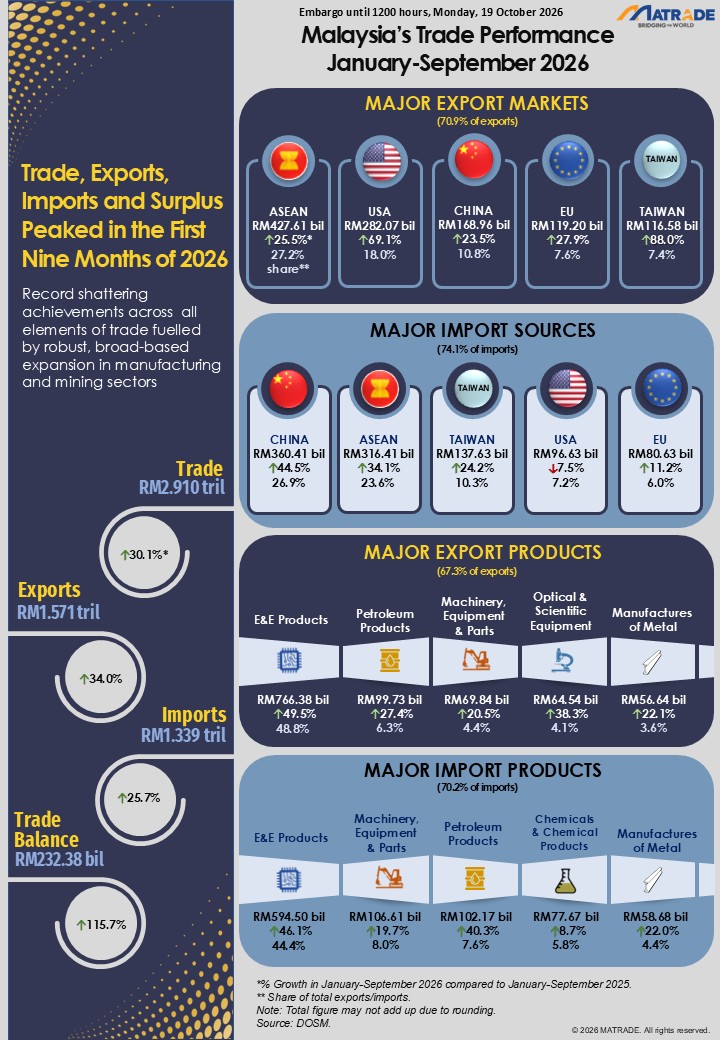
The September performance reinforced Malaysia’s strong trade momentum throughout 2026. Between January and September, total trade increased 30.1% to RM2.910 trillion, with exports growing 34.0% to RM1.571 trillion and imports rising 25.7% to RM1.339 trillion. All four indicators — total trade, exports, imports and trade surplus — recorded their highest levels for the first nine months of any year. The cumulative trade surplus reached RM232.38 billion, an increase of 115.7% compared with the corresponding period in 2025.
Electrical and Electronics Remain the Growth Engine
Malaysia’s electrical and electronic (E&E) industry continued to anchor the country’s export performance, supported by sustained global semiconductor demand, rising investment in artificial intelligence (AI) and the wider adoption of digital technologies. In September alone, E&E exports reached RM110.23 billion, accounting for 51.2% of Malaysia’s total exports. This represented a 69.2% increase compared with September 2025 and marked the sector’s highest monthly export value. Over the first nine months of 2026, E&E exports expanded 49.5% to RM766.38 billion, an increase of almost RM254 billion from the corresponding period last year.
Other manufactured products also contributed to the expansion. Petroleum product exports increased 33.2% to RM12.17 billion in September, while machinery, equipment and parts grew 38.4% to RM8.73 billion. Optical and scientific equipment exports rose 43.2% to RM8.11 billion. Collectively, manufactured goods accounted for 89.1% of Malaysia’s total exports in September, reaching a record RM191.57 billion, up 58.6% year-on-year. Mining exports also reached an all-time high of RM11.43 billion, expanding 56.3%, driven by higher exports of liquefied natural gas (LNG), crude petroleum, and metalliferous ores and metal scrap.
However, agricultural exports presented a contrasting picture. The sector recorded a 5.7% decline to RM9.03 billion, primarily due to lower export quantities of palm oil and palm oil-based agricultural products. For the January–September period, agricultural exports declined 8.5% to RM74.44 billion, highlighting the uneven performance across Malaysia’s major export sectors.
ASEAN Strengthens Its Position as a Key Trading Market
Malaysia’s trade expansion was supported by strong demand across its major international markets, particularly ASEAN, China, the United States, Taiwan and the European Union. Together, these markets accounted for 73.0% of Malaysia’s total trade in September. ASEAN remained a major contributor, with total trade expanding 53.7% to RM102.65 billion, representing 25.9% of Malaysia’s total trade.
Exports to ASEAN grew 46.2% to a record RM59.55 billion, marking the sixth consecutive month of double-digit export growth. All ASEAN markets recorded export growth during the month. Singapore remained Malaysia’s largest export destination within ASEAN, with shipments rising 50.4% to RM35.45 billion. Exports to Thailand increased 57.3% to RM8.68 billion, while Viet Nam recorded 55.0% growth to RM7.68 billion.
Higher E&E exports were a major contributor to the expansion in these three markets. For the first nine months of 2026, Malaysia’s total trade with ASEAN reached RM744.02 billion, increasing 29.0%, while exports rose 25.5% to RM427.61 billion.
US and Taiwan Record Significant Export Growth
The United States emerged as another major driver of Malaysia’s export performance. In September, exports to the US increased 89.9% to a record RM38.03 billion, supported primarily by higher shipments of E&E products. Total bilateral trade grew 72.8% to RM49.87 billion. For the January–September period, Malaysia’s exports to the US expanded 69.1% to RM282.07 billion, driven by growing demand for E&E products, optical and scientific equipment, and manufactures of metal. Taiwan recorded even stronger percentage growth in September, with exports surging 175.2% to RM21.45 billion, the highest monthly export value recorded for the market. The expansion was supported by E&E products, LNG, and optical and scientific equipment.
Meanwhile, exports to China increased 22.1% to RM20.39 billion in September, marking the ninth consecutive month of growth. Malaysia’s total trade with China expanded 51.7% to RM72.69 billion. The European Union also maintained positive momentum, with exports increasing 24.7% to RM14.79 billion. This marked the sixth consecutive month of double-digit growth in both total trade and exports to the region.
Free Trade Partners Open Wider Export Opportunities
Malaysia’s trade with Free Trade Agreement (FTA) partners continued to expand, reflecting stronger demand across a diverse range of markets. In September, trade with FTA partners increased 53.1% to RM261.73 billion, accounting for 66.0% of Malaysia’s total trade. Exports to these markets rose 42.0% to RM130.78 billion. Among the notable performers, exports to Hong Kong SAR increased 86.3% to RM15.01 billion, while Japan recorded 40.3% growth to RM8.74 billion. Mexico registered a 65.8% increase to RM4.53 billion, supported by higher E&E exports.
India also recorded strong growth, with exports rising 43.7% to RM6.46 billion, driven by increased shipments of palm oil and palm oil-based agricultural products. Exports to the United Kingdom grew 65.3% to RM1.26 billion, supported by transport equipment, while Canada recorded a 132.9% increase to RM1.01 billion, driven by iron and steel products. Hong Kong SAR, the United Kingdom and Canada each registered their highest monthly export values to date. The performance reflects the breadth of Malaysia’s export markets and the different product categories contributing to trade growth.
Rising Imports Reflect Strong Demand for Intermediate and Capital Goods
Alongside export growth, Malaysia’s imports also increased significantly. In September, imports reached RM181.39 billion, up 52.7% year-on-year. Intermediate goods accounted for the largest share, representing 50.8% of total imports. Their value surged 69.6% to RM92.10 billion, driven by higher imports of parts and accessories of non-transport capital goods.
Capital goods imports increased 20.9% to RM22.32 billion, while consumption goods rose 18.2% to RM10.91 billion. For the first nine months of 2026, intermediate goods imports increased 21.1% to RM645.77 billion, while capital goods imports rose 9.3% to RM174.76 billion. These figures illustrate the significant role of production-related and capital goods in Malaysia’s import composition.
Positive Outlook Amid Global Uncertainties
Malaysia’s exceptional trade performance comes alongside an improved outlook for both domestic economic growth and global merchandise trade. According to the Ministry of Finance’s Economic Outlook 2027, Malaysia’s total trade is projected to grow 27.2% in 2026, with exports increasing 31.0% and imports expanding 23.1%. The Ministry of Finance also forecast Malaysia’s gross domestic product growth at between 4.8% and 5.3% for 2026.
Meanwhile, the World Bank upgraded its Malaysian economic growth projection to 5.1%, compared with its earlier forecast of 4.4% in April 2026. At the global level, the World Trade Organization revised its 2026 merchandise trade volume growth forecast upwards to 3.9%, from 1.9% in March.
Nevertheless, MITI cautioned that Malaysia’s external trade remains exposed to uncertainties arising from changing trade policies among major economies and geopolitical tensions, particularly ongoing conflicts in West Asia. Such developments could disrupt international trade flows and intensify cost pressures.
In response, MITI and the Malaysia External Trade Development Corporation (MATRADE) will continue to assess global developments, strengthen market diversification, expand access to high-growth markets and support Malaysian exporters in adapting to evolving trade conditions.
Source: Ministry of Investment, Trade and Industry (MITI), Malaysia External Trade Statistics – September 2026 Trade Performance, released 19 October 2026. Data sourced from the Department of Statistics Malaysia (DOSM). September 2026 figures are provisional and subject to revision.