


By Natasha Isabel Saravanan
Uncle Law remembers the beginning almost casually. He had never known how to make custard, nor did he have a background in baking. Then, one day, his toddler asked him a simple question: why not try making custard? With some ideas and ingredients to work with, he decided to give it a go.
The first attempts were unsuccessful. Yet instead of abandoning the idea, he kept trying until he finally got the recipe right. His family tasted it and encouraged him to make it for others. That small experiment eventually became the foundation of Uncle Law Caramel Custard.
When the business began in 2022, however, there was little indication that it would become what it is today. Uncle Law started by operating from his son’s stall at the Perak Stadium Hawkers Centre. “It was not easy. When I first started operating the business at my son’s stall, I could hardly sell more than two pieces a day,” he said.
The turning point came through customers themselves. Those who tried the custard began recommending it to others, gradually creating demand beyond the stall. Eventually, Uncle Law was given a place in a coffee shop, giving him the opportunity to develop the business further.
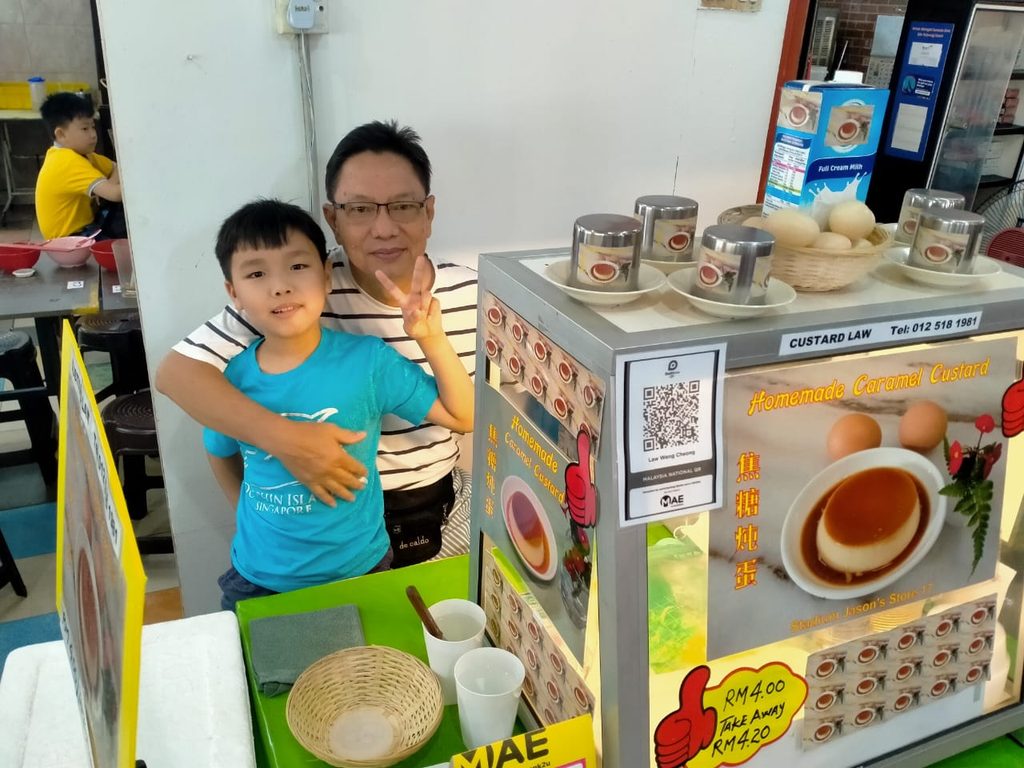
For him, those early days reinforced one lesson: patience matters. “Initially, it was really tough. If you do not have patience, you will give up,” he reflected. That patience remains central to the way he approaches the business today. Rather than expecting immediate success, Uncle Law watched demand grow piece by piece, allowing the product to establish itself through the response of the people who tasted it.
The Secret Is in the Caramel
One of the most important elements of Uncle Law’s custard is also one of the easiest to underestimate. The caramel may appear to be a simple layer at the bottom of a cup, but perfecting it took considerable effort, precision and even physical pain.
Uncle Law recalled being badly burned while learning how to handle the caramel. The injury was serious enough for him to require bandaging for more than a month. At the time, he had underestimated how dangerous the hot caramel could be. “The most difficult part was the caramel initially. I got hurt and burned. I even had to be bandaged for more than a month because of it,” he recalled.
The experience taught him that caramel could not simply be left to chance. It had to reach the right temperature and be prepared at precisely the right moment. Boil it for too long and the flavour changes; stop too early and it does not develop the character he wants. “It has to be timed at the boiling point. Not one minute more, not one minute less. Then the caramel comes out strongly, with that little bitterness that people enjoy,” he described.
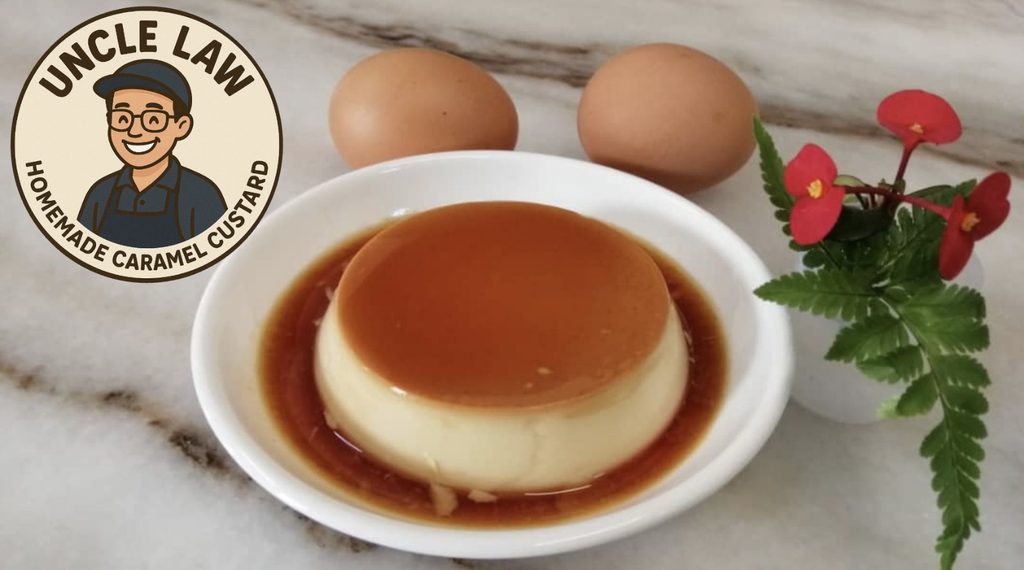
The custard itself requires the same attention. Eggs and milk have to be mixed carefully, as excessive stirring can make the mixture too watery. Once filtered and poured into cups, it is steamed until it reaches the desired texture. To someone eating the finished product, these details may be invisible. To Uncle Law, they are what separate a satisfactory custard from the one he wants to serve.
“It looks simple, but when it comes to making it, it is not that simple,” he observed.
His son, Gary, has experienced that difficulty himself. Despite being the second generation and having watched his father make the custard, he has failed numerous times when attempting the process. “When the timing is wrong, it is either burnt or undercooked, and I have to start all over again,” Gary mused with a laugh.
For the father and son, the demanding process is part of the product’s identity. The recipe is not something to be rushed simply to increase output. Its consistency depends on maintaining the same care that went into the original method.
A Taste That Is Not Meant to Be Changed
For Uncle Law, authenticity begins with refusing to compromise the foundation of the custard. The ingredients and preparation methods are deliberately kept simple, relying on fresh eggs, milk and sugar rather than powders or shortcuts. That commitment is closely tied to the flavour he associates with traditional custard. Even when experimenting with variations, he believes the original custard must remain untouched.
“I have tried adding things such as green tea, but it does not come out the same. If you want to add something, it should be an extra. The original base has to remain authentic first,” he explained.
Gary acknowledges that there is room for the business to explore new flavours, but he believes experimentation needs to serve a purpose. A new flavour cannot exist simply because it is fashionable. It has to complement the custard and meet what customers actually want. “There are thoughts to expand the varieties, but it has to be a perfect match. It is not enough to put in matcha or chocolate and expect it to work,” he acknowledged.
For now, the nostalgic character of the original product remains important. That nostalgia can be seen most clearly in customers’ reactions. Uncle Law remembers a young boy who returns almost every week after school to eat his custard. Older customers, too, often return after their first taste. For him, those repeat visits mean more than simply making another sale.

“We want to make something that people really enjoy, not just sell for the sake of selling a product. To sell something that is genuinely satisfying to them is the most important thing,” he emphasised.
Gary has noticed the same reactions. Some customers barely speak after their first bite. Instead, they simply nod before beginning to describe what they like about it.
“For those who are genuinely enjoying it, they put it in their mouths and just nod. Then they start describing it. That is when you know the preference is already there,” he said. That response is particularly meaningful for a product rooted in memory. A familiar taste can connect customers not only to the food itself, but also to the experiences and places associated with it.
Growing Beyond Ipoh, Without Losing Its Root
One of Uncle Law Caramel Custard’s biggest milestones came during Chinese New Year in 2024, when people returning to Ipoh from Kuala Lumpur began placing larger orders. Uncle Law vividly remembers one customer asking for a box of 50 custards. He had never sold that many at once and initially needed two days to fulfil the order. The customer was willing to wait.
“I had never tried selling 50 in one go, but suddenly somebody gave me an order for 50. Those days really encouraged me because it showed that the product was doing well, even with people from out of state,” he reminisced with a fond smile.
The business has since begun looking beyond its home city. Gary is now focused on expanding distribution, with Ipoh remaining the central kitchen while the business reaches customers in the north and south of Malaysia. The Kuala Lumpur market is one of the areas being developed, with the family exploring partnerships with resellers and distributors who can bring the custard into kopitiams and cafés.

The longer-term ambition is even bigger. Customers who have travelled overseas have asked whether Uncle Law Caramel Custard can be exported to places such as Europe and London. Gary sees the demand as encouraging, but he also understands that getting a fresh custard product across borders presents practical and technical challenges.
“We have people coming back from overseas asking whether we can export our caramel custards to Europe or London. We have to think about the science of the product and how we can export it,” he said.
For now, expansion remains a gradual process. Rather than rushing towards a national or international presence, Gary believes each stage has to be properly established before moving to the next.
“You cannot skip one step and leap to another. Even if you try to take shortcuts, you may eventually find yourself back at square one,” he cautioned.
A Second Generation, One Step at a Time
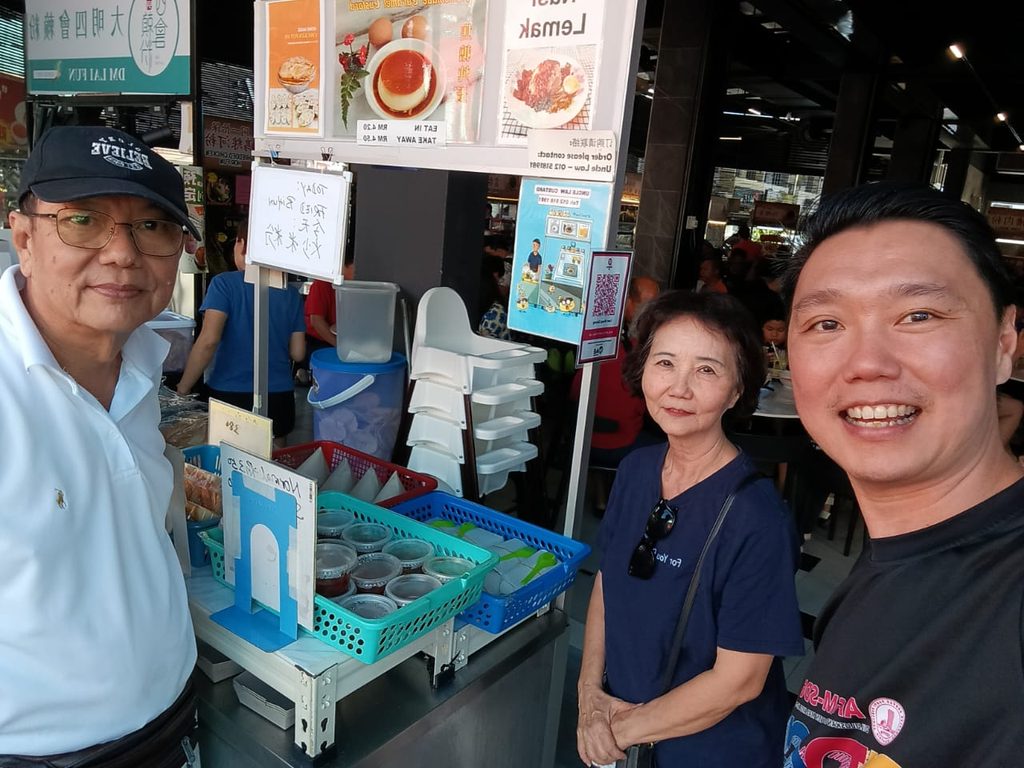
The division between father and son has become an important part of Uncle Law Caramel Custard’s growth. Uncle Law remains closely involved in production, personally making the custard and protecting the standards that shaped the product from the beginning. Gary, meanwhile, focuses on the business side, including expansion and scaling.
It is a partnership that reflects two different approaches to the same business. Uncle Law remains firmly rooted in the old-school method, while Gary looks at how that heritage can be carried into new markets.
When asked where the business would be in five years, Uncle Law jokingly turned to his son. “That is his problem, not my problem,” he said with a laugh. Behind the joke is a clear understanding of their respective roles. Gary may be thinking about distribution, technology and overseas possibilities, but the foundation remains his father’s craft.
For both of them, however, the lessons of the business are remarkably simple. Uncle Law believes entrepreneurs need to focus on what they are doing, believe in their product and accept failure as part of learning.
“Everyone fails. If you do not fail, you will not succeed. Failure teaches you, and then you try to improve,” he opined.
For Gary, perseverance means taking each challenge as it comes, without shortcuts. It is a philosophy that has guided the family as the business continues to grow. Uncle Law, who started making custard in his sixties, has a simple message for anyone thinking of starting something new: “Age is not a problem.”
From one or two cups a day to orders of dozens at a time, the journey of Uncle Law Caramel Custard remains a reminder that growth does not always happen in leaps. Sometimes, it happens one scoop, one customer and one step at a time.