

Malaysia’s micro, small and medium enterprises (MSMEs) are facing a more cautious business environment in 2026, yet many continue to strengthen their operations through digitalisation, productivity enhancements and market expansion strategies.
According to SME Bank’s SME Sentiment Index 1H 2026, business sentiment among Malaysian MSMEs has moderated amid evolving economic conditions. However, the sector’s operational outlook remains resilient as businesses continue investing in technology and efficiency improvements to support sustainable growth.
Released by Small Medium Enterprise Development Bank Malaysia Berhad (“SME Bank”), a subsidiary of Bank Pembangunan Malaysia Berhad (“BPMB”) Group, the survey highlights the key priorities, challenges and opportunities shaping Malaysia’s MSME landscape over the next six to twelve months.
Digitalisation Emerges as the Top Business Priority
For the first time, digitalisation has overtaken business expansion and marketing as the leading priority among Malaysian MSMEs.
The survey found that 51% of respondents are placing greater emphasis on technology investments to improve productivity and operational efficiency. At the same time, access to financing remains a key concern, with 51% identifying working capital financing as their primary funding requirement.
The findings suggest that many businesses are focusing on strengthening their internal capabilities rather than pursuing rapid expansion, reflecting a broader shift toward building more resilient and future-ready enterprises.
Cost Pressures Continue to Challenge Businesses
Despite improving business fundamentals in several areas, MSMEs continue to face elevated operating costs.
According to the survey, rising expenses related to raw materials, transportation, logistics and labour remain among the most significant challenges affecting businesses nationwide.
As a result, targeted financing and policy support continue to play an important role in helping businesses manage costs while accelerating digital adoption and strengthening long-term sustainability.
Cash Reserves Show Signs of Improvement
One encouraging trend identified in the report is the improvement in cash positions across the MSME sector.
Approximately 70% of surveyed businesses reported having more than six months of cash reserves, indicating stronger financial resilience compared to previous periods. However, SME Bank noted that micro-enterprises remain more vulnerable to liquidity constraints than their larger counterparts.
This suggests that while many businesses have strengthened their financial buffers, smaller enterprises may still require additional support to navigate economic uncertainties.
Export-Oriented Firms Remain More Optimistic
The survey also revealed a clear difference between export-oriented and domestically focused businesses.
According to Mazlina Abdul Rahman, Head of Macro-Monitoring & Analytics of BPMB Group, export-oriented MSMEs continue to demonstrate stronger growth expectations.
Among export-focused businesses, 55% expect sales growth compared to 38% of firms that primarily serve the domestic market. Furthermore, 61% of MSMEs plan to maintain their workforce while continuing to invest in operational improvements.
These findings indicate that many businesses are actively adapting to changing market conditions by diversifying revenue streams and exploring opportunities in regional and international markets.
Building Resilience Through Productivity and Technology
Commenting on the findings, Samad Majid Zain, Relief President and Chief Executive Officer of SME Bank, said Malaysian MSMEs must continue strengthening their resilience, productivity and competitiveness to navigate an increasingly complex business environment.
He noted that businesses are placing greater emphasis on digitalisation and operational efficiency, reflecting a shift towards stronger, more sustainable and future-ready enterprises. He also highlighted that these efforts align with Bank Negara Malaysia’s Performance Measurement Framework, which identifies productivity and resilience as key drivers of long-term competitiveness and economic contribution.
Samad added that SME Bank remains committed to supporting MSMEs through integrated financing and beyond-financing initiatives. These include close to RM2 billion in strategic initiatives under Budget 2026, the SME Bank Relief Programme and participation in Bank Negara Malaysia’s RM5 billion SME Stabilisation Relief Facility.
Insights from More Than 1,800 Businesses
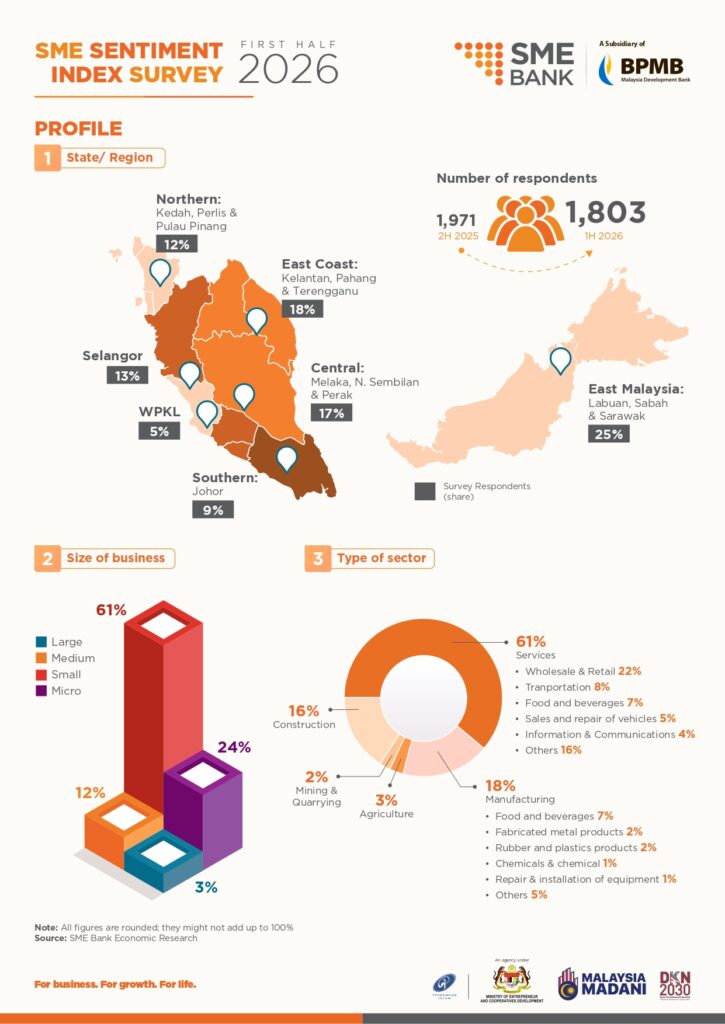
The SME Sentiment Index 1H 2026 survey was conducted between January and April 2026 and collected responses from 1,803 businesses across 40 sectors nationwide. The report provides a broad snapshot of the priorities, challenges and growth strategies shaping Malaysia’s MSME ecosystem.
Overall, while business sentiment has softened compared to previous periods, the survey points to a sector that remains proactive and adaptable. Rather than retreating in the face of economic uncertainty, many MSMEs are investing in technology, improving operational efficiency and exploring new growth opportunities.
As Malaysia continues to advance its digital economy agenda, the findings suggest that digital transformation is no longer viewed as an optional upgrade. Instead, it has become a strategic priority for businesses seeking to remain competitive, resilient and sustainable in an increasingly dynamic market environment.
The full SME Sentiment Index 1H 2026 report can be accessed at: https://go.smebank.com.my/4o98iFA